
Forget social media. You can grow your photography business by focusing on local SEO and client referrals - two strategies that deliver consistent leads without the stress of creating endless content. Here’s why they work:
- Local SEO helps you rank on Google for searches like "wedding photographer near me", reaching people ready to book. It’s 5x more effective than general online searches.
- Referrals from past clients or local vendors bring trust and credibility, often leading to bookings without needing to "sell" yourself.
Instead of chasing algorithms, invest in these reliable methods:
- Optimize your Google Business Profile with accurate details, high-quality photos, and consistent updates.
- Create a referral program offering rewards like discounts or free prints to encourage word-of-mouth recommendations.
- Partner with local vendors like wedding planners or venues to expand your network and gain more referrals.
These tactics not only save time but also build a steady stream of clients. Ready to grow your business without the social media grind? Let’s dive into the details.
How to Create a Client Referral Program
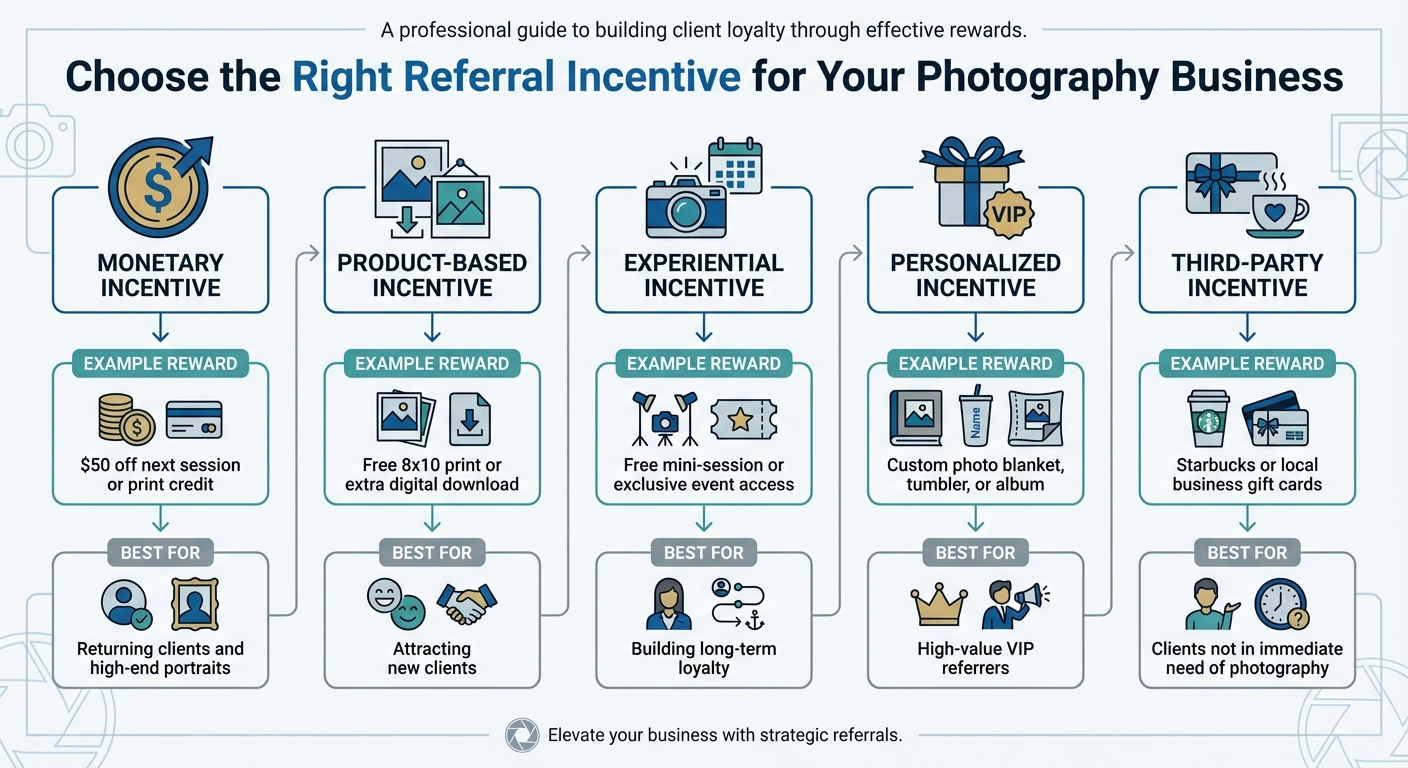
Photography Referral Program Incentive Types and Best Use Cases
A referral program transforms happy clients into advocates, helping you rely less on social media and build a steady stream of offline leads. The key is to keep it simple and worthwhile so clients feel motivated to share. Start by identifying your primary goal - whether that’s filling your calendar during slower months, attracting high-end portrait clients, or branching into a new photography niche. Once your goal is clear, you can craft rewards that resonate with the clients most likely to help you achieve it.
The best referral programs use double-sided rewards, offering benefits to both the referrer and the new client. For example, you might give your existing client a $50 print credit and their referred friend a free 8x10 print. This creates a win-win situation. As Megan Al-Hassani from Iris Works puts it, "The math is simple: one referral from each client will double your photography business growth".
Create Referral Incentives
Choose rewards that feel valuable to clients but don’t strain your budget. Print credits, for instance, are a cost-effective option that also encourage repeat purchases. A $50 print credit is an affordable way to offer something that feels substantial.
You can also add a tiered reward system to keep clients engaged over time. For example, the first referral might earn a $50 credit, the third could unlock a free mini-session, and the fifth might lead to a personalized photo album. This gamified approach encourages ongoing participation. Just make sure to clearly define a "successful referral" - typically, this means the new client has booked and paid for their session.
| Incentive Type | Example Reward | Best For |
|---|---|---|
| Monetary | $50 off next session or print credit | Returning clients and high-end portraits |
| Product-Based | Free 8x10 print or extra digital download | Attracting new clients |
| Experiential | Free mini-session or exclusive event access | Building long-term loyalty |
| Personalized | Custom photo blanket, tumbler, or album | High-value VIP referrers |
| Third-Party | Starbucks or local business gift cards | Clients not in immediate need of photography |
Track and Manage Referrals
Tracking your referrals is essential for improving your program. If you’re just starting out, a simple Google Sheets spreadsheet can do the trick. Create columns for the referrer, new client, booking status, and the reward given. As your business grows, you might want to switch to CRM tools like Iris Works, ShootQ, or 17Hats, which can integrate referral tracking into your workflow.
For an even more streamlined approach, consider automated referral tools like Referral Rock. These platforms generate unique sharing links for each client, making it easy to see exactly who referred whom. Megan Mosley from Referral Rock explains, "Normally, it's hard to track and measure the impact of word-of-mouth sharing. But referral programs make this easy thanks to the trackable links". Whichever system you use, make sure to include referral tracking in your client intake process. For instance, add a "How did you hear about us?" field to your website’s contact form for immediate feedback.
Promote Your Referral Program
Even the best referral program won’t work if clients don’t know about it. As Jen Bilodeau from Jen Bilodeau Photography notes, "Your referral program won't do you any good if your clients don't know that it is available to them or how to use it". Once you’ve set up your program and tracking, focus on spreading the word. Mention it during every client interaction - at the end of sessions, when delivering galleries, and in follow-up emails sent 3–4 weeks after the shoot, while excitement is still fresh.
Make sure referral details are visible across multiple touchpoints. Add the program to your email signature, print it on the back of your business cards, include a note in your invoice footer, and slip referral cards into your client packages. To make things even easier, provide pre-written email templates or digital referral cards that clients can forward to friends. The simpler the process, the more likely clients are to participate.
When paired with local SEO efforts, a well-executed referral program can help you build steady, offline growth.
sbb-itb-08dd11e
How to Improve Your Local SEO
Local SEO helps connect your photography business with nearby clients actively searching for services like yours. It boosts your visibility in search results and Google Maps, ensuring you’re front and center when potential clients are ready to book. Did you know that 46% of all Google searches have local intent? This makes local SEO as crucial as word-of-mouth referrals, but with the added benefit of reaching people who are ready to act now.
The key to local SEO success lies in making sure Google knows exactly who you are, where you’re located, and what services you offer. This involves optimizing your Google Business Profile, maintaining consistent business information across platforms, and using location-specific keywords on your website. Let’s dive into the essential steps.
Set Up and Optimize Google My Business
Your Google Business Profile (previously Google My Business) is like your online storefront. Considering that 90% of clients use Google to find local businesses and 83% rely on Google for reviews, optimizing this profile is non-negotiable. Start by claiming your profile at business.google.com and verify it using either a postcard or a video showcasing your studio or branded equipment. Be sure to select a specific category like "Wedding Photographer" or "Portrait Studio" - this detail significantly impacts your ranking.
Fill out every section of your profile completely. In your business description, use all 750 characters to naturally highlight your specialties and service areas, but don’t overdo it with keywords. Upload high-quality, non-watermarked photos and rename them with descriptive, location-based keywords. Tools like GeoImgr can embed GPS coordinates into these images, signaling to Google that you’re locally relevant. Profiles with images tend to perform better, receiving 42% more direction requests and 35% more website clicks.
Stay active by posting weekly updates. Share recent projects, announce mini-sessions, or link to your latest blog posts - Google rewards consistent activity. Enable messaging through the Google Maps app for quicker responses to inquiries, as faster reply times can improve your visibility. Use the Q&A section to your advantage by posting and answering common questions like, "Do you offer destination wedding photography?" This boosts keyword relevance and helps potential clients.
Don’t forget reviews. Ask for them as soon as you deliver galleries, and aim for at least 50 recent reviews to increase your chances of ranking in Google’s Local Pack by up to 4x. Respond to every review, mentioning specific services or locations to reinforce your SEO efforts.
"Your Google Business Profile can generate more leads than your website or Instagram. If it's optimized the right way." – Proudmarketer
Proudmarketer’s six-month case study proves the power of optimization. By refining Google Business Profiles for 10 photographers, they saw average monthly profile views jump from 2,150 to 9,012 (+319%) and bookings increase from 3–5 to 11–14 per month (+220%) within just 90 days.
Keep Your Business Information Consistent
Consistency in your business details - especially your Name, Address, and Phone number (NAP) - is critical for local SEO. This information must match across your website, Google Business Profile, and all online directories. Even small inconsistencies, like using "Street" in one listing and "St." in another, can confuse search engines and hurt your rankings.
"Consistency is everything. Your Name, Address, and Phone number must be exactly the same everywhere." – Clicks Geek
Inconsistent information can signal to search engines that your business might not be legitimate, which can lower your visibility. Plus, Google often pulls data from trusted platforms like Yelp or TripAdvisor, so keeping your details accurate across these sites increases your chances of being featured in search summaries.
Start by auditing your NAP. Search for your business name on Google and review every listing that appears. Standardize the formatting of your address and update any outdated or incorrect information. Remember, around 60% of business listings become outdated within two years, so make this a regular task.
To simplify the process, use tools like Semrush Listing Management, Whitespark, or BrightLocal to update multiple directories at once. For platforms you can’t edit directly, reach out to site owners with a polite request for corrections.
Use Local Keywords in Your Content
Local keywords are your ticket to appearing in searches from nearby clients. The formula is straightforward: combine your service with your city or neighborhood (e.g., "Austin wedding photographer"). You can get even more specific by adding venue or neighborhood modifiers, like "Brooklyn Bridge wedding photographer" or "Santa Monica beach wedding photos".
Long-tail keywords - phrases with 3–5 words - are especially effective. They have 37% higher click-through rates and face 32% less competition than shorter terms. Use modifiers like "elopement", "affordable", or "luxury" to attract high-intent clients. Adding stylistic keywords like "candid", "natural light", or "moody" can help you connect with your ideal audience.
Strategically place these keywords throughout your site. Include them in your page titles (within the first 60 characters), meta descriptions (under 160 characters), H1 headings, the first 100 words of your content, and even in your URL structure. For example, if you’re targeting couples in Austin, your homepage H1 could say, "Austin Wedding Photographer | Candid & Romantic Photography."
Another great tactic? Write venue-specific blog posts. Create content like "Top 7 Spots for Fall Foliage Photos Near [City]" or "Best Outdoor Wedding Venues in [Neighborhood]" to attract couples planning events in those locations. When uploading images, rename files with descriptive, localized names (e.g., "miami-wedding-photographer-vizcaya-museum.jpg") and include city and event details in the Alt Text.
You can also use Google’s autofill feature to discover what people in your area are searching for. Start typing phrases like "wedding photographer [your city]" and note the suggestions Google provides - they’re often goldmines for keyword ideas.
"The more clearly Google understands who you are, where you are, and what you do, the higher you'll rank locally." – High Tide Strategy
Build Better Client Relationships
Strong client relationships are the foundation of a referral-based photography business. When clients feel appreciated and cared for, they naturally become advocates for your work, recommending you to friends and family. In fact, customers are 4x more likely to make a purchase when referred by someone they trust. Every interaction is an opportunity to create an experience so memorable that one-time clients turn into lifelong supporters. These relationship-building strategies work hand-in-hand with your referral program and local SEO efforts, boosting trust and credibility to fuel your offline growth.
Provide Outstanding Service
Delivering top-notch service starts with how you handle inquiries. Aim to respond within 24–48 hours, using a warm, conversational tone that engages potential clients. Ask thoughtful questions to understand their needs and ensure you're the right fit for each other.
Once a client books, set realistic expectations and then exceed them. For example, if your usual gallery delivery time is 4–6 weeks, tell clients to expect their photos in 6–8 weeks. Delivering ahead of schedule will pleasantly surprise them without adding unnecessary pressure to your workflow. Use pre-session questionnaires to gather personal details - like a child’s favorite character or a couple’s must-have shots - so you can customize their experience. Small gestures, like a handwritten thank-you note or a thoughtful token, can go a long way in showing you care.
After the session, don’t just send a gallery link and vanish. Take the time to guide clients through their photos, highlight standout images, and assist with product selections. This personal touch adds value to their experience. You can also automate follow-ups, like anniversary or birthday emails, to stay connected without being intrusive.
"The client relationship should and will outlast the wedding you're planning on shooting, the family session you're planning, the graduation event and volume portraits you're shooting." – Elizabeth T, Photographer
Collect and Display Client Testimonials
Happy clients often turn into repeat customers and enthusiastic advocates. After delivering their photos, ask for feedback while their excitement is fresh. Use direct email templates with specific prompts like, "What was your favorite part of the session?" or "How did this experience solve a problem for you?" These open-ended questions encourage detailed and meaningful responses.
For clients who are short on time, consider using voice memos through platforms like Instagram or Voxer. Speaking can feel more natural than typing, and you can easily transcribe their feedback later. Every piece of positive feedback is valuable and can be repurposed as social proof.
Showcase testimonials on your website to build trust instantly. Place them strategically on service pages, pairing them with key benefits or addressing common concerns. Always use the actual text of testimonials instead of images - this ensures search engines can index the content, and clients’ natural keywords may align with what future leads are searching for.
"I believe our clients say things better than we could ever imagine." – Brittany Herzberg, SEO and Case Study Copywriter
Connect with Local Businesses
Partnering with local vendors like wedding planners, event venues, florists, and makeup artists can create a reliable stream of referrals without spending on ads. A recommendation from a trusted vendor carries far more weight than a flurry of social media likes because it comes with built-in credibility.
Adopt a "give first" mentality to kickstart these relationships. Offer free, high-quality images of a venue’s setup, provide complimentary headshots for a wedding planner, or feature local businesses on your blog. Collaborative efforts, such as exchanging marketing photos for referral placements, can lead to bookings within weeks.
Focus on businesses that serve your ideal clients before or after you do. For example, wedding photographers might connect with florists or makeup artists, while family photographers might partner with children’s boutiques. Create a "Preferred Vendors" page on your website to highlight these partners, and consider hosting joint events, like a "Headshot Day" with a coworking space or Chamber of Commerce.
"When you help out the local businesses in your community with a full heart and honest intentions, the relationships you build with them will come back to you tenfold." – Sarah Petty, Boutique Photographer
Building and nurturing these relationships is a key step in sustaining and expanding your offline growth strategy.
Measure and Grow Your Results
Focusing on the right metrics helps you align your offline and online efforts, ensuring a steady increase in bookings. By zeroing in on referrals, local search traffic, and conversions, you can track the numbers that directly contribute to your revenue.
Measure Referral Performance
Keep an eye on three crucial metrics: total referrals, conversion rates, and revenue generated from referrals. Whether you use a simple spreadsheet or a CRM tool like 17Hats, tracking who referred whom and the outcomes is essential. Referral software simplifies this process by creating unique links or codes for each client, making it clear which advocates bring in the most business. Plus, referred clients often stick around longer - they’re 18% more likely to become repeat customers.
"Tracking helps you understand what works and allows you to reward clients accurately." – Kara Hubbard, Business Coach for Photographers, Tografy
Don’t forget to review your incentives. Ask clients which rewards - like discounts, free prints, or gift cards - they value most, and adjust your program accordingly. A solid benchmark is aiming for referrals to make up at least 20% of your client base.
Track Website Traffic with Google Analytics
Google Analytics (GA4) provides a clear view of which local markets are driving traffic and which pages are converting visitors into clients. Focus on user data by city or region to identify areas that need improvement, and monitor local conversion events like click-to-call, direction requests, and booking form submissions. A strong engagement rate for local visitors is 60% or higher.
Make use of UTM parameters on your Google Business Profile links (e.g., utm_source=google&utm_medium=organic&utm_campaign=local-profile) to differentiate Maps traffic from organic search. Also, mark actions like click-to-call or get-directions as conversions in GA4. Use the "Add comparison" feature to filter reports by geography and focus on traffic from your target service areas.
Dive into the "Traffic Acquisition" report and filter by "Session source/medium" with "referral" to spot top-performing local partners. If a partner is driving great results, consider collaborating further through co-marketing efforts. Be sure to exclude third-party payment systems like PayPal or Stripe from referral reports to ensure accurate attribution.
| Metric | Good Performance | Poor Performance |
|---|---|---|
| Engagement Rate | Matches or exceeds site-wide average | Falls well below average, signaling irrelevant traffic |
| Average Engagement Time | Higher than site-wide average | Lower than average, indicating disinterest |
| Key Event Conversion Rate | Outperforms other non-branded sources | Low or zero conversions |
| Sessions | Steady growth from new users | Sudden drops or minimal activity |
Use these insights to fine-tune your offline efforts and invest more in areas with the highest engagement.
Expand Your Offline Marketing
Once your digital metrics highlight what works, reinvest in offline campaigns that amplify your local reach while complementing your referral and local SEO efforts. For example, donate portrait session packages to silent auctions at charity events, school fundraisers, or hospital galas to connect with affluent audiences. Collaborate with local organizations - like coworking spaces, real estate brokerages, or community centers - for events such as Headshot Days or photography workshops. These events not only build your email list but also position you as a trusted expert.
Make the referral process seamless for your partners by providing them with high-quality business cards or a one-page PDF about your services that they can easily share with their clients. You could also offer free or discounted photography for local charity runs or community projects in exchange for being featured on their "Sponsors" or "Partners" pages.
To strengthen your local relevance online, geotag portfolio images before uploading them to your website or Google Business Profile. Additionally, ensure NAP consistency (Name, Address, Phone number) across platforms like Google, Yelp, and local directories to avoid confusing search engines.
Conclusion
Growing a photography business without relying on social media is absolutely possible - and can be both sustainable and profitable. By prioritizing client referrals and local SEO, you’re focusing on strategies that build momentum over time, rather than ones that fade away when you stop posting.
Start by optimizing your Google Business Profile, ensuring your NAP (Name, Address, Phone) details are consistent across directories, and geotagging portfolio images before uploading. Develop a formal referral program with clear rewards, like $50–$100 session credits or complimentary prints, to encourage happy clients to spread the word about your services. Strengthen your network by reaching out to 10–15 local businesses and offering complimentary headshots or venue photos to establish vendor partnerships.
These tactics work together to create a solid foundation for your business. They not only bring in steady traffic but also foster long-term client loyalty. Keep an eye on key metrics like referral conversion rates, local website traffic through Google Analytics, and engagement on your Google Business Profile. Use this data to focus on what’s driving the best results - whether it’s a vendor partnership leading to more bookings or a blog post about a popular venue climbing search rankings. Let the numbers guide your next steps.
"Your Google Business Profile can generate more leads than your website or Instagram. If it's optimized the right way." – Proudmarketer
The best part? This approach works tirelessly in the background. Local SEO serves as a 24/7 digital salesperson, while strong client relationships naturally expand your network of advocates. Take the first step today, stay consistent, and watch your photography business thrive.
FAQs
How long does local SEO take to bring bookings?
Local SEO can begin showing results in just a few weeks, but it typically takes 3 to 6 months of consistent effort to see a noticeable increase in bookings. Staying patient and focusing on regular improvements is essential for building lasting success.
What referral reward works best without losing profit?
The best referral rewards strike a balance between being appealing to clients and staying cost-effective for your business. Offering discounts on future services, small gift cards, or coupons can be a smart approach. These types of rewards not only encourage clients to refer others but also help you maintain your profit margins. The key is to customize rewards that inspire action while ensuring the value of the referrals outweighs the cost of the incentives.
Do I need a studio address to rank on Google?
No, you don’t need a physical studio address to rank on Google. By focusing on local SEO strategies, you can boost your visibility and attract clients. Start by optimizing your Google Business Profile, listing your business in relevant local directories, and improving your website content. These steps can help you connect with your audience even without a brick-and-mortar location.
Related Blog Posts
 Report an issue
Get the newest tips and tricks of starting your business!