
90% of startups fail. The main reason? Building something no one needs. Nearly half of startup failures stem from poor product-market fit, and 35% fail because there’s no demand. Founders often waste six months and $50,000 before realizing their idea won’t work.
Here’s the solution: Validate your idea before investing time and money. True validation answers one question: Will strangers pay for this? This guide outlines six steps to help you test your idea, identify real problems, and confirm its financial potential.
Key Steps:
- Define the Problem: Identify a specific, urgent problem for a well-defined audience.
- Analyze the Market: Study competitors and find market gaps.
- Measure Market Size: Perform a market size assessment by calculating TAM, SAM, and SOM to assess opportunity.
- Test with Real Customers: Conduct interviews, launch landing pages, and gather feedback.
- Check Financial Viability: Ensure your pricing, costs, and unit economics make sense.
- Plan Your Launch: Choose acquisition channels and create a go-to-market strategy.
Takeaway: Spend weeks validating your idea now, not months building something that fails.
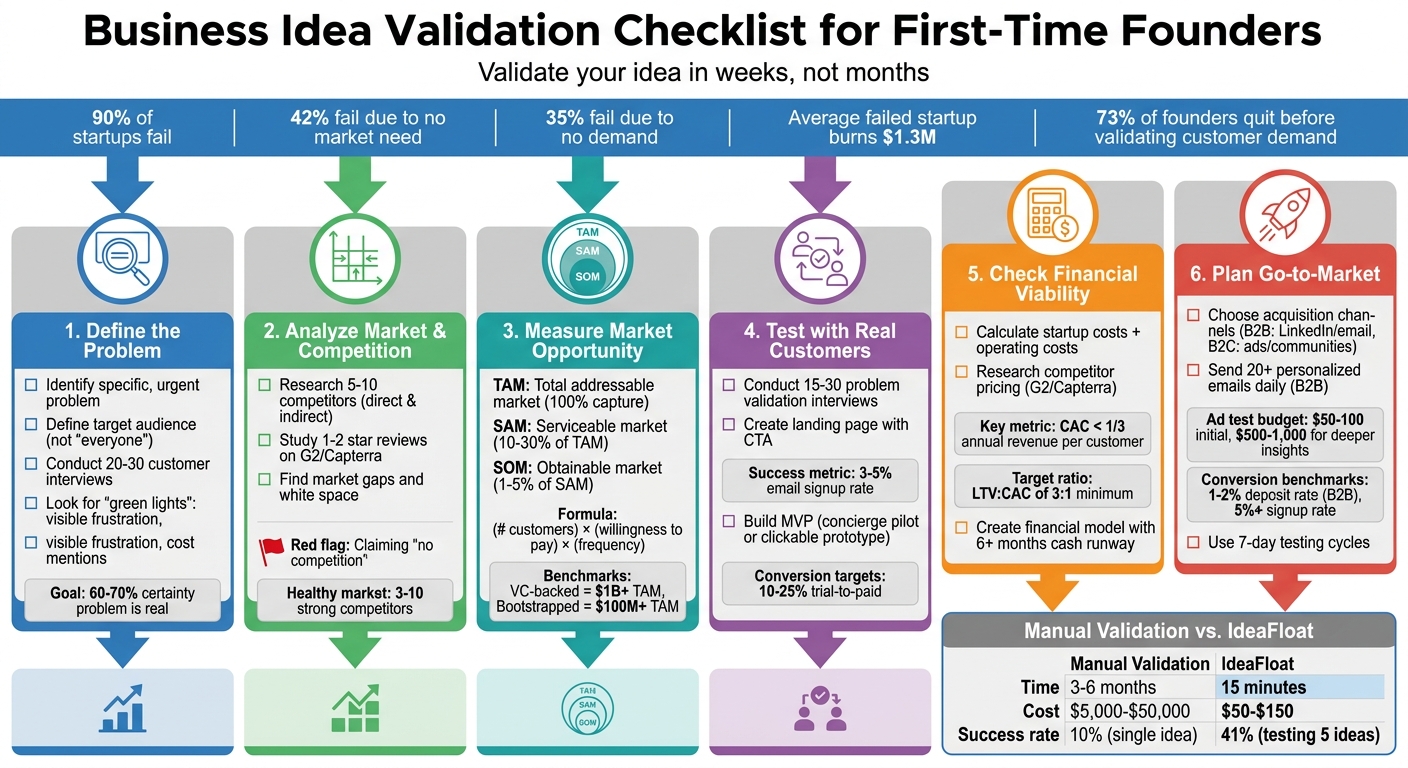
6-Step Business Idea Validation Framework for Startups
How to Validate Your Startup Idea for $50 (Same Method That Built a $100M Brand)
sbb-itb-08dd11e
Step 1: Define the Problem and Target Customers
Before diving into development, you need to address two key questions: What problem are you solving? and Who needs this solution? Without clear answers, your foundation is shaky.
Identify the Problem You're Solving
A solid idea addresses a problem that costs your target audience time, money, or productivity. As Sunita Mohanty, Founder and former Meta/Oculus Product Lead, puts it:
"The bottom line is that you can very easily build something, but to increase your chance of creating something that is solving a real problem you need to be more rigorous in your approach".
Frame your problem like this: "[Specific group] struggles with [specific problem] because [root cause], costing them [quantifiable impact]". For instance, instead of vaguely stating, "People need better invoicing software", you could say, "Freelance consultants lose $2,000–$5,000/year in unbilled hours because they forget to invoice for ad-hoc calls". This version is specific, measurable, and highlights urgency.
To validate the problem, check if people are already voicing frustrations about it. Look at 1-star reviews on platforms like G2 or Capterra for competing products, or search Reddit threads where users vent their issues in detail. If no one is complaining, the problem might not be pressing enough to support a business. You can also examine search volumes for keywords like "how to fix [problem]" - a combined monthly search volume over 1,000 suggests active demand.
A well-defined, painful problem within a clear customer group lays the groundwork for effective market and competitive analysis in the next steps.
Research Your Target Customers
"Everyone" is not a target customer. If your problem statement uses "people" without qualifiers, your audience is too broad. A strong customer definition includes specifics like job title, industry, pain points, and where they gather - be it subreddits, Slack groups, or industry events. As a quick test, you should be able to find 10 ideal customers on LinkedIn in 15 minutes.
Conduct 20–30 interviews to uncover patterns - most emerge after 8–10 conversations. Focus on understanding current behavior and costs, rather than gauging hypothetical interest. For example, ask questions like, "How are you solving this problem today?" or "How much time does this cost you weekly?" If they haven’t tried any workarounds (manual processes, spreadsheets, etc.), the issue might not be urgent enough.
A great example of customer research comes from Cocoon’s co-founders Mahima Chawla, Amber Feng, and Lauren Dai. In 2020, they validated their employee-leave platform by interviewing dozens of parents and using Craigslist ads to connect with hourly workers outside their network. They discovered that leave administration was a "nightmare" for both employees and employers. With just Figma prototypes, they signed their first two customers - Carta and Benchling - and have since raised $26M. Reflecting on this, Chawla said:
"In other areas, we were searching for the problem, whereas with leave it was obvious".
During interviews, look for "green lights": visible frustration when describing the problem, unprompted mentions of time or money costs, or asking when your solution will be ready. If identifying the pain point feels forced, you might not have found a problem worth solving. Aim for 60% to 70% certainty that the problem is real and customers are willing to pay for a solution before moving forward.
Once you’ve clearly defined the problem and your target customers, you’re ready to analyze the market and competitors.
Step 2: Analyze the Market and Competition
Once you've confirmed there's a real problem and identified your target audience, it's time to dig into the market and see what's already out there. Competition is actually a good sign - it shows there’s demand. As Michael Porter from Harvard Business School puts it:
"If all you're trying to do is essentially the same thing as your rivals, then it's unlikely that you'll be very successful".
The key is not to avoid competition but to find a way to stand out. This step helps you figure out your unique position in the market.
Research Your Competitors
Start by identifying 5–10 competitors, both direct and indirect. Direct competitors provide similar products, while indirect ones solve the same problem in a different way. Use problem-specific keywords to uncover how customers currently address the issue and any workarounds they use.
For each competitor, dig deeper. Look into their funding stage using platforms like Crunchbase or LinkedIn to understand if you’re competing against a well-funded company or another startup. Check their pricing on their websites or platforms like G2 to see whether they cater to small businesses, enterprise clients, or both. Most importantly, scour 1-star and 2-star reviews on sites like G2, Capterra, and Reddit. These reviews often highlight customer frustrations - golden opportunities for you to step in with a better solution.
Ask yourself: Does your solution stand out in a meaningful way? Is it faster, cheaper, simpler, or more accessible? Competing on features alone can be risky since features are easy to copy. Instead, focus on creating advantages that are harder to replicate, like network effects, high switching costs, or proprietary data. Remember, 19% of startups fail because they get outcompeted. This research will help you identify areas where you can truly make a difference.
Find Market Gaps
After mapping out the competition, look for "white space" in the market. This could be underserved customer groups, overly complex features that users don’t need, or recurring complaints that span several products. Use this insight to craft a positioning statement like:
"Unlike [Competitor X] with [Weakness], we deliver [Differentiator] for [Specific Audience] seeking [Outcome]."
A solid market gap addresses a problem that others have overlooked and does so in a way that’s profitable. For example, if most solutions target enterprise clients, there might be an opportunity to create a more affordable option for small businesses or freelancers. Claiming "no competition" is a red flag - investors typically view markets with 3–10 strong competitors as healthy. Your goal is to carve out a niche or highlight a feature that sets you apart.
Once you’ve nailed down your competitive position and identified those market gaps, you’ll be ready to assess the full potential of the opportunity ahead.
Step 3: Measure the Market Opportunity
Figuring out if your market is large enough - and growing quickly enough - is crucial for your business. The numbers don't lie: 42% of startups fail because there's no real market need, and the average failed startup burns through $1.3M before shutting down. Clearly, measuring your market opportunity is non-negotiable.
To get started, focus on three key metrics: TAM, SAM, and SOM. Picture them as three nested circles.
- TAM (Total Addressable Market): This is the total revenue opportunity if you captured 100% of the market without any competition.
- SAM (Serviceable Addressable Market): A slice of TAM that you can realistically target based on your business model and geographic reach - usually 10% to 30% of TAM.
- SOM (Serviceable Obtainable Market): The portion of SAM you can actually capture within 3 to 5 years, typically 1% to 5% of SAM.
Here's the catch: many founders get these numbers wrong. As Marcus Chen from ValidateStrategy puts it:
"Total Addressable Market is the most abused number in startup pitches".
The mistake? Over-relying on top-down estimates like "1% of a $10B market." Investors see through this right away. Instead, use a bottom-up approach. Start by defining a specific customer type - don’t generalize with terms like "small businesses." For example, narrow it down to "independent real estate agents in the US with 2 to 10 years of experience." Then, use tools like LinkedIn filters or census data to count potential customers, and multiply that number by your expected annual revenue per customer. If your bottom-up and top-down estimates differ by more than 10x, revisit your assumptions.
By focusing on specific customer data and competition, you’ll get a clearer picture of your market potential.
Calculate Market Size (TAM, SAM, SOM)
To calculate market size, use this formula: (# of target customers) × (average willingness to pay) × (annual purchase frequency). Here’s an example: if you have 50,000 target users, can realistically reach 10% through LinkedIn ads, and charge $29 per month, your SOM would be roughly $174,000 annually.
It’s also critical to confirm customers’ willingness to pay. If people are willing to pay $100 or more per month, you likely have strong potential. If they’re only willing to pay less than $5, it might signal trouble.
Don’t forget to consider market growth. A $500M market growing at 25% annually is often more appealing than a $5B market growing at just 2%. For venture-backed startups, aim for a TAM of $1B+; for bootstrapped businesses, $100M+ is usually a good target.
Estimate First-Year Revenue Potential
Once you’ve calculated your market size, use realistic penetration rates to estimate your first-year revenue. Your SOM is the foundation for these projections. For new SaaS tools, industry benchmarks suggest capturing 2% to 5% of the market in the first year. For instance, with a SOM of $174,000, capturing 3% would result in $5,220 in first-year revenue.
To validate demand early, spend $50–$100 on ads driving traffic to a landing page. A strong signal is a 3% to 5% email signup rate; anything below 1% could mean your market positioning needs work. The most reliable revenue estimates come from pre-orders or deposits - actual commitments, not just interest. As Preuve AI wisely points out:
"Someone saying 'that sounds useful' isn't the same as someone entering their credit card number".
Finally, check your unit economics. If your customer acquisition cost (CAC) is higher than your lifetime customer value (LTV), your business model won’t hold up - no matter how great your product is. Aim for an LTV:CAC ratio of at least 3:1. This simple calculation can help you determine if your market opportunity is real or just wishful thinking.
Step 4: Test Your Idea with Real Customers
Once you’ve analyzed your market, the next step is to see if real customers are interested in your solution. The stakes are high: 42% of startups fail because they create products no one wants. The best way to avoid this pitfall? Get your idea in front of strangers and pay close attention to what they do, not just what they say.
Gather Customer Feedback
Start by conducting problem validation interviews. Aim to have 15 to 30 conversations with people who have no bias toward your idea. As Rob Fitzpatrick, author of The Mom Test, explains:
"The truth about your idea lives in the specifics of their experience, not in their polite encouragement".
Focus on their past behaviors. For example, instead of asking, “Would you use this?”, ask, “How do you currently solve this problem?”. This approach helps you uncover whether the problem is real and pressing enough to warrant a solution.
Once you’ve confirmed the problem exists, move on to solution interviews. Share a prototype and observe their reactions. In 2022, Mahima Chawla, CEO of Cocoon, landed her first two customers - Carta and Benchling - by presenting Figma prototypes before her product was even functional. The goal here is to secure real commitments. Instead of vague questions like “What do you think?”, ask direct ones like, “Would you buy this today?”.
For broader validation, try smoke testing (also known as demand testing). Create a landing page with a clear call-to-action - like a waitlist signup or a “Buy Now” button - and drive traffic to it. If your cold traffic conversion rate exceeds 5%, it’s a good sign there’s actual demand. This method measures genuine interest, not just polite feedback.
Once you’ve validated interest through interviews and landing page tests, you’ll be ready to move on to creating a minimum viable product.
Build and Test a Minimum Viable Product (MVP)
Use the insights from customer feedback to design your MVP. Before diving into development, identify your product’s "atomic unit" - the smallest version of your value proposition that still delivers value. For Google, it was a single search query; for a food delivery app, it might be the ability to order one specific item. Testing this atomic unit helps you validate your assumptions without overbuilding.
Choose the right MVP approach for your needs. One option is a concierge pilot, where you manually perform the service for a small group of users (typically 3 to 5) to understand the workflow. For example, in December 2022, the founders of Pilot validated their accounting startup by manually handling clients’ accounting tasks using order forms - long before building any software. Alternatively, you could create a clickable prototype using tools like Figma or Miro to test whether users can navigate your interface and understand your product’s flow, without needing a backend.
Set clear success metrics before testing. For instance, you might aim for a 3% to 5% click-to-pricing rate or a 10% to 25% trial-to-paid conversion rate. If your MVP doesn’t hit these targets after two attempts, use the qualitative feedback you’ve gathered to pivot, rather than continuing to pour resources into the same idea. As Gagan Biyani, co-founder and CEO of Maven, puts it:
"You're nothing until you have customers who want your product".
Once you’ve validated customer interest, your next step is to refine and develop the MVP further. The goal is to learn quickly, adapt, and avoid wasting time on ideas that won’t work.
Step 5: Check Financial Viability
You've confirmed customer interest - great start. But now, it's time to dig into the numbers. After validating your market and customer base, you need to ensure your idea makes financial sense. Here's a stark reality: around 90% of business ideas fail when they skip proper validation before launch. A big reason? Founders often overlook the financial groundwork. A concept might sound appealing, but the math has to check out for it to work as a business.
Calculate Costs and Set Pricing
Start by figuring out your startup costs - these are the one-time expenses you'll need to get off the ground. Think about things like equipment, initial inventory, legal fees, marketing materials, and rent or lease deposits. Then, move on to your operating costs, which cover ongoing expenses like salaries, rent, utilities, marketing, insurance, taxes, and interest on any loans. Be as precise as you can when estimating both.
Next, tackle your pricing strategy. Study your top three to five competitors to see what they're charging. For extra insight, check out customer complaints in their one-star and two-star reviews on platforms like G2 or Capterra. This can reveal pricing issues or gaps in value. When interviewing potential customers, let them suggest a price first. This prevents you from unintentionally influencing their answer and helps you gauge their actual willingness to pay.
Don't forget to calculate your unit economics early on. A key metric here is your Customer Acquisition Cost (CAC). As a rule of thumb, your CAC should be less than one-third of your annual revenue per customer. The VibNFlow Team puts it bluntly:
"If your customer acquisition cost is higher than your lifetime customer value, the math never works - no matter how good the product is".
These numbers will help you build a financial model that shows exactly where your break-even point lies.
Create a Basic Financial Model
With your cost and pricing data in hand, the next step is to create a financial model. This model should include three key financial statements:
- Income statement: Tracks revenue minus expenses to calculate net profit.
- Balance sheet: Summarizes assets, liabilities, and equity at a specific point in time.
- Cash flow statement: Shows how cash flows in and out of the business.
Pay special attention to the cash flow statement. It's crucial for spotting liquidity problems that might not show up in other reports.
When projecting revenue, use bottom-up modeling. Instead of claiming a slice of a massive global market, focus on real numbers - count potential customers and multiply by a realistic revenue per customer. To stress-test your assumptions, run a sensitivity analysis. For example, see how your model holds up if costs are 20% higher or revenue is 15% lower than expected. This helps you identify your margin of safety and pinpoint which assumptions are most critical.
Set clear performance benchmarks. Your model should show at least six months of cash runway and identify your break-even point - the minimum performance needed to stay afloat. As Tim Stobierski from Harvard Business School Online points out:
"Knowing how to determine the financial health of a company is a vital business skill... it can help you make more informed decisions about your organization's direction and how resources are allocated".
If the numbers don't add up, take it as a valuable lesson. It's much better to learn this now - after spending $50 to $150 on validation - than after sinking $5,000 to $50,000 into a business the market can't support.
Step 6: Plan Your Go-to-Market Strategy
Once you've verified demand and confirmed your financial model works, it's time to focus on launching your product. The goal here is clear: create a plan to bring in customers. This isn’t about perfecting every detail - it’s about identifying the right channels and executing a targeted launch.
Choose Customer Acquisition Channels
Your acquisition strategy should match how your ideal customers behave. For B2B businesses, direct outreach works well. Use cold emails or LinkedIn DMs to connect with potential customers. A good rule of thumb? Send at least 20 personalized emails daily to your target audience to book discovery calls. Keep in mind that warm introductions typically convert at 30–50%, while cold outreach has a lower conversion rate of 2–5%, so adjust your outreach volume accordingly.
For niche markets, platforms like Slack groups, Discord servers, or specific subreddits are excellent. These communities let you directly interact with highly targeted users without needing to spend on ads. If your product is aimed at a broader audience, small ad tests on platforms like Google, Meta, or LinkedIn can help you figure out your cost-per-lead. Start with a small budget - $50 to $100 - to test your messaging and see which ads perform best. For deeper insights into your acquisition costs, allocate $500 to $1,000.
When setting up your landing pages, include pricing right from the start. Even offering a small deposit or a "founding member" tier can help gauge interest. For B2B products, aim for a deposit or Letter of Intent rate of 1–2% from your landing page traffic. If your signup rate exceeds 5% from a pool of 500+ visitors, that’s a strong indicator of market interest. Also, ensure your lifetime value to customer acquisition cost ratio is at least 3:1. If your numbers don’t add up, you’ll know early enough to make adjustments without wasting resources.
Once you’ve identified your acquisition channels, focus on launching quickly to engage potential customers.
Create a Launch Plan
Build excitement for your product before it’s fully developed. Alex Cloudstar, an indie hacker, sums this up well:
"Post the problem + solution on X, gauge reactions (saves, replies, DMs), create a waitlist page, and see if people sign up. If you can't get 100 signups, you won't get 100 customers".
Use mockups, content, and social media to spark interest and gather email addresses before launch.
Adopt a 7-day cycle for rapid testing:
- Day 1: Define your objective and key metric.
- Days 2–3: Launch a low-fidelity test, like a landing page or prototype.
- Days 4–5: Drive targeted traffic to your test.
- Day 6: Collect feedback through interviews.
- Day 7: Decide whether to pivot or move forward.
This fast-paced approach ensures you’re building something people actually want, avoiding the common pitfall of spending weeks on unnecessary features - a mistake that contributes to the high failure rate of new products.
To validate user interest with minimal investment, try techniques like the "fake door" method. Set up a landing page with a clear call-to-action and track conversions. For more complex workflows, the "Wizard of Oz" method can be effective - manually deliver the service while simulating automation. This lets you test whether users find the solution valuable before investing in backend development.
Keep your product lean by prioritizing features using the MoSCoW framework. Categorize them into "Must have", "Should have", "Could have", and "Will not have" to focus on what’s truly essential for your MVP.
Finally, track the metrics that matter. Focus on leading indicators like the number of qualified conversations per week rather than vanity metrics like pageviews. Monitor your funnel at every stage, from outreach to closed deals. For early-stage products, a qualified-to-closed conversion rate of 20–40% is typical. Once you’ve secured 5–10 customers, analyze who they are, what messaging worked, and which channel performed best. Then, double down - allocate 80% of your resources to the top-performing channel instead of spreading your efforts thin.
Using IdeaFloat to Speed Up Validation
Bringing an idea to market can be a slow and costly process, but IdeaFloat changes the game. Traditional validation methods often take months, leaving entrepreneurs drained of time and money. With IdeaFloat, this process is streamlined into just 15 minutes.
The platform transforms validation by replacing static templates with an interactive AI experience. Acting like a co-founder, the AI asks targeted questions, performs live web research through specialized APIs, and provides answers backed by verifiable citations that even investors can trust. So far, over 1,247 business ideas have been validated using this approach.
IdeaFloat Features for Validation
IdeaFloat organizes the validation process into four key phases, aligning with the steps most founders already follow:
- Phase 1: Problem Validation
This phase ensures your idea addresses a problem that people are willing to pay to solve. Tools like the Problem Validator assess urgency, while Consumer Insights scan online communities to gauge demand and understand customer language. Additionally, the Competitor Analysis tool maps out the competitive landscape, helping you identify underserved segments and position your business effectively. - Phase 2: Market Opportunity
The Smart Market Sizing tool calculates TAM (Total Addressable Market), SAM (Serviceable Available Market), and SOM (Serviceable Obtainable Market), using up-to-date and reliable sources. This eliminates guesswork and reliance on outdated reports. - Phase 3: Financial Viability
Automated tools handle cost analysis and pricing research. The AI evaluates competitor pricing and applies pricing theories to determine optimal margins. It also generates interactive financial projections, including break-even analysis and funding needs. - Phase 4: Customer Acquisition
IdeaFloat provides a Waitlist Landing Page with compelling copy, a Community Launch Map that pinpoints where your audience spends time online, and pre-written social posts to drive traffic. As Nick Sherwing, founder of woohoPets, shared:"IdeaFloat saved us weeks of work by helping us explore demand for new products across different regions and took the guesswork out of finding gaps in the market".
Manual Validation vs. IdeaFloat
The platform doesn’t just save time - it delivers insights with greater accuracy and depth. Here’s how it stacks up:
| Feature | Manual Validation | IdeaFloat |
|---|---|---|
| Time Investment | 3–6 months of research | ~15 minutes for initial analysis |
| Data Source | Static templates and outdated reports | Live web research with verifiable citations |
| User Experience | Lengthy forms | Conversational, co-founder-like interaction |
| Feedback Style | Often generic or overly optimistic | Honest, actionable insights |
| End Goal | Static business plan | A roadmap ready to acquire customers |
Soba, who owns a bar, Pilates, and yoga studio, praised the platform:
"It replaced months of research and Excel modelling with real-time data insights. Highly recommend!".
This side-by-side comparison illustrates how IdeaFloat delivers faster, more actionable results.
IdeaFloat Plans for First-Time Founders
IdeaFloat offers flexible plans tailored to different needs:
- Free Plan: No credit card required, includes basic tools for research, naming, and positioning.
- Standard Plan ($20/month): Unlocks tools for demand validation, pricing strategies, and investor-ready presentations.
- Pro Plan ($40/month): Adds advanced features like market sizing, go-to-market playbooks, and premium exports. Annual plans come with a 20% discount.
Robert Bates, Partner at McFillin Accounting, highlighted its value:
"IdeaFloat will save me and my team countless hours of work, as we help clients articulate their business ideas".
The platform integrates APIs for reliable market data and delivers investor-ready exports in formats like PDF, Word, and PowerPoint. With 73% of founders quitting before validating customer demand, IdeaFloat provides the tools to move forward with confidence, backed by real data.
Conclusion
Finalizing your decision comes down to one key principle: uncovering the truth before committing your time and money. As Ryan Glasgow, Founder of Sprig, wisely stated:
"A great outcome for any startup, product or new feature that you're working on is that you determine in the very beginning, or as soon as possible, that it's not worth spending time on".
The steps are straightforward. Begin by clearly defining the problem you're solving. Then, test your concept with real customers - not friends or family, who might sugarcoat their feedback. Talk to 10–20 strangers who fit your target audience to get honest insights. Gauge whether people are willing to pay by setting up a simple landing page or asking for pre-orders.
Here’s a striking comparison: testing five ideas through rapid validation gives you a 41% chance of finding a winning concept. In contrast, pouring resources into a single untested idea leaves you with just a 10% probability of success. A validation sprint costs about $50–$150 and takes 4–8 weeks, while diving straight into development can cost $5,000–$50,000 and take 3–6 months.
To keep emotions out of the equation, establish clear success criteria from the outset. For example, aim for 100 waitlist signups in 30 days or conduct 20 interviews where at least half of the participants express a willingness to pay. Defining these metrics upfront ensures you rely on data, not gut feelings, when making your decision. For more guidance, explore our entrepreneurship courses to help you plan and launch your business.
FAQs
How do I know if the problem is painful enough to pay for?
To figure out if a problem is pressing enough for people to pay for a solution, start by assessing its urgency and demand. Look into search trends, customer reviews, online forums, and even competitor activity for clues. AI tools can help speed up this research by analyzing large amounts of data quickly. If you notice that people are actively searching for answers or are already spending money to tackle the issue, that’s a clear sign the problem is worth solving.
What proof of demand should I get before building an MVP?
Before diving into building an MVP, it's essential to gather proof of demand. This means confirming that your target audience not only identifies a pressing problem but is also actively looking for solutions - and willing to pay for a better option. You can validate this through methods like market research, customer interviews, and even pre-sales efforts. Taking these steps ensures there's real interest, helping you avoid risky assumptions and saving both time and resources before development begins.
What numbers should I hit to decide if I should launch or pivot?
To gauge whether your product has real market potential, it's crucial to confirm that a notable segment of your target audience is ready to pay for it. A common way to measure this is by reaching 40–50 paying customers or generating at least $10,000 in monthly recurring revenue (MRR) within the first few months. Hitting these benchmarks can help you decide whether to keep moving forward or rethink your strategy.
Related Blog Posts
- IdeaFloat: The 15-Minute Business Plan Solution
- Validate Your Idea Before Wasting Money
- I Validated My Business Idea in 24 Hours - Here's The Exact Process
- What Makes a Business Idea Worth Pursuing?