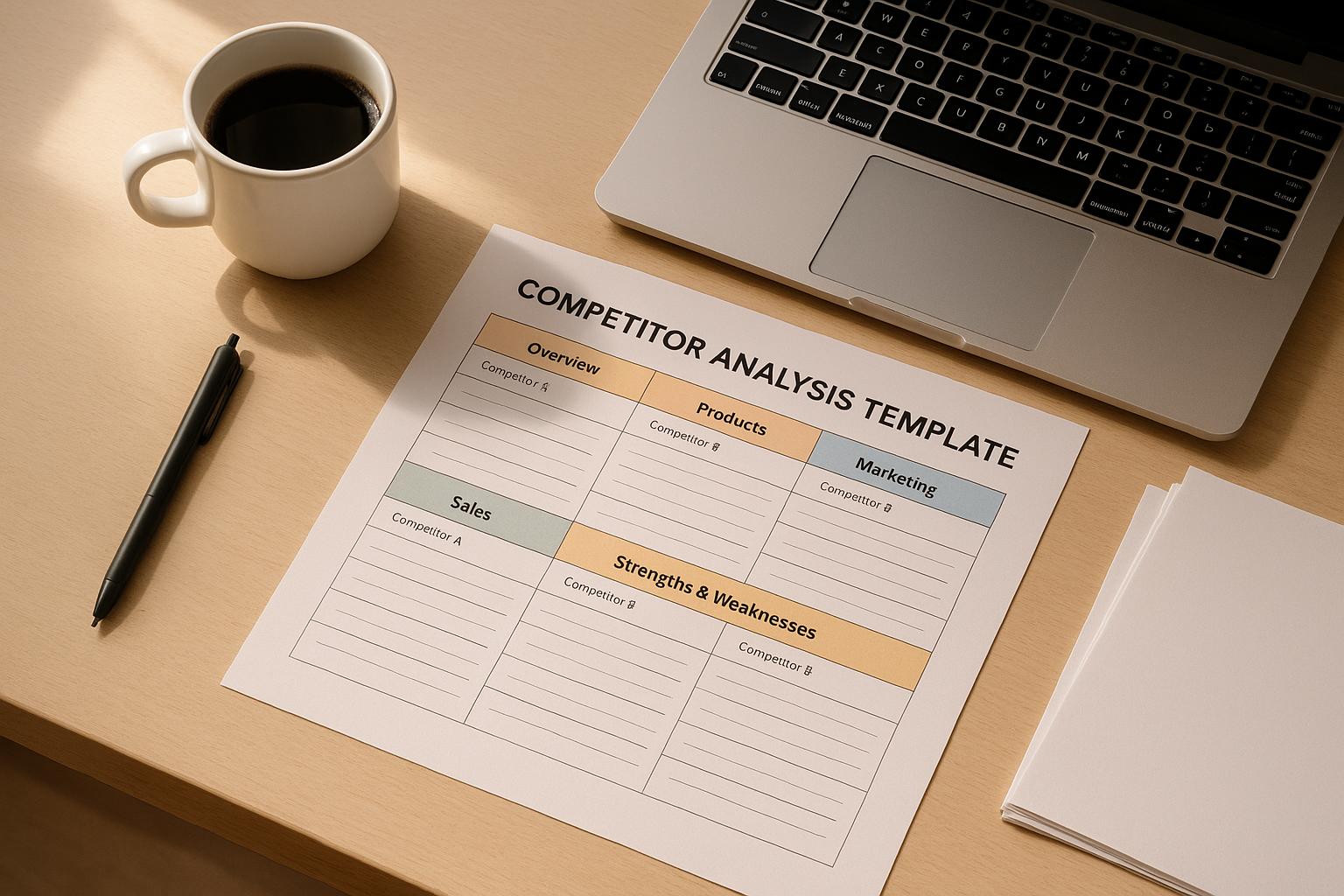
Competitor analysis is critical for understanding your market and standing out. This article breaks it down into five simple sections to help you focus on what matters:
- Competitor Snapshot: Identify 3-5 competitors and create basic profiles, covering their location, business model, main product, target customers, sales channels, and founding date.
- Market Position & Value Proposition: Analyze how competitors position themselves in terms of pricing, audience, and differentiation. Identify gaps in their messaging.
- Strengths & Weaknesses: Use customer feedback to determine what competitors do well and where they fall short.
- Pricing & Revenue Models: Compare pricing structures, tiers, and revenue strategies to find opportunities.
- Customer Details & Market Gaps: Study their customer base and find underserved segments or unmet needs.
Competitor Analysis Made Easy: Structure & Design Tips
1. Competitor Snapshot: Create a Basic Profile
Start by pinpointing your competitors and gathering essential details about them. Skip digging too deep for now - just focus on the basics that will help you dive deeper later.
Identify 3 to 5 direct competitors who target the same customer base. These should be businesses that pose the most immediate challenge or share the closest similarities with your model.
Once you’ve nailed down your list, create a straightforward profile for each competitor. Think of it as a quick reference guide for side-by-side comparisons. These profiles will lay the groundwork for more in-depth analysis later.
What to Include in a Competitor Snapshot
Your competitor snapshot should cover six key areas. This gives you a clear sense of who they are, what they offer, and how they operate.
- Company Name and Location: Note the name, headquarters, and any key markets they operate in. Location can reveal their market focus, regulatory challenges, or expansion plans.
- Business Model: How do they make money? Are they subscription-based, transaction-based, or ad-supported? Do they sell to consumers (B2C), businesses (B2B), or both? Understanding this helps you see their priorities and the sustainability of their approach.
- Main Product or Service: Summarize their core offering in one or two sentences. What problem does it solve? What sets it apart? For example, in May 2025, Promodo studied the mobile fitness app market and profiled "FitTrack Pro" as offering "Fitness tracking with AI coaching" for "Busy professionals aged 25–40". This level of detail makes it easy to see what you’re up against.
- Target Customers: Who are they trying to reach? Break it down by demographics, behaviors, or pain points. This helps you figure out if you’re competing for the same audience or if there’s room to carve out your own niche.
- Sales Channels: Where and how do they sell? Are they using their website, retail stores, third-party platforms like Amazon, or a mix? Do they lean heavily on social media, paid ads, or partnerships? Knowing this can highlight opportunities to stand out.
- Founded Date: When did they launch? A startup from 2023 will have different opportunities and challenges than a company founded in 2010. Newer players might be more agile but lack brand recognition, while older ones may have loyal customers but struggle with staying modern.
Here’s an example template you can use for each competitor:
| Field | Details |
|---|---|
| Company Name | [Competitor's full name] |
| Location | [Headquarters city, state, country] |
| Business Model | [B2B, B2C, subscription, freemium, etc.] |
| Main Product/Service | [Brief description of core offering] |
| Target Customers | [Demographics, behaviors, pain points] |
| Sales Channels | [Website, retail, Amazon, social media, etc.] |
| Founded | [MM/DD/YYYY or year] |
To fill out these profiles, start with the basics. Visit competitors’ websites and check their "About Us" pages, product descriptions, and case studies. Look at their social media profiles to see how they market themselves and who’s engaging with their content. Tools like BuiltWith can reveal their tech stack, giving insight into their priorities and sophistication. Platforms like SEMrush or Ahrefs can show their traffic sources and top-performing pages, offering clues about how they attract customers.
Don’t skip customer reviews on sites like Trustpilot, Google Reviews, G2, or Amazon. These can tell you a lot about who’s using their products and what matters most to them. If you want firsthand insight, consider buying a competitor’s product or service to experience it yourself.
As you build these snapshots, look for patterns. For example, in May 2025, Promodo analyzed the organic skincare market and found that "Herbivore Botanicals" thrived on "luxury, sustainability, and glass packaging", while "Burt’s Bees" emphasized "affordability, accessibility, and natural ingredients." Meanwhile, "The Ordinary" stood out with "transparency in ingredients and low prices". This kind of insight helped PureGlow Organics position itself as a "clean-luxury" brand, filling a gap between high-end and budget options.
Remember, these profiles aren’t set in stone. Competitors will launch new products, shift strategies, or expand into new markets. Update your snapshots regularly - quarterly or whenever you notice major changes. Keeping them current ensures your decisions are based on the latest information.
With these profiles ready, you’ll be well-prepared to dive into analyzing market positioning and value propositions.
2. Market Position and Value Proposition
After creating competitor snapshots, the next step is to evaluate their market positions and the promises they make to customers. This analysis uncovers gaps you can leverage to stand out.
Understanding market position goes beyond what competitors sell; it’s about how they’re perceived - whether they’re budget-friendly, premium, or specialized. This perspective helps identify crowded areas and untapped opportunities.
Pinpointing Competitors' Market Fit
Start by figuring out if competitors cater to a specific niche, like vegan athletes in urban areas, or aim for a broader audience. Then, assess their competitive strategy - are they focused on price, quality, convenience, or something else? This reveals what they prioritize and where they allocate resources.
Use your competitor snapshots as a foundation and analyze these four key dimensions to understand their market positions:
- Price positioning: Are they budget, mid-range, or premium? For instance, a $9.99/month subscription suggests affordability, while $99/month or higher indicates a premium offering.
- Market breadth: Do they serve a general audience or a specific niche? A tool for "all businesses" has wide appeal, while one for "architecture firms managing construction projects" targets a niche.
- Differentiation focus: What sets them apart? Some emphasize speed, others focus on quality, convenience, or customization. Their marketing, features, and customer reviews can reveal their main differentiator.
- Customer segment: Who are their actual customers? Look beyond their stated audience - reviews, case studies, and testimonials often provide a clearer picture of who’s buying.
Visualizing this data can be helpful. Create a simple positioning map with price (low to high) on one axis and specialization (broad to niche) on the other. This chart quickly shows where competitors cluster and where gaps might exist. For example, if most competitors are in the "mid-price, broad market" space, there could be room for a "budget, specialized" or "premium, niche" offering.
Also, keep an eye on how competitors evolve. If a company shifts from budget to premium, it might leave room for someone to step into the affordable space.
Breaking Down Competitors' Value Propositions
Next, focus on how competitors define their core promise - what makes them worth choosing over others. A value proposition answers the question: "Why should I pick you?"
This information is often front and center on their homepages or taglines. It might be a straightforward statement like, "Save 10 hours per week on administrative tasks", or something more abstract like, "The simplest way to manage your finances."
To analyze these, break down each competitor’s value proposition into three parts: the problem they address, the solution they offer, and the outcome they promise. For example:
- "Competitor A helps busy professionals [problem] by providing AI-powered meal planning [solution], so they can eat healthy without spending hours on grocery shopping and cooking [outcome]."
Compare competitors' value propositions side by side. Look for common themes. If most focus on "speed" or "efficiency", it suggests these are key customer priorities. If one competitor emphasizes "customization" or "personal service", they might be targeting a different audience or trying to stand out in a crowded field.
Identify what’s missing in these promises. For instance, if no one mentions affordability, there could be an opportunity to serve budget-conscious customers. If simplicity isn’t highlighted, there might be demand for a more user-friendly option.
IdeaFloat’s Unique Value Proposition workflow can help you refine your positioning based on this research. By mapping out competitors’ promises, you can identify gaps and craft a message that appeals to customers who feel underserved by current offerings.
An effective test of your analysis is to ask: "Would these value propositions feel distinct to a customer?" If they all sound similar - like "fast, easy, affordable" - competitors may not be differentiating well, leaving customers to rely on brand loyalty or word-of-mouth instead of clear messaging.
Organizing Your Findings
To keep your insights organized, create a simple table like this:
| Competitor | Market Position | Value Proposition |
|---|---|---|
| Competitor A | Premium, broad market | Helps [target customer] achieve [outcome] through [unique approach] |
| Competitor B | Budget, niche-focused | Solves [specific problem] for [specific audience] with [key differentiator] |
| Competitor C | Mid-range, broad market | Delivers [benefit] by [method], enabling [result] |
This table becomes a handy reference for understanding what’s currently offered and where you can position yourself differently. Update it whenever competitors rebrand, launch major features, or change their messaging - these shifts often signal strategic moves worth noting.
With a clear understanding of competitors’ market positions and value propositions, you’re better prepared to identify their strengths, weaknesses, and how customers perceive them.
3. Strengths, Weaknesses, and Customer Feedback
Once you’ve mapped out competitors' market positions, it’s time to dig deeper into how they actually perform. This means evaluating their strengths, weaknesses, and what their customers are saying. By identifying recurring patterns, you can uncover opportunities to stand out.
Strengths and weaknesses aren’t always obvious from a company’s marketing materials. For instance, a competitor might boast about having "industry-leading support", but customer reviews could paint a very different picture. Similarly, they might downplay a feature that customers rave about. The trick is to combine your observations with real customer feedback to get a complete and accurate view.
Create a Strengths and Weaknesses Table
A simple two-column table works well for organizing this information. On one side, list the strengths - areas where the competitor excels. On the other, note their weaknesses - places where they fall short or receive consistent criticism.
Here’s how to identify each:
- Strengths: Look at what competitors highlight in their marketing, recent investments in features, awards, or consistent praise in customer reviews. For example, if customers frequently compliment fast shipping or excellent onboarding, those are strengths worth noting.
- Weaknesses: These are often easier to spot. Scan reviews for repeated complaints, missing features, mismatched pricing, or operational issues like slow response times or frequent outages.
Here’s an example of how to structure your findings:
| Strengths | Weaknesses |
|---|---|
| Fast customer support (avg. 2 hours) | Limited payment options (credit card only) |
| Regular product updates | No mobile app available |
| Strong brand recognition in the market | Higher pricing than competitors ($49/month) |
| Effective onboarding | Steep learning curve for new users |
Be as specific as possible. Replace vague phrases like "good customer service" with measurable details like "responds to tickets within 2 hours." Instead of saying "expensive", note, "priced at $49/month, which is 69% higher than the $29 market average."
This approach not only helps spot patterns across competitors but also reveals gaps you can potentially fill. For instance, if most competitors struggle with mobile functionality, that’s a clear opportunity. Conversely, if all competitors excel at customer support, it’s likely a baseline expectation rather than a differentiator.
Keep this table updated. If a competitor launches a new feature or addresses a weakness, adjust your analysis. This ensures your insights remain relevant and actionable.
Use Customer Feedback to Find Insights
Customer reviews are like goldmines for understanding what really matters to your audience. People are often brutally honest in their feedback, sharing exactly what frustrated them, what delighted them, and what they wish existed.
Start by gathering feedback from multiple sources. Explore platforms like Trustpilot, G2, and Amazon for reviews. Check social media platforms like Facebook, X (formerly Twitter), and LinkedIn for comments on competitors’ posts. Don’t forget community forums like Reddit or industry-specific boards where customers often share unfiltered opinions.
When analyzing reviews, focus on recurring themes, not isolated complaints. If one person complains about shipping delays, it might be an outlier. But if 20 people mention it, that’s likely a systemic issue. Patterns in feedback can reveal what customers truly value.
For U.S.-based customers, expectations can differ significantly from other markets. Here’s what typically stands out:
- Generous return policies: Many Americans expect a clear money-back guarantee.
- Fast shipping: Anything beyond 5-7 business days often leads to complaints.
- Responsive support: Same-day email responses or live chat during business hours are highly valued.
- Transparent pricing: Hidden fees or unexpected charges are major turnoffs.
Here’s what to look for in customer feedback:
- Pain points competitors aren’t solving: Look for repeated complaints like “setup is too complicated” or “reporting features are lacking.” These unmet needs could be your opportunity.
- Features customers love: Pay attention to what gets consistent praise, like a competitor’s mobile app or educational content.
- Deal-breakers: Identify the reasons customers leave competitors. Common issues include poor customer service, lack of integrations, or rigid contracts.
- Customer language: Note how customers describe their needs. For example, if they say, “I need help organizing my chaos,” that’s a clue for your marketing language.
- Pricing sensitivity: Watch how customers talk about price. Are they saying, “Totally worth it” or “Too expensive for what you get”? This reveals perceived value.
Organize these findings in a document or spreadsheet. For each theme, note the competitors it applies to, how often it appears, and include specific quotes to illustrate the point. This becomes a valuable reference for shaping your own strategy.
A helpful tool like IdeaFloat’s Competitor Analysis workflow can streamline this process, gathering customer feedback from across the web to save you hours of manual research.
For practical analysis, aim to read 20-30 recent reviews for each major competitor. This sample size is usually enough to spot trends without getting overwhelmed. Sort reviews by “most helpful” or “most recent” for a balanced view. Don’t just focus on 5-star or 1-star reviews; 3-star reviews often provide the most balanced and actionable insights.
Also, watch for shifts over time. If recent reviews are more negative than older ones, something may have changed - perhaps they raised prices, reduced support staff, or were acquired. Similarly, if reviews have improved, it could mean they’ve addressed past issues, making them a stronger competitor.
Not all feedback is equally useful, though. Some complaints stem from user error or unrealistic expectations. Focus on feedback that highlights genuine gaps between what competitors offer and what customers need. These gaps are where you can position yourself to win.
This detailed analysis will also contribute to understanding competitors’ pricing and revenue models.
sbb-itb-08dd11e
4. Pricing, Packages, and Revenue Models
Studying competitors' pricing strategies offers a glimpse into their value proposition, target audience, and revenue generation tactics. By examining how pricing structures, package options, and revenue models are set up, you can uncover opportunities to stand out and identify gaps in the market.
When paired with competitor snapshots and market positioning, pricing analysis highlights key differences in how customers perceive value. Start by documenting each competitor's pricing model - whether it's a subscription, a one-time payment, or a mix of both. Many businesses combine these strategies, offering subscriptions for primary access while charging separately for add-ons, premium features, or professional services.
Also, pay attention to whether subscription plans include both monthly and annual options, and note any discounts for annual payments (often ranging from 15% to 30%). For instance, if a competitor charges $49 per month but offers an annual plan for $490, that’s roughly a 17% discount, signaling their interest in locking in long-term customers.
Next, break down pricing tiers - basic, standard, premium - and document what’s included in each. For example, note features like user limits, storage capacities, or access to advanced tools. This analysis helps you understand how the market segments its offerings and which features are positioned as premium.
Keep track of promotions, discounts, and trial offers to gauge customer acquisition strategies. For example, does a competitor offer a 14-day free trial, a 30-day money-back guarantee, or discounted rates for specific customer groups? These details can reveal how they attract and retain customers.
Additionally, examine revenue models such as product sales, subscriptions, advertising, consulting, or transaction fees. Understanding how competitors generate revenue can help you anticipate their strategies and pinpoint weaknesses. This knowledge equips you to create a clear visual comparison.
Format Pricing Data for Easy Comparison
Once you’ve gathered these insights, organize them into a comparison table for a straightforward, side-by-side evaluation. Use consistent formatting, listing prices in U.S. dollars ($) and specifying whether they’re monthly or annual rates. If both options are available, include them alongside calculated annual savings.
Here’s an example of how your pricing comparison table could look:
| Competitor | Pricing Model | Monthly Price | Annual Price | Free Trial | Key Features Included | Add-Ons/Extras |
|---|---|---|---|---|---|---|
| Competitor A | Subscription | $29/month | $290/year (17% off) | 14 days | Up to 5 users, 50GB storage, email support | $10/month per additional user |
| Competitor B | One-time Purchase | N/A | $299 (lifetime) | 30-day refund | Unlimited users, 100GB storage, priority support | $99/year for updates |
| Competitor C | Freemium + Subscription | Free (basic) / $49/month (pro) | $490/year (17% off) | Unlimited (free tier) | Basic: 1 user, 10GB; Pro: 10 users, 500GB, phone support | $15/month for advanced analytics |
| Competitor D | Subscription | $99/month | $990/year (17% off) | 7 days | Unlimited users, 1TB storage, dedicated account manager | Custom integrations at $500 setup fee |
This format allows for easy comparisons of pricing models, tiers, and revenue strategies. It also highlights the price-to-value ratio, showing which competitors offer bundled value versus those that rely on extra fees to increase the overall cost.
5. Customer Details and Market Gaps
Digging into competitors' customer bases can uncover valuable opportunities to stand out. While pricing and features highlight what competitors offer, understanding their customers reveals where gaps lie. These gaps are your chance to step in and win over customers who feel overlooked or underserved.
Start by gathering customer demographic details. For B2C businesses, this might include age, income, location, education, and lifestyle. For B2B, focus on company size, industry, and revenue. You can find this information in competitors' case studies, testimonials, reviews, social media, or marketing materials that outline their target audience.
Customer reviews are a goldmine for spotting unmet needs. Platforms like G2, Capterra, Trustpilot, and Google Reviews often reveal frustrations beyond star ratings. Complaints about missing features, poor customer support, complicated interfaces, limited integrations, or pricing mismatches are common. Each of these pain points could represent an opportunity for you to stand out.
Social media platforms, Reddit threads, and online communities also provide unfiltered feedback. Look for posts in subreddits, Facebook groups, LinkedIn communities, or industry forums where users discuss frustrations. For instance, users might wish for additional features or point out that a product works well for large teams but falls short for freelancers.
You can also examine how competitors acquire customers. If they rely heavily on paid ads but neglect content marketing or community-building efforts, that might signal an opportunity. Similarly, if their focus is on enterprise clients while ignoring self-serve options for smaller customers, you might discover an underserved segment. This approach helps pinpoint untapped customer groups.
Spotting Market Gaps
By analyzing competitors, you can identify segments that consistently lack options. For instance, if competitors cater to mid-market companies (revenues between $10 million and $1 billion) but small businesses (revenues between $1 million and $10 million) struggle to find affordable solutions, that’s a clear gap. Similarly, geographic gaps can emerge - if a competitor dominates in coastal cities but has little presence in the Midwest or South, that’s an opening. Industry-specific gaps also exist when general tools fail to meet the unique needs of sectors like healthcare, legal services, or manufacturing.
Identify Unmet Customer Needs
To turn these observations into actionable strategies, connect customer needs with what competitors fail to deliver. Then, figure out how you can fill that gap in a way that’s both feasible and profitable.
Organize your findings into a framework. List common customer complaints or unmet needs, note which competitors address them (if any), and evaluate how effectively they do so. This overview helps you identify patterns and prioritize opportunities based on the number of customers affected and how underserved their needs are.
For example, if customers frequently complain about complex onboarding processes, mentioning steep learning curves or weeks-long setups, you’ve identified a pain point. If no competitor has simplified onboarding, you could differentiate by offering guided setup, video tutorials, or personalized onboarding services.
Similarly, if reviews suggest pricing is too high for small teams or startups, consider offering affordable tiers, transparent costs, or flexible payment options. This could make your solution accessible to these underserved groups.
Feature gaps are another common opportunity. If customers love a product but consistently request a specific feature that competitors haven’t implemented - or have poorly executed - it’s a chance to stand out. However, focus on features that align with your strengths and strategy, as not every request is worth pursuing.
User experience (UX) gaps also provide room to shine. Even if competitors offer robust features, clunky interfaces, slow load times, or confusing navigation can drive customers away. Position your product as a simpler, more intuitive alternative to attract users who prioritize ease of use.
Support and service gaps can be just as impactful. If competitors rely on slow email support, consider live chat, phone support, or dedicated account managers. Offering personalized training instead of self-service onboarding could also set you apart. For many customers, especially in B2B, responsive support matters more than extra features.
Integration gaps are worth exploring too. If your target audience relies on specific tools - like accounting software, CRMs, or communication platforms - and competitors don’t integrate well with them, addressing these issues can add immediate value. Customer comments about manual data exports or poor integration are clear signals.
Pricing models are another area to differentiate. If competitors only offer annual contracts but customers prefer monthly flexibility, that’s an opportunity. Similarly, if costs are based on per-user pricing instead of a flat rate, or if features are bundled instead of offered à la carte, you can stand out by providing more flexible options.
Evaluating Opportunities
Before pursuing a market gap, ask yourself three key questions:
- Is this need shared by enough customers to justify the effort? A few isolated complaints don’t define a market.
- Can you realistically deliver a better solution? Ideas are great, but execution is what matters.
- Will customers pay for this improvement? Some gaps exist because they aren’t financially viable to fill.
Once you’ve identified viable gaps, translate them into clear positioning statements that highlight your differentiation. For example, you might promise 24/7 live chat support with under two-minute response times for small business owners who can’t afford downtime. Or, you could offer transparent monthly pricing starting at $29 with no annual commitment, tailored for teams of five or fewer.
These positioning statements should directly address unmet needs and clearly set you apart from competitors. They’ll form the foundation for your marketing, sales conversations, and product roadmap. When potential customers visit your site, they should instantly understand who you serve and why your solution is the better choice.
Conclusion
To conduct competitor analysis effectively, it's important to follow a structured and straightforward approach. Each step contributes to building a clear, actionable understanding of your competitive landscape, allowing for smarter strategic choices.
Start with the Competitor Snapshot, which lays the groundwork by summarizing essential details like each competitor's name, location, and business model. This initial overview provides the context needed for deeper exploration. The Market Position and Value Proposition section then digs into how competitors position themselves and what makes their offerings stand out, giving insight into their strategies and unique appeal.
The Strengths, Weaknesses, and Customer Feedback section highlights where competitors shine and where they struggle, while customer feedback uncovers unmet needs and areas for improvement. Moving to the Pricing, Packages, and Revenue Models section, you'll get a side-by-side view of pricing structures and revenue strategies. Finally, the Customer Details and Market Gaps section pinpoints the customer segments competitors focus on - and those they neglect - revealing untapped opportunities.
Each of these sections builds on the last: the snapshot identifies key players, market positioning reveals their strategies, strengths and weaknesses show their execution capabilities, pricing analysis clarifies their revenue approach, and customer insights uncover overlooked opportunities. Together, these elements provide a well-rounded perspective that goes beyond surface-level observations.
This framework equips you to make informed decisions about your product, pricing, and market positioning. Whether you're evaluating a new business idea or fine-tuning an existing strategy, this approach ensures you're working with actionable insights. The goal isn't to mimic competitors but to understand the market deeply enough to carve out your own unique space. Use this roadmap to refine your strategy and seize opportunities with confidence.
FAQs
How can I use the Competitor Snapshot section to identify and understand my competitors?
The Competitor Snapshot section helps you zero in on the key players in your market and understand their strategies. Begin by identifying your main competitors and collecting important details like how they position themselves in the market, who their target audience is, their pricing models, and what makes them stand out. The goal is to pinpoint what they do differently and how they cater to their customers' needs.
To dig deeper, explore publicly available resources such as their websites, customer feedback, and marketing campaigns. Take note of their strengths and weaknesses - this insight can reveal areas where your business can stand out and help you sharpen your approach.
How can I identify market gaps and underserved customer segments in my industry?
To find market gaps and underserved customer groups, begin with a competitor analysis. This helps you see how other companies are positioning themselves and which customer needs they’re targeting. Pay attention to areas where customer demands seem only partially addressed or where competitors might be ignoring specific niches.
Another approach is to dive into customer feedback. You can collect insights through surveys, analyze online reviews, or explore forums to identify common frustrations or unmet needs. On top of that, keeping an eye on industry trends and demographic data can reveal new opportunities or overlooked audiences. By combining these methods, you can pinpoint areas where your business can truly make an impact.
How can I evaluate competitors' pricing and revenue models to stand out in the market?
To get a clear picture of competitors' pricing and revenue models, start by analyzing how they structure their pricing. Are they using subscription plans, one-time fees, or tiered options? Take note of their price ranges, available payment methods, and any discounts or special offers they promote. Pay attention to recurring patterns in their approach and evaluate how well these strategies address customer preferences.
Once you've gathered this information, think about ways to set yourself apart. Can you provide better value, introduce more flexible payment options, or include standout features that justify your pricing? By digging into competitors' tactics, you can craft a pricing strategy that emphasizes what makes your offering special and resonates with your audience.
Related Blog Posts
 Report an issue
Get the newest tips and tricks of starting your business!