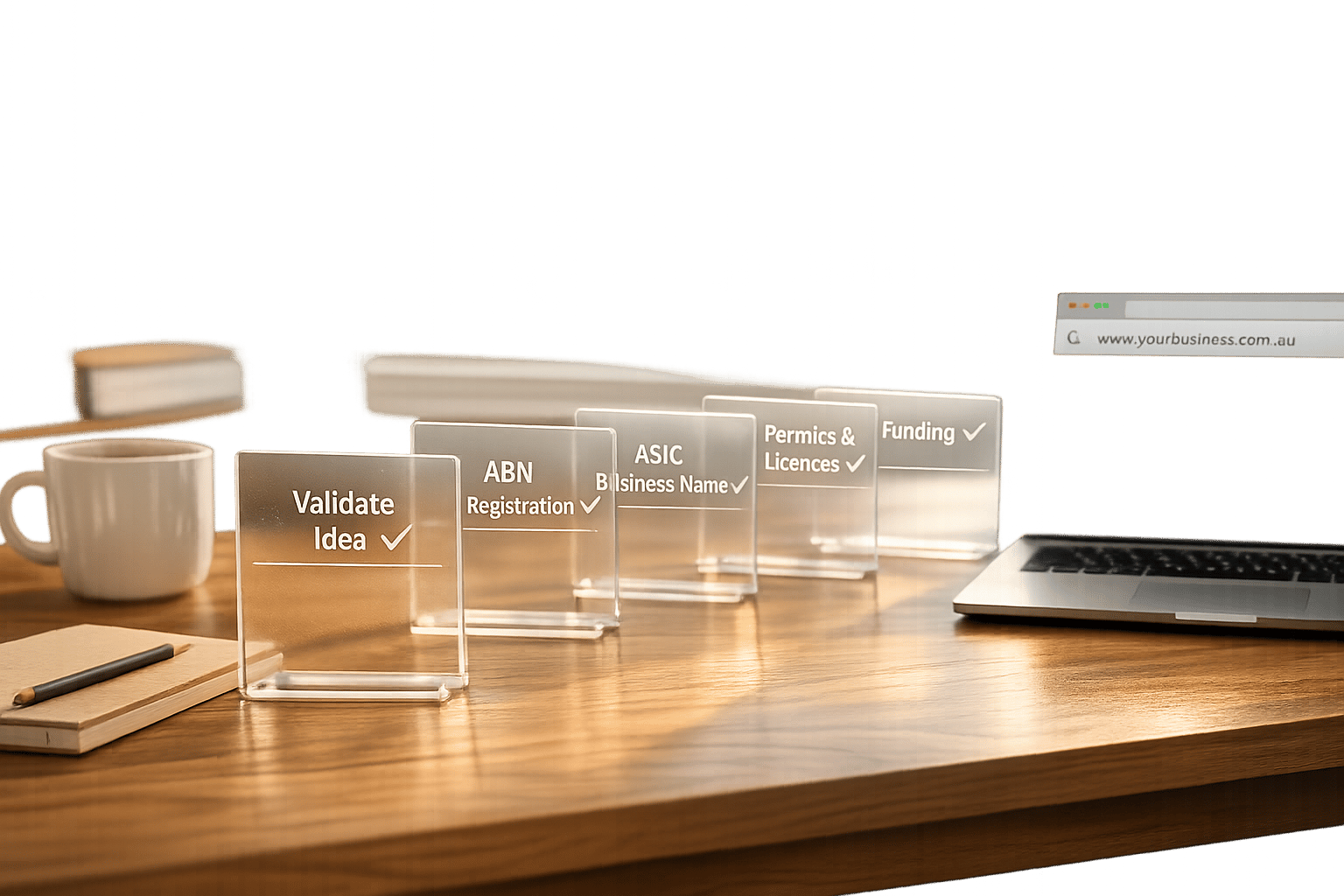
Starting a business in Australia is simpler than you might think. With over 2.5 million small businesses contributing $418 billion annually, the country offers a promising environment for entrepreneurs. Here’s how you can get started step-by-step:
- Validate Your Idea: Ensure your business solves a real problem with market demand. Tools like IdeaFloat can help you assess viability quickly.
- Choose a Business Structure: Decide between sole trader, partnership, company, or trust based on liability, tax, and costs.
- Register Your Business: Obtain an ABN, and register your business name with ASIC if needed. Sole traders can start with $0 setup costs.
- Plan and Research: Conduct market research, create a business plan, and set financial projections. Platforms like IBISWorld and IdeaFloat simplify this process.
- Handle Licenses and Funding: Use ABLIS to identify required permits. Secure funding through savings, loans, or grants, and manage cash flow with a dedicated business account.
- Launch and Build Presence: Create a professional brand, register a domain, and build a website. Establish your online and social media presence to attract customers.
Key Stats:
- Setup Time: 1-2 weeks
- Costs: $0 for sole traders; ~$1,843 for companies
- GST Registration: Mandatory if turnover exceeds $75,000
Follow these steps to navigate the process efficiently and lay the groundwork for success.
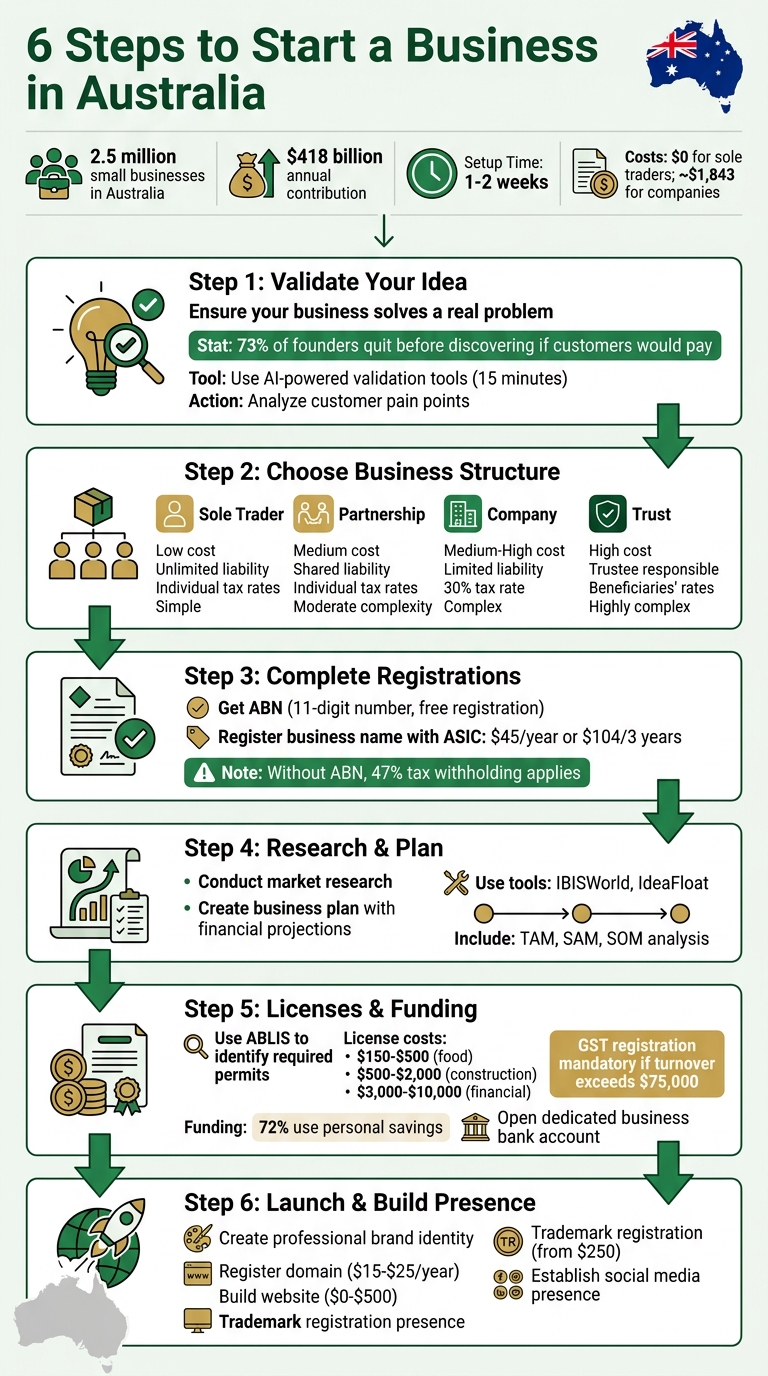
6 Steps to Start a Business in Australia: Complete Beginner's Guide
How to Easily Start a Business in Australia - Complete Beginners Guide to Set Up a Company
sbb-itb-08dd11e
Step 1: Validate Your Business Idea
Before you dive into registering or spending money, make sure your business idea addresses a real problem that people are willing to pay to solve. This isn't about how great the idea sounds; it's about whether it meets an urgent need.
"One of the biggest mistakes is being so attached to your idea that you ignore whether it solves a real problem. A great idea that doesn't address a need won't gain traction." – Stripe
In 2024, the U.S. saw roughly 430,000 new business applications each month. That’s a crowded space. Even more telling, 73% of founders quit before discovering if customers would actually pay for their idea.
Use AI-Powered Tools for Validation
Market research doesn’t have to take weeks or cost a fortune. Platforms like IdeaFloat can condense the process into just 15 minutes. By analyzing demand, identifying gaps in the competition, and providing data-backed insights, it simplifies the validation process. IdeaFloat walks you through four key phases: Problem Validation, Market Opportunity, Financial Viability, and Launch Preparation.
For instance, its Problem Validator tool gauges how urgent the problem is and identifies early demand signals. Meanwhile, the Competitor Analysis feature helps pinpoint underserved areas in the market. A great example of validation in action? When Drew Houston launched Dropbox, he created a short demo video showing how file-syncing worked. That video alone skyrocketed their waiting list from 5,000 to 75,000 overnight. After gathering insights, connect with potential customers to ensure the data aligns with their actual pain points.
Analyze Customer Pain Points and Market Needs
The best way to understand customer needs? Talk to them. Directly. Ask pointed questions like "What’s the hardest part about [task]?" or "What do you wish current solutions did better?". Dive into negative reviews of existing products to uncover specific frustrations. Actions speak louder than words - look for tangible proof like waitlist signups or pre-orders. If interest is lukewarm, the problem might not be pressing enough.
Running a pre-launch campaign with a landing page is another effective way to gauge interest. A click-through rate (CTR) of 2% or higher is usually a solid indicator of demand. For additional insights, tools like IBISWorld can provide detailed industry research and financial benchmarks, especially useful for evaluating commercial viability.
"Market research can help you assess the viability of your business idea. Although your concept may be well intended, it may not be commercially successful in terms of customer demand or cost." – Small Business Development Corporation (SBDC)
Step 2: Choose the Right Business Structure
Once you've validated your business idea, the next step is deciding on a legal structure. This choice impacts your taxes, personal liability, and initial setup costs. In Australia, the four primary options are sole trader, partnership, company, and trust.
Understand Different Business Structures
A sole trader setup is the simplest and most affordable option. You’ll be the sole owner, and taxes are filed under your individual Tax File Number (TFN). However, this structure comes with unlimited personal liability, meaning your personal assets are at risk if the business incurs debt.
Partnerships involve two or more people running the business together. Partners share profits, losses, and responsibility for debts. While a separate TFN is required for the partnership, it’s also essential to have a written agreement that clearly defines each partner's roles and responsibilities.
A company operates as a separate legal entity, meaning it can incur debt, sue, and be sued independently of its owners. This structure provides limited liability, which protects personal assets, but it’s more expensive to establish and maintain. Companies are subject to ongoing fees from the Australian Securities and Investments Commission (ASIC) and a 30% company tax rate. Directors must also apply for a director identification number before their appointment.
Trusts are more complex and typically used for managing assets on behalf of beneficiaries. Setting up a trust requires expert legal advice and can be costly. While trusts are often used for holding property or family assets, they may not be the best fit for most new businesses.
| Feature | Sole Trader | Partnership | Company | Trust |
|---|---|---|---|---|
| Setup Cost | Low | Medium | Medium to High | High |
| Liability | Unlimited (Personal) | Unlimited (Shared) | Limited | Trustee responsible |
| Tax Rate | Individual rates | Individual rates | 30% company tax rate | Beneficiaries' rates |
| Complexity | Simple | Moderate | Complex | Highly complex |
Your choice will influence the registration steps you’ll need to follow, including applying for an ABN and meeting ASIC requirements.
Decide Based on Your Business Goals
If you're starting small with limited upfront investment, becoming a sole trader might be the best route. It’s quick, affordable, and requires minimal paperwork. Many Australian entrepreneurs begin as sole traders and later transition to a company structure as their business grows, offering better protection for personal assets and making it easier to attract investors.
For businesses that carry higher financial risks or face potential legal challenges, opting for a company structure can provide peace of mind by safeguarding your personal assets from the start.
"Your choice of structure will depend on the size and type of business and how you want to run it." – business.gov.au
When in doubt, seek advice from professionals. You can also explore the "Help me decide" tools on business.gov.au to clarify the requirements for your chosen structure. Once you’ve made your decision, you’ll be ready to move forward with the necessary registrations in the next step.
Step 3: Complete Required Registrations
Once you've chosen your business structure, it's time to handle the necessary registrations to legally operate in Australia. Two key steps are obtaining an Australian Business Number (ABN) and registering your business name with the Australian Securities and Investments Commission (ASIC) if you're not trading under your own legal name.
Register for an Australian Business Number (ABN)
An ABN is an 11-digit number that serves as your business's unique identifier. It's essential for tasks like invoicing, claiming GST credits, registering an Australian (.au) domain, and accessing government services. Without an ABN, businesses paying you are required to withhold 47% of payments as tax. The good news? Registering for an ABN is completely free through the Australian Business Register.
Here’s what you’ll need to get started:
- Your Tax File Number (TFN).
- Details about your business structure.
- Information about your business activities.
If you're setting up a company, you'll need to secure an Australian Company Number (ACN) from ASIC before applying for an ABN. Sole traders, however, can streamline the process by using their individual TFN.
The easiest way to register is through the Business Registration Service (BRS). This platform lets you apply for an ABN, business name, and other tax registrations (like GST and PAYG) all at once. Most applications are approved instantly, but in some cases, the Australian Taxation Office (ATO) may manually review your application, which can take up to 20 business days. Once registered, remember to update your details within 28 days if anything changes.
With your ABN secured, the next step is registering your business name.
Register Your Business Name and ASIC Requirements
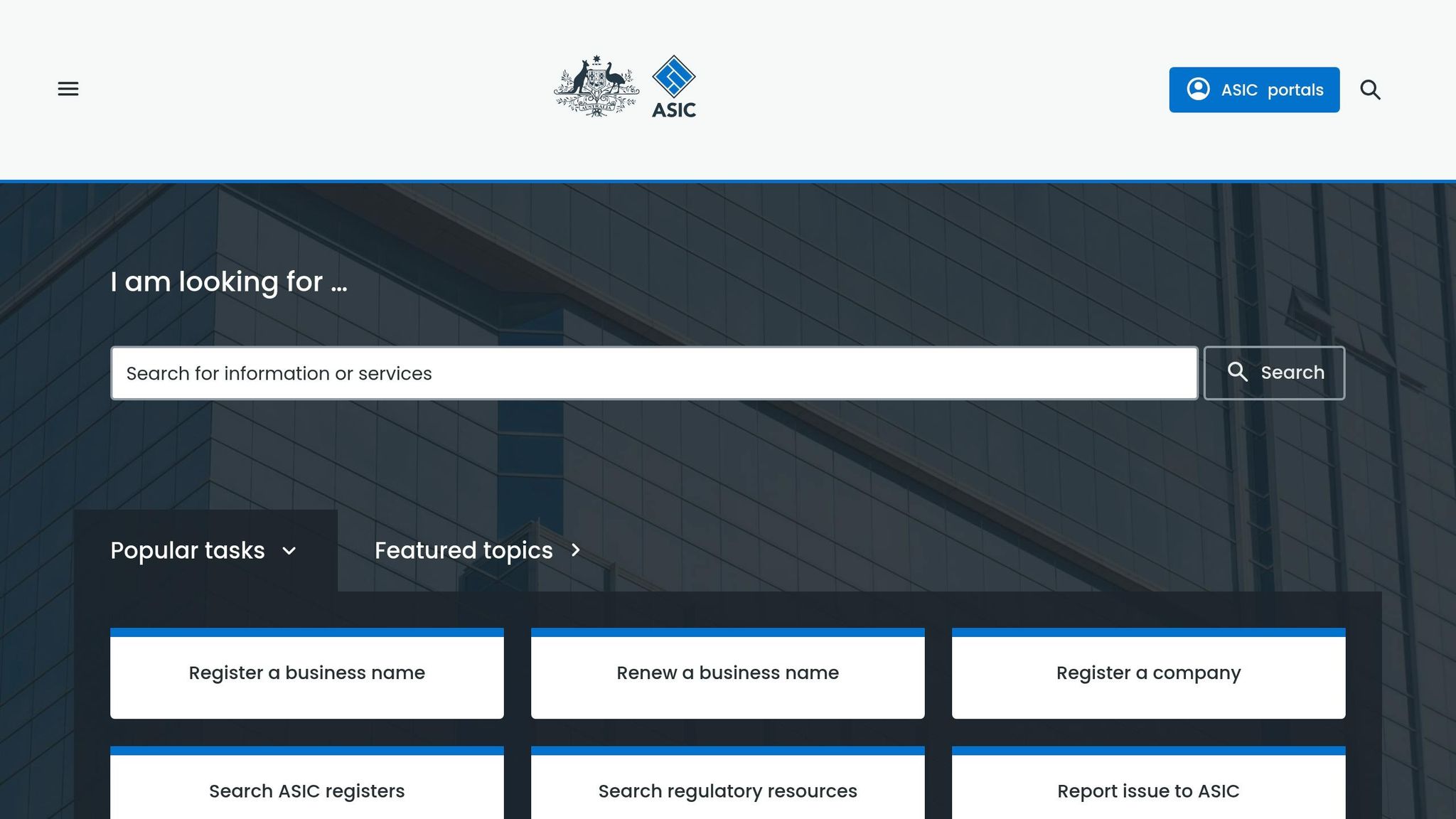
If you're not trading under your own legal name (or all partners' names in a partnership), you'll need to register your business name with ASIC. This step ensures you're compliant with Australian law and helps establish your business's professional presence.
Here’s what you need to know:
- Costs: Registration fees are A$45 for one year or A$104 for three years.
- Prerequisite: You’ll need your ABN (or an ABN application reference number) before registering your business name.
Use ASIC's "traffic light" system to check if your desired business name is available:
- Green: The name is available.
- Amber: The name requires manual assessment.
- Red: The name is unavailable.
Keep in mind, registering a business name doesn’t give you exclusive rights to it. For legal protection, you’ll need to register a trademark with IP Australia. The "TM Checker" tool can help you confirm that your proposed name doesn’t conflict with existing trademarks.
Once your business name is registered, you must display it prominently at any public business location and include it on all official documents like invoices and purchase orders. To save time, you can apply for your ABN and business name simultaneously through the BRS. Payments for registration typically take 2 business days to process for credit cards and up to 5 business days for BPAY or bank transfers.
Step 4: Conduct Market Research and Create a Business Plan
After completing your registrations, it’s time to dive into the strategic work that sets successful businesses apart. Market research ensures your product or service aligns with customer needs, while a well-thought-out business plan acts as your guide to secure funding and shape your strategy.
Conduct Market Research to Understand Your Audience
Market research is all about understanding your audience and the landscape you’re entering. Start by analyzing public data to uncover industry trends and assess the local market. Look at competitors' strengths and weaknesses - what are they doing well, and where are they falling short? Engage directly with potential customers to identify unmet needs and confirm there’s a market for your product. Collect feedback from diverse sources to get a full picture of market sentiment.
To refine your approach, segment your audience and create detailed customer personas. These personas help you focus your marketing efforts and ensure your business resonates with the right people. All of this research lays the groundwork for a business plan that’s built on real, actionable insights.
Use a Business Plan to Guide Your Strategy
Once you’ve gathered market data, your next step is crafting a business plan. While not a legal requirement in Australia, having a plan helps you identify potential challenges and refine your strategy. A strong business plan typically includes:
- Executive Summary: A concise overview of your business (written last).
- Business Overview: Key details about your company and objectives.
- Market Opportunity Analysis: Insights into your target market and competitors.
- Product and Service Descriptions: What you’re offering and how it stands out.
- Operational Plans: How your business will function day-to-day.
- Financial Forecasts: Projections for profit and loss, balance sheets, and cash flow.
Platforms like IdeaFloat can make this process far less time-consuming. Instead of wrestling with Excel spreadsheets for weeks, IdeaFloat uses AI to calculate your Total Addressable Market (TAM), Serviceable Addressable Market (SAM), and Serviceable Obtainable Market (SOM). It pulls data in real-time with verifiable sources and also offers AI-driven pricing research, cost analysis, and financial projections.
"It replaced months of research and Excel modeling with real-time data insights." – Soba, Founder of Bar, Pilates, and Yoga Studio
IdeaFloat allows you to start for free and export a professional business plan, complete with visuals and financial details, in formats like PDF, Word, or PowerPoint. It’s a tool designed to save you time while delivering data-backed results.
Step 5: Secure Required Licenses, Permits, and Finances
Once your business plan is ready, the next step is to sort out the necessary licenses, permits, and finances to get your venture off the ground. Here's how to tackle these tasks effectively.
Identify Licenses and Permits with ABLIS
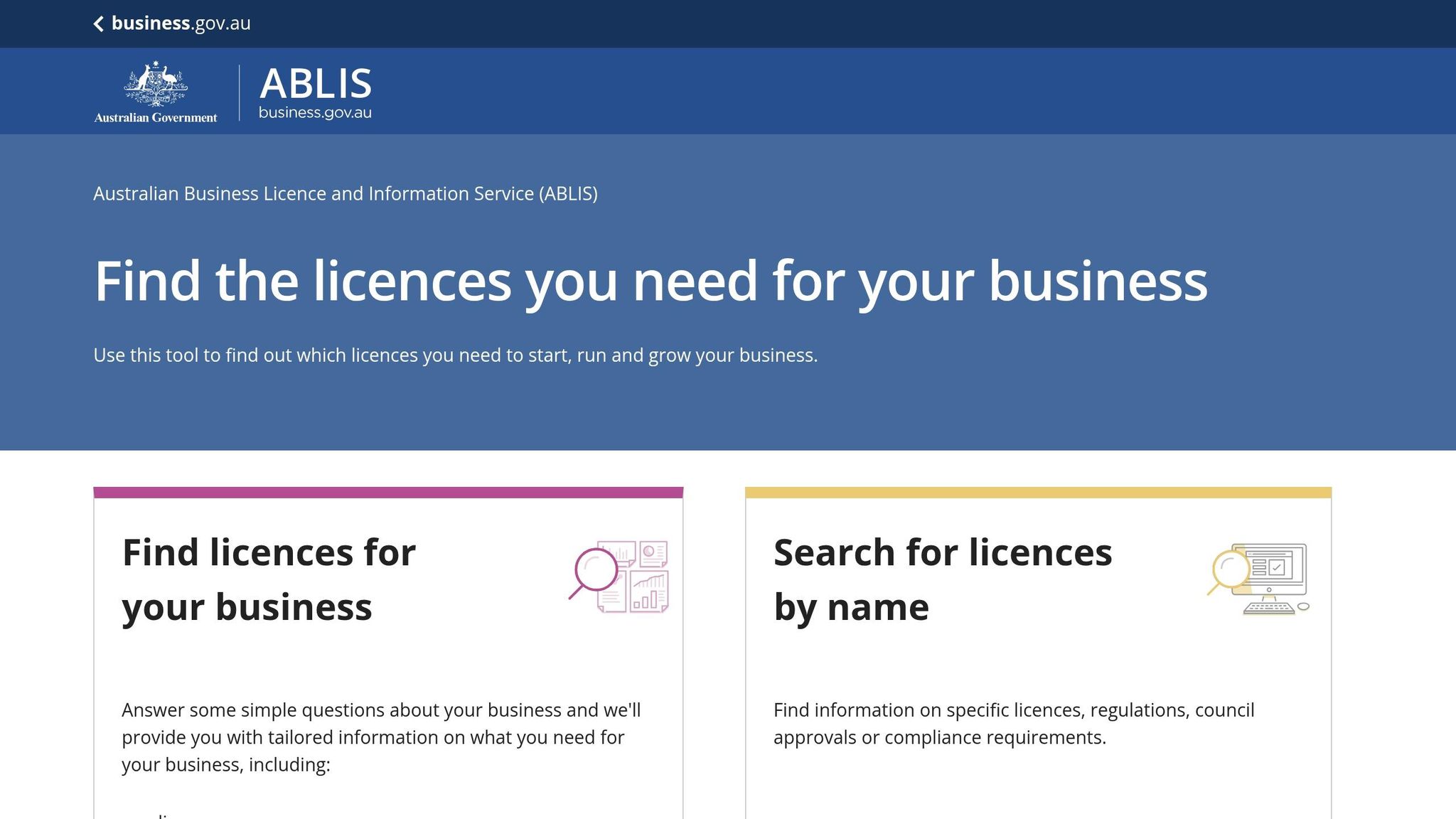
The Australian Business Licence and Information Service (ABLIS) is a handy online tool designed to simplify compliance. It helps you figure out the exact licenses, permits, registrations, and approvals required at federal, state, and local levels. By answering a few questions about your business type, planned activities, and location, ABLIS generates a custom report detailing the relevant regulations and council approvals.
Requirements can vary widely depending on your industry. For instance:
- Food businesses often need council permits and food handling certificates, which typically cost between $150 and $500 annually.
- Construction businesses require White Cards and builder's licenses, with costs ranging from $500 to $2,000 annually.
- Financial services can face higher costs, with an Australian Financial Services License (AFSL) running anywhere from $3,000 to $10,000.
If you're still unsure after using ABLIS, consider consulting an industry association or a professional adviser for guidance.
Key Compliance Notes:
- Hiring employees? Workers' compensation insurance is mandatory, and non-compliance can lead to fines of up to $55,000.
- Expecting an annual turnover of $75,000 or more? You must register for Goods and Services Tax (GST).
With your compliance needs sorted, it’s time to focus on funding.
Secure Initial Funding and Manage Cash Flow
To build a solid financial foundation, include all start-up costs - such as equipment, stock, legal fees, and at least six months of operating expenses - in your budget. Having an accountant or financial professional review your budget is a smart way to ensure accuracy.
After securing your Australian Business Number (ABN), open a dedicated business bank account to simplify tax compliance and manage cash flow efficiently. While this is optional for sole traders, it’s a requirement for companies, partnerships, and trusts. Some banks, like Up Business and Macquarie Business, offer $0 monthly fees, making them a good choice for digital-first sole traders.
When it comes to funding, 72% of Australian entrepreneurs rely on personal savings as their main source. If you need additional financing, consider these options:
- Debt finance: Borrowing money through loans, which must be repaid with interest but allow you to retain full ownership.
- Equity finance: Selling a portion of your business to investors. This doesn’t require repayments but involves sharing profits and control.
Government grants are another avenue worth exploring. Use the "Grants and programs finder" on business.gov.au to search over 500 available supports tailored to your industry and location. Keep in mind that most grants require an ABN and GST registration.
"Investors and lenders will expect some self-funding before they agree to offer you finance." – business.gov.au
To give you an idea of the costs, setting up as a sole trader might require around $617 (covering business name registration, domain, and insurance). On the other hand, registering a Pty Ltd company could cost approximately $1,843 due to company registration fees. Separating your finances early and setting aside funds for taxes will save you headaches down the line.
Step 6: Launch Your Business and Build an Online Presence
Now that your licenses and finances are sorted, it’s time to officially kick off your business. To make an impact from day one, you’ll need a strong brand identity and an online presence that grabs attention and builds trust.
Create a Professional Brand Identity
Your brand is more than just a name - it’s how people recognize and remember your business. Start by picking a name that reflects what you offer and stands out from the competition. Before you get too attached, check its availability using the ASIC business names register and IP Australia's TM Checker to ensure no one else has claimed it.
Keep in mind, registering your business name doesn’t give you exclusive rights. To safeguard your brand, consider registering a trademark, which typically starts at around AUD 250.
Next, secure your digital footprint. Register a domain name that matches your business name, even if you’re not quite ready to launch a website yet. For ".com.au" or ".net.au" domains, you’ll need to provide your ABN or ACN. Domain registration generally costs between AUD 15 and AUD 25 per year. Don’t forget to claim matching social media handles to ensure your branding is consistent across platforms.
If you’re not sure where to start with visuals, tools like IdeaFloat's Logo Generator can help you design a professional logo and establish brand guidelines, giving your business a polished look from the outset.
Once your branding is in place, it’s time to focus on building your online presence.
Build a Website and Launch Online
Your website is often the first interaction customers will have with your business, so it’s important to make a great impression. A user-friendly design with clear navigation and straightforward language is key. If you’re going the DIY route, setting up a website can cost anywhere from AUD 0 to AUD 500. Use pre-designed templates, high-quality images, and concise content to create a site that’s both functional and appealing.
Before launching, test your website thoroughly to catch any errors and ensure it has strong security measures in place to protect customer data and transactions. Once live, focus on good design, compelling content, and a consistent social media presence to improve your search rankings and visibility. Instead of trying to be everywhere online, use market research to identify one or two platforms where your target audience is most active.
For an extra boost, tools like IdeaFloat's Waitlist Landing Page can help you create a page with persuasive copy that captures emails and builds anticipation before your official launch. Their Community Launch Map can also provide tailored suggestions for online communities where your potential customers are active, complete with ready-to-use posts to drive traffic to your business. Lastly, set up a Google Business Profile to connect with local customers and enhance your visibility during the launch phase.
Conclusion
Starting a business in Australia can be straightforward when you approach it step by step. Begin by validating your idea, selecting the right business structure, completing necessary registrations, conducting thorough market research, obtaining permits and funding, and building a strong online presence. Each of these steps lays the groundwork for turning your idea into a functioning business.
Funding, in particular, can take time to secure. It's wise to plan ahead and aim for a six-month cash reserve to protect against cash flow challenges - one of the top reasons businesses fail. On the bright side, setting up a new business in Australia typically takes just one to two weeks, so there’s no need to put off getting started.
Tools like IdeaFloat can make this process much easier. It helps validate your idea with real market data, creates professional logos, builds waitlist landing pages with compelling copy, and even pinpoints the online communities where your target customers are active. With IdeaFloat, you can move from concept to customers 10 times faster.
Thousands of entrepreneurs have stood where you are now and taken the leap. There’s no better time to start building your dream - don’t let overthinking hold you back.
FAQs
Do I need an ABN before I can start selling?
Yes, you absolutely need an Australian Business Number (ABN) before you start selling in Australia. It's one of the first steps in setting up a business and is crucial for both trading and tax purposes. Without an ABN, you might run into issues like being unable to issue invoices properly or claim tax credits.
Should I start as a sole trader or register a company first?
Choosing whether to operate as a sole trader or register a company depends on what you want to achieve with your business. Being a sole trader is straightforward and quick to set up, making it a great choice if you're just starting out or testing a business idea. You'll need an ABN (Australian Business Number) and possibly a TFN (Tax File Number).
On the other hand, registering a company involves more formal steps, including registration with ASIC (Australian Securities and Investments Commission). This option is better suited for those who want limited liability protection or have plans to grow their business significantly. Many entrepreneurs begin as sole traders and switch to a company structure later as their business expands.
What licenses or permits do I need for my business type?
The licenses and permits your business needs in Australia will vary based on factors like your business type, activities, and location. To figure out exactly what applies to you, the Australian Business Licence and Information Service (ABLIS) is a helpful tool.
In some cases, you might also need additional approvals for specific activities or measures to protect both your business and employees. For personalized guidance, it’s a good idea to consult with your industry association or a business adviser. They can help ensure you meet all the necessary legal requirements.
Related Blog Posts
- Best Small Business Ideas in Australia Under $5,000
- What Business Can You Start in Australia With $10,000? 15 Realistic Ideas for 2026
- Best Small Business Ideas in Australia Under $30,000
- Best Business Ideas in Australia for Couples Starting Together