Starting a mobile car detailing business can generate meaningful profits in just three months if managed well. Here's what you need to know:
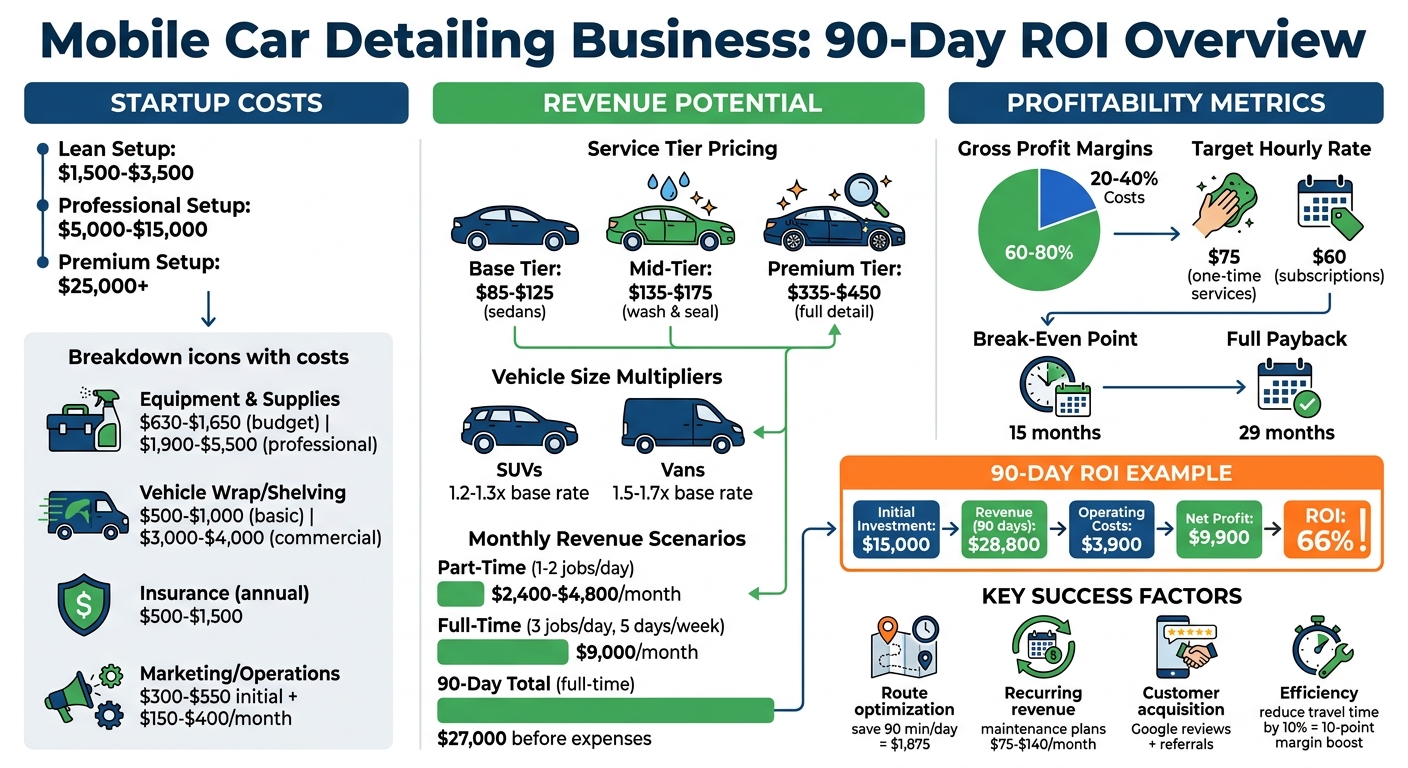
- Startup Costs: Initial investment ranges from $1,500 (lean setup) to $25,000+ (professional-grade operation).
- Revenue Potential: Part-time work can bring in $2,400–$4,800/month, while full-time operators might earn $9,000/month or more.
- Profit Margins: Gross margins often range from 60–80%, with break-even typically at 15 months and full payback in 29 months.
- Customer Acquisition: Start with friends and family, leverage Google reviews, and expand through referrals and targeted ads.
- Efficiency Tips: Optimize routes, track billable hours, and focus on recurring revenue like maintenance plans.
Mobile Car Detailing Business 90-Day ROI Breakdown: Costs, Revenue & Profit Margins
Starting a Mobile Car Detailing Business with $500
sbb-itb-08dd11e
Startup Costs: What You Need to Get Started
Your startup costs will have a direct impact on your 90-day ROI. Whether you’re testing the waters with a lean launch or going all-in to scale quickly, your initial investment matters. If you already own a reliable truck or SUV, you can get started for around $1,500 to $3,500. Without a dedicated vehicle, your investment could range from $5,000 to $15,000 for a fully equipped mobile setup. This difference reflects whether you’re validating your business idea or diving straight into growth.
Let’s break down the key costs for equipment, vehicles, and operations.
Equipment and Supplies
The basics of your toolkit include a pressure washer (1,000–1,500 PSI), a dual-action polisher, a wet/dry vacuum, and a generator. If you’re working with a budget, expect to spend $630–$1,650 on equipment and an additional $425–$2,450 on chemicals and supplies. For those aiming for a professional-grade setup, costs can climb to $1,900–$5,500, with similar add-ons for supplies.
"The detailers who spend six months researching the 'perfect' equipment list before doing a single car are usually the ones who never launch at all." – ACG Pro Hub
A $2,000 setup can produce professional results, provided you focus on honing your technique rather than chasing brand names. Starting with entry-level equipment is a smart move - reinvest profits into premium gear only after you’ve built up demand.
Vehicle and Insurance
While a wrapped cargo van is ideal, any reliable vehicle will do when you’re starting out. A basic wrap and shelving setup costs $500 to $1,000, while a full commercial conversion can run $3,000 to $4,000. If you’re purchasing a dedicated van, expect to pay between $5,000 and $35,000 for a used model, depending on its condition and age.
Insurance is a must-have. General liability coverage typically costs $500–$1,500 annually for solo operators. You might also consider garage keepers liability, which covers damage to customer vehicles in your care. To avoid unexpected downtime from repairs, set aside 1% to 2% of your revenue from each job as a maintenance reserve.
Marketing and Operational Costs
Once your setup is ready, ongoing operational costs will keep your business running smoothly. Start by creating a free Google Business Profile - it’s essential from day one. Building a website and forming an LLC will set you back around $300 to $550 combined. Monthly expenses include fuel ($200 to $400), phone service, and marketing. Social media advertising, like Facebook Ads, can be as low as $150 per month, but many detailers rely heavily on word-of-mouth and Google reviews. Even a modest ad spend can drive sales, such as gift cards.
To simplify tax and financial management, open a dedicated business bank account right away.
Revenue Projections: Service Tiers and Pricing Models
Your pricing structure is the backbone of your 90-day ROI. Offering multiple service tiers helps capture a broad range of customers - from those looking for affordable options to those ready to pay for premium services.
Service Tiers and Pricing Structure
Many successful mobile detailers rely on a three-tier pricing model that scales based on vehicle size. Here's a breakdown:
- Base tier: Quick maintenance washes, priced between $85–$125 for sedans.
- Mid-tier: Wash and seal packages with paint protection, ranging from $135–$175.
- Premium tier: Full detailing with deep cleaning and polishing, priced at $335–$450.
This structure is designed around a target hourly rate of $75 for one-time services, ensuring profitability.
When adjusting for vehicle size, apply a multiplier:
- SUVs and crossovers: 1.2–1.3x the base rate.
- Vans: 1.5–1.7x the base rate.
For example, a sedan full detail priced at $335 would increase to $400–$435 for an SUV and $500–$570 for a van. These adjustments account for the extra time and materials required for larger vehicles.
Monthly maintenance subscriptions are another way to stabilize your income. These should be priced between $75–$140 per month, depending on the vehicle size. While the hourly rate for subscription services drops to around $60 per hour, the steady revenue and lower customer acquisition costs make it a worthwhile trade-off.
Revenue Scenarios
Let’s look at some potential earnings:
- Part-time work: Completing 1–2 jobs per day at an average of $120 can bring in $2,400–$4,800 per month.
- Full-time work: With 3 jobs per day, 5 days a week, averaging $150 per job, you could generate $9,000 per month, or $27,000 in 90 days before expenses.
Specialty services like paint correction and ceramic coatings offer another revenue stream but follow a different pricing model. For instance, handling 3 cars a week at $1,200 per car could generate $14,400 per month. These services require advanced skills and targeted marketing but can significantly boost your income.
Solo mobile detailers often achieve 60–80% gross profit margins. For example, earning $9,000 per month translates to $5,400–$7,200 in gross profit after covering direct costs.
"The difference between operators earning $90,000–$150,000+ annually and those struggling to break even lies in market positioning, pricing strategy, and digital differentiation." – Lovable Team
Customer Acquisition: Building a Client Base in 90 Days
Once you've nailed down your startup costs and revenue model, the next big step is getting your first customers. Those initial 90 days are all about using budget-friendly marketing tactics that actually work. Start with free methods to get the ball rolling, and then gradually introduce paid strategies as you gain momentum.
Days 1-30: Setting Up Your Presence
Your first 10–20 customers will likely come from people you already know. Offer your services to friends, family, and coworkers at a small discount in exchange for honest reviews and referrals. This phase isn't about making big profits - it's about building credibility. Use this time to gather before-and-after photos and secure those all-important Google reviews.
One of the first things you should do is create a Google Business Profile. This will help you show up in local searches like "mobile detailer near me", which is crucial for long-term growth. After every job, ask customers to leave a review - Google reviews play a huge role in boosting your visibility.
Get active in local Facebook groups and car enthusiast pages to promote your services. Instead of slashing prices, offer launch specials like free add-ons (think headlight restoration or engine bay cleaning). This helps build excitement without cheapening your brand. Avoid setting rock-bottom prices just to gain experience, as it can attract customers who might leave when you eventually raise your rates.
"Your first ten customers come from people who already trust you. Detail vehicles for friends, family, and coworkers at a modest discount in exchange for honest reviews and referrals."
– Lovable Team
Days 31-60: Growing Your Customer Base
Once you have a handful of reviews and some social proof, it's time to widen your reach. A referral program can be a game-changer. Offer incentives like $50 credits for both the referrer and the new customer to turn your happy clients into your biggest promoters.
For example, the mobile detailing brand Detaild, led by Sam R., used branded gift boxes to boost referrals. These $5 boxes included a thank-you postcard with a QR code for reviews, a $25 referral coupon, and branded keychains. This simple strategy helped them generate over $30,000 in revenue within their first four months.
You can also partner with local businesses like car dealerships, real estate agents, or office complexes. Offering them a commission or discount for referrals can help you tap into their networks. Another idea? Use door hangers in upscale neighborhoods to reach potential customers who might not be active on social media. And don’t forget to post daily transformation photos on Instagram to show off your skills and stay visible to car enthusiasts.
Days 61-90: Expanding with Paid Advertising
By now, you’ve built a solid foundation. This is the perfect time to test the waters with paid ads to scale up your bookings. Start with Facebook ads, which can be highly cost-effective. On average, these campaigns can generate leads for about $4.59 each.
Take this example: an 84-day campaign with a daily ad spend of $27 brought in nearly 500 qualified leads. Focus your ads on high-intent searches like "mobile car detailing near me" and target affluent neighborhoods. Keep track of which ads lead to actual bookings, and continue to encourage reviews and post photos of your work. These efforts will help you rely less on paid ads over time.
"Thanks to Modall, our phone was ringing all summer and we had a constant stream of clients. They built our brand and handled the marketing so effectively that we could focus solely on delivering a high-quality service."
– Sam R, Owner & General Manager, Detaild
Maximizing ROI: How to Improve Efficiency and Profit
Profitability isn't just about working harder - it's about working smarter. While startup expenses and gaining customers are crucial early steps, operational efficiency is what truly drives profits in those critical first 90 days. For instance, every 15 minutes spent driving instead of detailing could cost you around $1,875. By fine-tuning how you schedule, manage customers, and handle unexpected disruptions, you can significantly improve your bottom line. These strategies build on earlier discussions about revenue and customer acquisition by zeroing in on efficiency.
Route Optimization
Efficient scheduling is a game-changer for mobile car detailing services. Instead of taking jobs as they come, focus on grouping appointments by zip code. This simple adjustment can lower your fuel and maintenance costs from 70% of revenue to 60%, giving you a 10-point margin boost.
Time lost to travel has a direct impact on your earnings. For example, if you lose 90 minutes between jobs, a $300 detailing job could effectively pay out just $33 per hour. For technicians traveling two hours daily, that’s eight 15-minute blocks of billable time lost.
To combat this, use booking software that prioritizes geographic density and minimizes travel time. You might also consider offering performance bonuses for completing multiple jobs within a tight radius. Even small improvements, like shaving five minutes off setup and breakdown times, can add up fast. If your service uses vans, ensure they can fit into parking structures to avoid wasting time searching for legal parking in urban areas.
"Reducing travel time between jobs is the single biggest operational lever for your Mobile Car Detailing service right now."
– Brooke Weddle, Financial Analyst
Optimizing your routes doesn’t just save time - it sets the stage for building consistent, recurring revenue.
Recurring Revenue Strategies
Recurring revenue is the backbone of a stable business. Subscriptions and maintenance plans not only provide predictable income but also boost customer loyalty. Solo detailers who focus on these plans often see gross profit margins between 60% and 80%.
To jumpstart this strategy, offer your first 10 customers a 20% discount on maintenance plans during your first 30 days. Experiment with pricing tiers like $150, $300, or $450, and consider offering an annual prepay option with a 10–15% discount. This approach secures upfront cash for investments while locking in long-term customers.
Once your processes are running smoothly, shift your focus to fleet contracts. These contracts provide consistent work schedules and professional invoicing, which can help scale your business. Take Fabian, the founder of 2LC Detail in Midland, Texas, as an example. Starting with just $299 in December 2022, he transitioned from retail customers to fleet contracts. By April 2026, his business had grown to 23 employees and was generating $60,000 to $70,000 in monthly recurring revenue. One key win? A contract for 800 employee vehicles and 1,300 commercial vehicles for a major oil and gas company - all while maintaining profit margins of 70–80%.
"Retail customers are the hard way to grow. Fleet contracts are the easy way to scale."
– Fabian, Founder, 2LC Detail
Weather Contingencies and Resource Management
Weather disruptions can wreak havoc on your schedule and income. To minimize losses, implement escrow-based payments and set clear cancellation policies. Use integrated platforms that automate rescheduling and track rebooking rates, ensuring you don’t lose customers during unexpected weather events.
Modern weather-aware scheduling tools can send automated reminders and manage rescheduling, streamlining your process. Many platforms combine booking, payment processing, and weather tracking into one system, making it easier to maintain consistent service. Additionally, offering maintenance plans with 30-day rebooking cycles can provide a steady revenue stream, helping to offset weather-related cancellations.
Keep an eye on your rebooking rate as a critical metric. Regular customers are the backbone of your business, especially when unpredictable weather impacts your operations.
Conclusion: Calculating Your 90-Day ROI
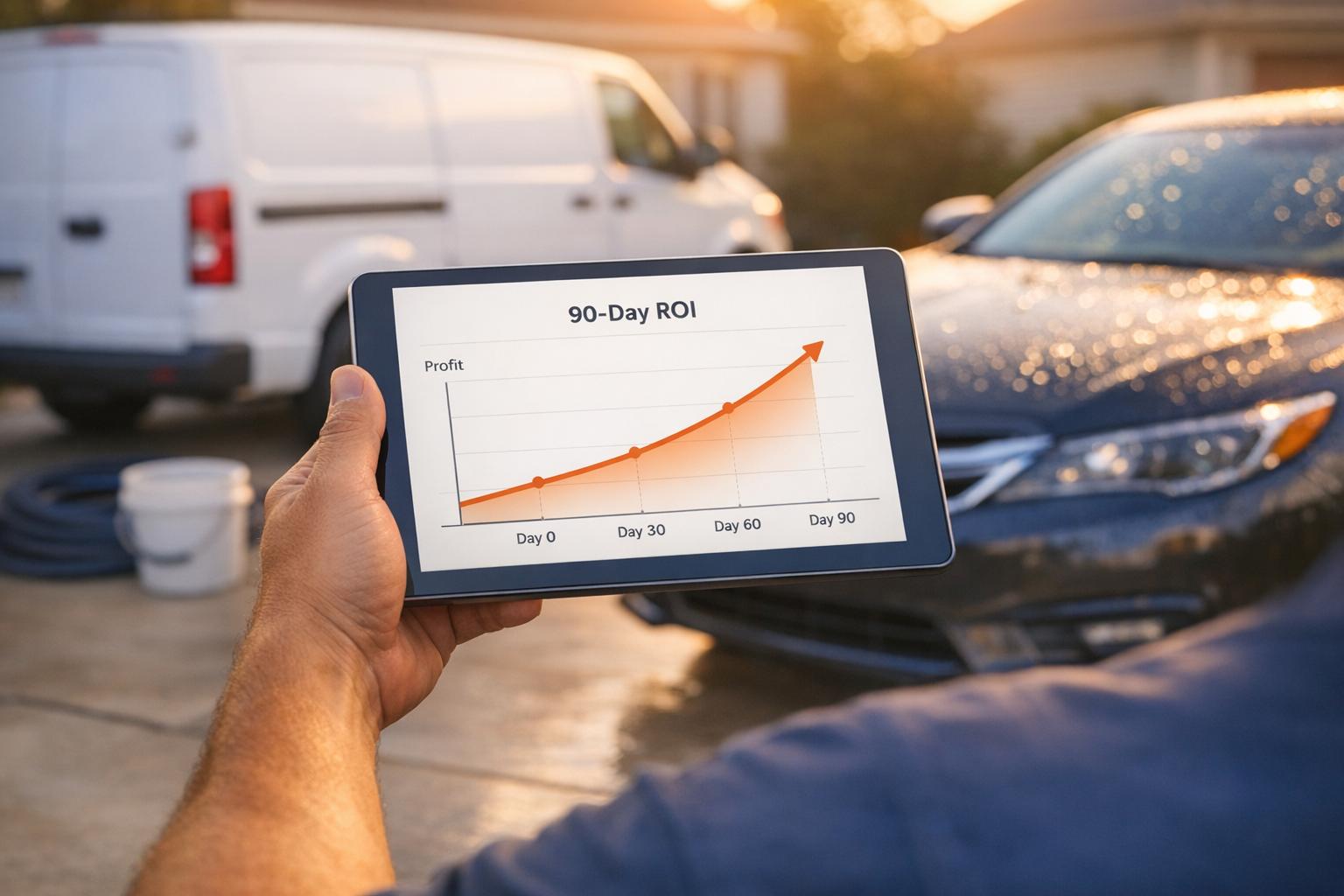
To calculate your 90-day ROI, compare your net profit to your initial investment. Start by subtracting your startup costs and three months of operating expenses from your revenue. Then, divide that result by your initial investment to determine your ROI percentage.
Here’s an example: If your setup costs were $15,000, and you completed three jobs per day at $160 each over 90 days, your revenue would total $28,800. After subtracting $3,900 in operating costs, your net profit would be $9,900. That works out to a 66% ROI. While this is a great starting point, remember that long-term success depends on how well you manage your operations.
As highlighted in earlier sections, factors like equipment reliability, efficient scheduling, and pricing strategies directly impact your ROI. For instance:
- Maximize billable hours: Focus on earning time instead of wasting hours in transit.
- Keep equipment reliable: Avoid downtime by ensuring your tools are always in working order.
- Set smart prices: Charge rates that reflect your value rather than undercutting competitors.
- Limit your service area: A smaller geographic range helps reduce fuel and travel costs.
"A one-person detailing business can bring in as much as $90,000 per year." – The Mobile Tech RX Team
From day one, track your numbers using business apps that can help identify inefficiencies and measure performance. Allocate 1–2% of each job's revenue for tool maintenance to prevent unexpected breakdowns. Additionally, maintain a financial buffer to cover slower weeks. These steps are crucial for staying profitable and avoiding early business struggles.
FAQs
How many jobs do I need to break even in 90 days?
To cover your startup costs within 90 days, you’ll need to complete about 3 to 4 jobs. This calculation is based on an average job price ranging from $120 to $150, factoring in typical expenses and projected earnings during that timeframe.
What should I charge when I’m brand new?
When you're just getting started as a mobile car detailer, charging about $150 per full-service job is a good starting point. This price fits within industry norms and ensures you can cover expenses while attracting new clients.
If you're working on your own, a typical range is $100–$150 per job. As you build experience and establish a solid reputation, you can slowly raise your rates to match your expertise and the demand for your services.
What expenses do most new detailers forget?
New detailers sometimes miss crucial startup costs, including equipment, vehicle setup, legal requirements, insurance, supplies, fuel, and marketing. These expenses can pile up fast, often falling between $5,000 and $15,000. Planning your budget carefully for these necessities is key to preventing unexpected hurdles and getting your business off to a strong start.
Related Blog Posts
- How to Start a Mobile Car Detailing Business: Complete Guide
- How to Start a Mobile Car Detailing Business: From $0 to $5K/Month
- Mobile Detailing Startup Costs: Packages, Pricing, Profit
- How to Start a Mobile Car Detailing Business: From $0 to $5K/Month