
The Profit First™ method is a financial system that prioritizes profit by allocating it first, rather than treating it as what's left over after expenses. Created by Mike Michalowicz in 2014, this approach helps business owners manage cash flow effectively, ensure they're paid, and set aside taxes - without overspending.
Key Takeaways:
- Formula Shift: Traditional accounting is Sales – Expenses = Profit. Profit First flips it to Sales – Profit = Expenses.
- Separate Accounts: Use five accounts - Income, Profit, Owner's Pay, Tax, and Operating Expenses - to organize funds.
- Allocation Percentages: Start with small percentages (e.g., 5% for profit, 50% for owner’s pay) and adjust gradually.
- Twice-Monthly Allocations: Distribute income on fixed dates (10th and 25th) to maintain discipline and track progress.
This system works for businesses of all sizes and helps avoid common pitfalls like overspending, neglecting profit, or scrambling for tax payments. By focusing on intentional money management, you can build a sustainable foundation for growth.
Core Principles of the Profit First™ Method
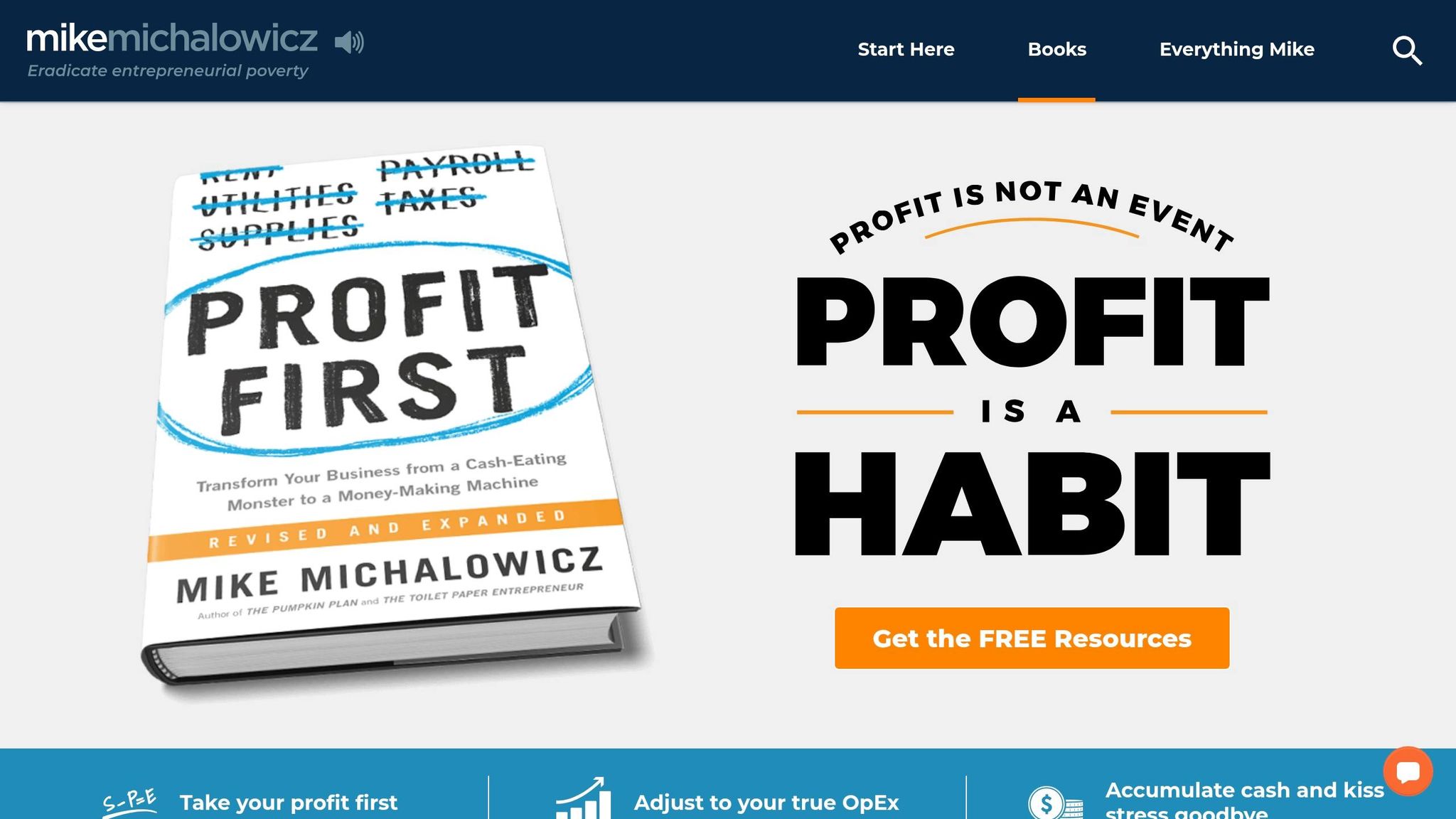
The Formula Shift: Sales – Profit = Expenses
The traditional accounting formula - Sales – Expenses = Profit - often leaves profit as an afterthought. Essentially, you’re left with whatever remains after covering expenses, which is usually not much.
The Profit First™ method flips this on its head: Sales – Profit = Expenses. Here’s the difference: you prioritize profit by taking it out first, then manage your business expenses with what’s left. This approach forces you to be more intentional with spending. A tighter budget helps you focus on what truly matters. Anna Noa of Patrick Accounting explains it well:
"By taking profit first and setting it aside, you adjust your budget to what's actually available for expenses, not the other way around."
This mindset shift is the foundation for the method’s practical steps.
Using Dedicated Bank Accounts
The reason this system works? It’s all about separating your money into specific accounts. Each account has a clear purpose, which reinforces the discipline needed to stick to the Profit First™ strategy.
Here are the five key accounts:
- Income: The account where all revenue is deposited before being distributed.
- Profit: Money set aside as a reward and reserve, distributed quarterly.
- Owner's Pay: Your salary for the work you do in the business.
- Tax: Funds reserved for taxes, ensuring you’re prepared for IRS obligations.
- Operating Expenses (OpEx): The only account used for paying business bills.
The OpEx account is particularly important because it acts as a natural limiter. If this account runs low, it’s a signal to cut costs or boost revenue - not to borrow from your profit or tax funds.
"Profit is not an event. Profit is a habit." - Mike Michalowicz, Author of Profit First
Allocating Income Using Fixed Percentages
Every business has unique financial dynamics, which is why Profit First uses two sets of percentages: Current Allocation Percentages (CAPs) and Target Allocation Percentages (TAPs). CAPs show how your money is currently being distributed, while TAPs represent your financial goals.
The difference between CAPs and TAPs is essentially your roadmap. You don’t have to reach your TAPs overnight. Gradual adjustments work better and reduce cash flow strain. For example, you can increase your Profit allocation by 1% each quarter and reduce OpEx by the same amount. Below are the recommended TAPs based on revenue levels:
| Real Revenue | Profit | Owner's Pay | Tax | Operating Expenses |
|---|---|---|---|---|
| Under $250,000 | 5% | 50% | 15% | 30% |
| $250,000 – $500,000 | 10% | 35% | 15% | 40% |
| $500,000 – $1M | 15% | 20% | 15% | 50% |
| $1M – $5M | 20% | 10% | 15% | 55% |
| Over $5M | 25% | 5% | 15% | 55% |
Source: Mike Michalowicz, Profit First [1]
By following these percentages and adjusting gradually, you can build a sustainable financial structure for your business.
Setting an Allocation Schedule
Sticking to a consistent schedule is key to making this system work. Instead of moving money around whenever revenue hits your account, the Profit First method recommends allocating funds twice a month, on the 10th and 25th. This regularity simplifies cash flow management and curbs the temptation to spend whatever’s sitting in the bank.
This schedule also doubles as a built-in review system. Twice a month, you’ll see exactly how much money came in and where it’s going. It’s a simple habit that boosts financial awareness without requiring hours of bookkeeping.
sbb-itb-08dd11e
Profit First™: Practical Steps for Small Business Financial Success
Step-by-Step Guide to Setting Up Profit First™
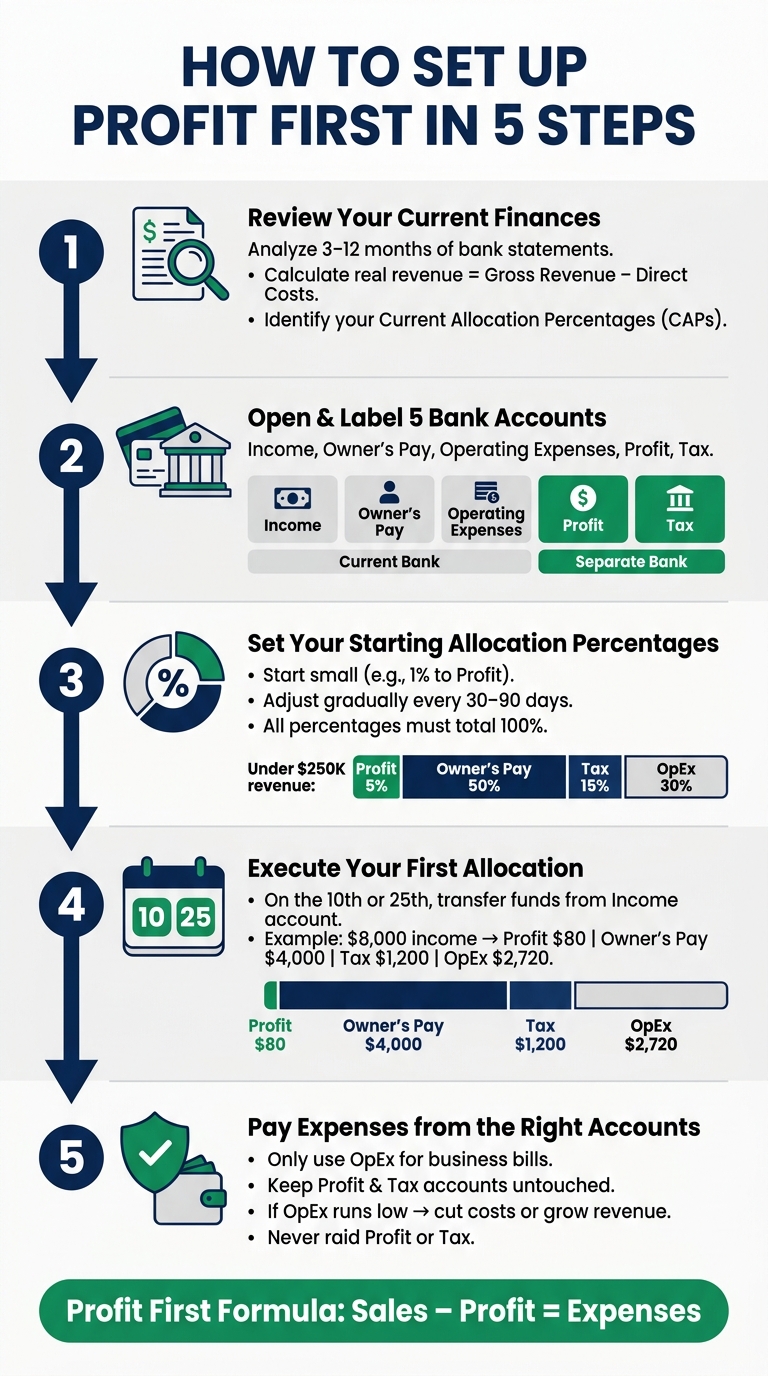
Profit First Method: 5-Step Setup Guide for New Business Owners
Step 1: Review Your Current Finances
Profit First™ flips the usual financial approach by prioritizing profit allocations before expenses. Start by reviewing your last 3–12 months of bank statements to identify your current allocation percentages (CAPs) - essentially, how your money is currently divided among profit, owner's pay, taxes, and operating expenses.
To calculate your real revenue, subtract direct costs from your gross revenue. This figure serves as the foundation for all future allocations. While reviewing your finances, keep an eye out for recurring charges, such as subscriptions or automatic payments.
This step provides a clear understanding of your financial habits and sets the stage for creating dedicated bank accounts.
Step 2: Open and Label Your Bank Accounts
With your financial review complete, it’s time to set up specific bank accounts for Profit First™. Use your current business checking account as your Income account to avoid the hassle of updating payment information with clients or vendors. Keep your Owner's Pay and Operating Expenses accounts at your primary bank, but open Profit and Tax accounts at a separate bank. This separation helps minimize the temptation to dip into these funds. Clearly label each account for its purpose: "Profit", "Tax", "Owner's Pay", and "OpEx."
| Account | Account Type | Recommended Bank |
|---|---|---|
| Income | Checking | Current bank |
| Profit | Savings | Different bank |
| Owner's Pay | Checking | Current bank |
| Tax | Savings | Different bank |
| Operating Expenses | Checking | Current bank |
Step 3: Set Your Starting Allocation Percentages
Compare your CAPs with the target benchmarks outlined earlier. Start with small, manageable adjustments - such as allocating 1% to your Profit account - to build the habit gradually over 30 to 90 days. Ensure your total allocations add up to 100%. If your business has outstanding debt, include debt payments within your Operating Expenses allocation, rather than pulling from your Profit or Tax accounts.
Once you’ve finalized your percentages, you’re ready to make your first allocation.
Step 4: Execute Your First Allocation
Choose an allocation day - usually the 10th or 25th of the month - and calculate the total deposits in your Income account. Apply your percentages to distribute funds to the appropriate accounts. For example, if you’ve received $8,000 and your allocation percentages are 1% for Profit, 50% for Owner's Pay, 15% for Tax, and 34% for Operating Expenses, the transfers would look like this:
- Profit: $80
- Owner's Pay: $4,000
- Tax: $1,200
- Operating Expenses: $2,720
Lisa Van Gemert, founder of The Gifted Guru in Arlington, TX, shared her experience with setting up Profit First:
"Implementing Profit First took me 30 minutes to set up and has given me a huge sense of peace. The biggest difference really isn't even in the numbers. The biggest difference for me is in the weight off my mind."
Step 5: Pay Expenses from the Right Accounts
Consistency is key. After making your allocations, only use your Operating Expenses account for daily business expenses like software, rent, payroll, or marketing. The Income account should be reserved exclusively for receiving and distributing funds, while the Profit account remains untouched until your quarterly distribution. Similarly, the Tax account is strictly for tax payments.
If your Operating Expenses account runs low before the next allocation day, take it as a signal to cut costs or find ways to boost revenue. Avoid borrowing from the Profit or Tax accounts - this discipline is essential for long-term success with the Profit First™ system.
Applying Profit First™ to AI-Powered Startups Using IdeaFloat

Budgeting for AI Tools and SaaS Subscriptions
For AI-powered startups, software expenses can quickly drain cash reserves if not managed carefully. Tools for automation, customer research, market analysis, and financial modeling all fall under Operating Expenses (OpEx) in the Profit First framework. This means that every SaaS subscription must fit within the OpEx allocation after setting aside funds for profit, taxes, and the owner's pay.
This constraint encourages thoughtful spending. If your OpEx account can't accommodate a new AI tool, you'll need to make a choice: cancel an underused subscription, negotiate better pricing, or boost revenue. Performing a quarterly SaaS audit - evaluating which tools deliver real value and cutting those that don’t - helps keep your OpEx lean and purposeful. These budgeting challenges offer a chance for IdeaFloat to help fine-tune your allocation strategy.
Using IdeaFloat to Set Realistic Allocation Percentages
IdeaFloat’s Financial Model and Cost Analysis tools bring clarity to your budgeting process by grounding your decisions in actual data. These tools align perfectly with the Profit First framework, which relies on disciplined allocation for sustainable growth. The Cost Analysis feature lets you account for all expenses - from hosting fees to contractor payments - so you know your exact monthly burn before deciding on allocations. Meanwhile, the Financial Model provides a complete view of revenue, expenses, and leftover funds, making it easier to compare your spending habits against the recommended targets.
With these insights, IdeaFloat helps you determine whether your current cost structure fits within your OpEx limits or if adjustments are needed to stay on track.
Combining AI Insights with Financial Discipline
Once your allocation percentages are set, IdeaFloat takes it a step further with AI-powered insights. Features like the Product & Service Creator and Advanced Pricing Research help founders pinpoint high-margin offerings while identifying services that quietly strain the OpEx budget. By combining these insights with the structured discipline of Profit First, startups can make smarter financial decisions and consistently act on them with confidence.
Tracking Progress and Avoiding Common Mistakes
Reviewing Your Allocations Each Month
To keep the Profit First™ method effective, it’s crucial to track your progress regularly. Each month, compare your Current Allocation Percentages (CAPs) with your Target Allocation Percentages (TAPs). This helps ensure your expenses stay in check and your profit targets are being met. Take time to review your account balances and calculate the percentage of your real revenue that has been allocated to each account. If your Profit account consistently falls short of its TAP, it’s a red flag that your expenses might be too high. These monthly reviews are essential for gradually increasing your profit targets over time.
Gradually Raising Your Profit Percentage
A good rule of thumb is to increase your profit allocation by 1% every quarter while reducing Operating Expenses (OpEx) by 2%. For businesses earning less than $250,000 in annual real revenue, a common allocation might look like this: 5% for profit, 50% for owner’s pay, 15% for taxes, and 30% for operating expenses. This gradual adjustment allows your business to adapt without causing cash flow issues. Most business owners can reach their ideal allocation targets within 12 to 18 months by following this steady approach.
Common Profit First™ Mistakes to Avoid
If your OpEx account runs low, resist the temptation to dip into your Tax or Profit accounts. Instead, focus on cutting unnecessary expenses or finding ways to increase revenue. The discipline to keep these accounts untouched is what ensures the long-term success of the Profit First system. Once you compromise these protected funds, the structure of the system starts to break down.
"When your OPEX account runs low, you cut expenses or find more revenue. You don't raid your tax account or skip your own paycheck."
- Venn
Another mistake is setting overly ambitious profit targets too quickly or forgetting to plan for irregular expenses like annual insurance premiums or quarterly software fees. These predictable costs should be factored into your operating expenses to avoid unexpected financial strain. By steering clear of these common errors, you’ll create a stable foundation for adjusting your percentages as your business evolves.
When to Revisit and Adjust the System
Certain milestones, like reaching $250,000, $500,000, or $1,000,000 in annual real revenue, are clear signals that it’s time to reassess your TAPs. Similarly, significant changes like adopting a new business model, taking on large debts, or experiencing seasonal revenue fluctuations should prompt a review. Adjusting your allocations isn’t a disruption - it’s a necessary step to keep the system aligned with your business’s current reality. Start by listing your essential expenses to determine your minimum OpEx, then make gradual adjustments to your percentages as your financial situation changes.
Conclusion: Getting Started with Profit First™
The Profit First™ approach flips the traditional way of managing finances. Instead of focusing on expenses first, you prioritize profit by following the formula: Sales – Profit = Expenses. With dedicated accounts and a consistent allocation schedule, this method helps businesses stay profitable from the very beginning - even if you start by allocating just 1%. That small step can create a lasting habit.
To summarize, Profit First™ changes how you think about money. Every dollar gets a specific purpose, promoting financial discipline. Taxes are automatically accounted for, and you ensure you're paying yourself regularly. Josh Steimle, founder of WMI International Marketing Agency, shared his experience with the system:
"The benefits have been immediate and large. I fully expect that 10 years from now we'll look back and say, 'It wouldn't have happened if we hadn't read THAT book.'"
If you're ready to take the plunge, here’s a simple starting point: open your accounts, set allocation percentages, and make your first transfer. Tight margins? No problem - start with a 1% profit allocation. The key is to begin the habit and grow it gradually over time.
For new business owners, tools like IdeaFloat can simplify the process by helping you identify real revenue, fixed costs, and break-even points. This clarity makes it easier to set realistic allocation percentages and open your first Profit First account. Combining a clear financial picture with the Profit First system gives you a strong foundation.
The toughest step is starting. Pick a date, open the accounts, and make that first allocation. Once you do, the system’s structure will guide you from there.
The Profit First logo and term are registered trademarks of Mike Michalowicz.
FAQs
Do I need all five Profit First™ accounts to start?
No, you don’t have to open all five Profit First™ accounts right away. You can start with just a couple of accounts and expand as your business evolves and your financial goals become more defined. Begin with what works for your current needs and scale up when the time feels right.
What if my OpEx account can’t cover my bills?
If your OpEx account isn’t enough to cover your bills, it’s time to take a closer look at your allocated percentages and expenses. Make sure they match your actual cash flow. You might need to cut back on operating costs, postpone non-essential expenses, or tweak your allocation percentages. Staying within your available funds and prioritizing profit along with critical bills is essential for keeping your finances steady under the Profit First approach.
How do I pick my first allocation percentages?
To manage your finances effectively, start by allocating percentages of your revenue to profit, owner’s pay, taxes, and operating expenses. Many businesses opt for a cautious approach at first, setting aside 5-10% for profit, and then tweaking these allocations as they grow. Make it a habit to review and adjust these percentages regularly. This ensures they reflect your financial goals, maintain healthy cash flow, and support steady business growth.
Related Blog Posts
- The Monthly Cash Flow Template That Saved My Business
- The Silent Killers of Cash Flow Most New Entrepreneurs Miss
- The 'Profit First'™ Method That Keeps New Businesses From Going Broke
- Bookkeeping Startup Costs: Software, Pricing, Profit