
Crafting cold emails that actually get replies can feel impossible, but it doesn’t have to be. With average response rates sitting at just 8.5%, the key is using targeted strategies that focus on personalization, specific metrics, and clear next steps. This guide offers five proven reply templates to help you secure meetings with investors, customers, and partners - or re-engage when conversations go quiet. Each template is designed to save time, boost response rates, and move conversations forward without sounding pushy.
Key Takeaways:
- Keep it short: Emails with 75–125 words perform best, with a 52% booking rate.
- Use clear metrics: Share specific numbers (e.g., "$50K MRR | 40% MoM growth") to build credibility.
- Simplify the ask: Include direct calendar links to make scheduling easier - this boosts meetings by 1.5x.
- Follow up smartly: A single follow-up can increase reply rates from 16% to 27%.
Whether you're pitching investors, connecting with customers, or reviving stalled threads, these templates are designed to help you stand out and secure those critical meetings.
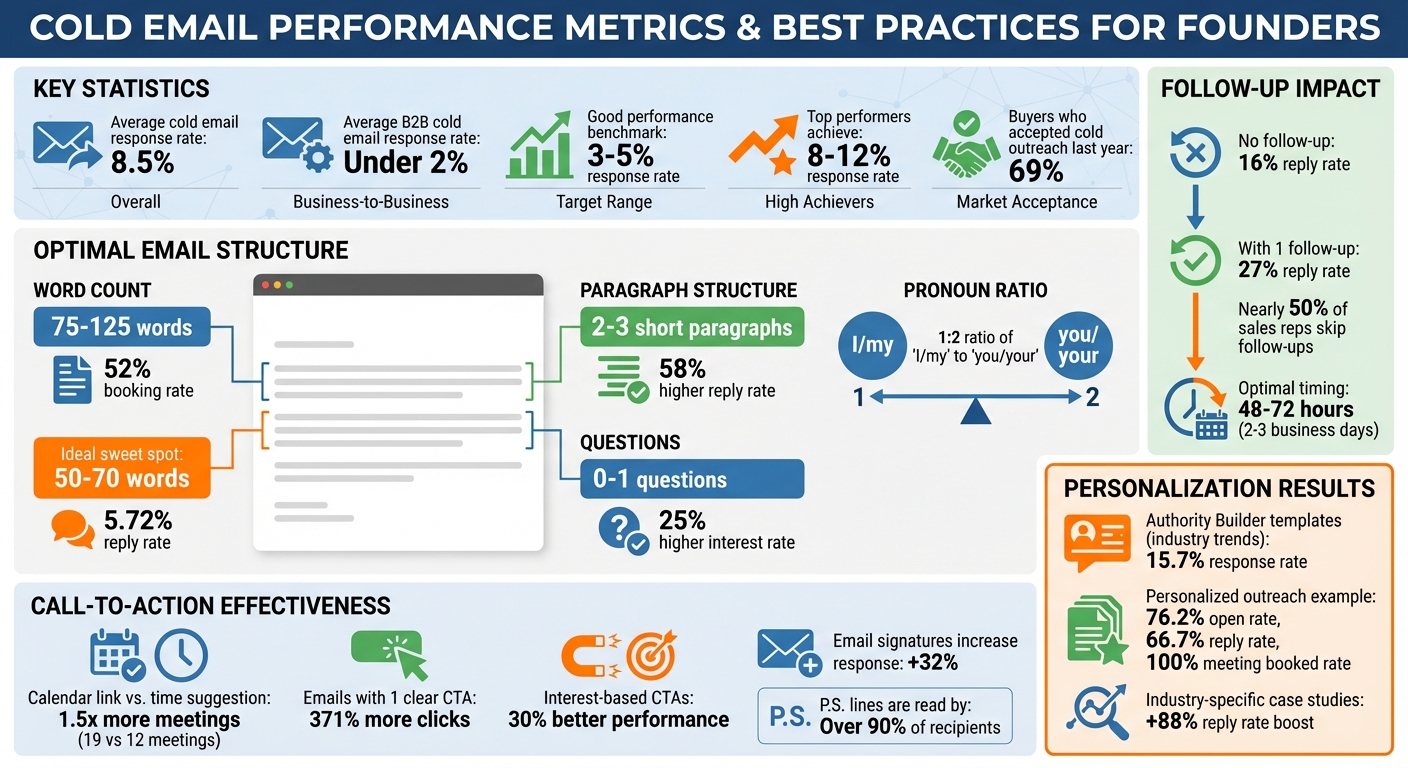
Cold Email Performance Metrics and Best Practices for Founders
How I booked 1,000+ calls with this cold email template (just copy me)
Core Principles for Cold Email Replies
To craft a cold email reply that works, it’s important to focus on the essentials. As Sales.co puts it:
"The best cold email templates share three traits: they're personalized, value-focused, and have a clear call-to-action."
These three elements form the foundation of successful communication.
Keep it short. Research shows that emails with 75–125 words achieve the highest booking rates, coming in at 52%. Decision-makers are busy, so your email needs to deliver its value and next steps quickly. Concise replies not only respect their time but also make your message easier to digest.
Lead with specific numbers in USD. Clarity and specificity go a long way. Replace vague claims with concrete data. For instance, instead of saying, “We’re growing fast,” you could say, “We just hit $30K MRR” or “$50K MRR | 40% MoM Growth”. This approach works - just look at the example of Talkdesk founders Tiago Paiva and Cristina Fonseca. When they emailed investor Jason Lemkin, they shared real traction metrics and early customer wins. Their data-driven pitch was so compelling that Lemkin invested, and Talkdesk went on to become a multi-billion-dollar company. The takeaway? Numbers build trust and credibility.
Tools like IdeaFloat’s Problem Validator and Smart Market Sizing can help you back up your claims with solid data. Problem Validator quantifies the pain points your solution addresses, while Smart Market Sizing provides reliable market calculations supported by credible sources. These tools turn generic pitches into data-backed, persuasive conversations, making your outreach far more effective.
Conclude with one clear, low-friction request. Simplicity is key when asking for next steps. Don’t overwhelm your recipient with multiple options or open-ended questions. In June 2023, lemlist conducted an A/B test comparing two closing strategies. One version suggested a specific meeting time, while the other included a direct calendar link. The calendar link version outperformed, securing 19 meetings compared to 12 for the time-suggestion version - a 1.5x increase. The lesson? Make it as easy as possible for your recipient to say yes. Include a direct calendar link and request a quick 15-minute chat instead of a longer meeting to lower the commitment level.
1. Traction Snapshot Reply for Investor Interest
When you're reaching out to investors, your email needs to do more than just inform - it has to grab attention and make the case for your startup. Jason Lemkin, founder of SaaStr, sums it up perfectly:
"A great cold email can absolutely work, and does work. But it has to stand on its own, and sell the deal - on its own."
Lead with your strongest metric in the subject line. A subject like "$1M ARR | 15% MoM Growth - Raising Seed" immediately highlights your startup's success. This kind of direct, high-impact headline has been known to secure multi-million dollar investments [14,15]. Once you've piqued their interest, follow up with a clear breakdown of your metrics.
Present key metrics using bullet points. Investors often skim emails, especially on their phones, so make it easy for them to spot the highlights. Include figures like ARR, MRR, growth percentages, customer numbers, and any recognizable client logos. Be precise - specific numbers like "$47,832 MRR" make a stronger impression. If you're pre-revenue, focus on user engagement and growth metrics that show potential for future earnings [14,15,17].
Add a personal touch by referencing the investor's interests or portfolio. Mentioning recent blog posts, tweets, or portfolio companies that align with your business can significantly increase your response rate - from the typical 2–3% to as much as 8–12% [2,14,16]. Jason Lemkin emphasizes that investors appreciate concise, data-driven emails that skip unnecessary flattery.
Finish with a clear and simple ask. Include a direct calendar link and attach your pitch deck, making it easy for the investor to schedule a short 15–20 minute call. This straightforward call-to-action not only simplifies their decision-making process but can also increase the likelihood of booking a meeting by 1.5x [3,14].
2. Insight Drop Reply for Potential Customers
When reaching out to potential customers, ditch the hard sell. Instead, think of yourself as a trusted advisor who’s here to help them uncover and solve problems they might not even know exist. As Lemlist puts it:
"An Account Executive or a KAM is like a doctor. They diagnose and uncover problems the lead might not even know they have."
Here’s how to craft a message that resonates:
Start with a specific observation about their business. Show them you’ve done your homework. Maybe you’ve noticed they’re struggling with multi-currency pricing or scaling operations. Highlighting these details demonstrates that you’ve taken the time to understand their business. For example, in June 2025, Gorgias leveraged AI-powered personalization through Lemlist and managed to book around 55 meetings per month, adding $300,000 to their pipeline with a 6% positive reply rate.
Dig into the root cause of their issue. Don’t just skim the surface - help them understand what’s really going on. For instance, Seaside Lodge in San Diego initially offered free luggage storage, but it was eating into their revenue. By switching to a paid model, they not only added $3,000 in monthly revenue but also boosted bookings by 13%.
Use peer benchmarks to create urgency. Once you’ve identified the challenge, show how others in their industry have tackled similar issues. For example, Authority Builder templates that focus on industry trends (rather than a direct sales pitch) achieve a 15.7% response rate. Highlighting success stories from competitors can naturally spark a little FOMO and motivate action.
Wrap up with a no-pressure offer. Instead of immediately asking for a meeting, offer something useful - like a quick playbook, a short video, or a custom analysis. This low-friction approach builds trust and often leads to better results. Once they see the value you bring, suggesting a quick call becomes a much easier next step.
3. Warm Intro Style Reply for Partner Opportunities
When reaching out to potential partners, the goal is to make your email feel more like a friendly introduction than a cold sales pitch. A great way to start is by referencing a mutual connection directly in your subject line - something like, "[Mutual connection] suggested I reach out." This small touch can establish immediate trust, especially since 47% of recipients open emails based solely on the subject line.
It’s also important to show you’ve done your homework. Reference something specific about their work, like a recent LinkedIn post on scaling operations or a podcast episode they hosted about industry trends. These tailored details demonstrate that your outreach is thoughtful and not just another generic email. As the lemlist team wisely says:
"When prospects feel like they've been contacted by another human, not a business, it's easier for them to relate and reply."
Once you’ve personalized your introduction, add a touch of credibility by mentioning partnerships with companies they might recognize. For example, you could say, "We recently worked with [Similar Partner] to streamline their onboarding process." This kind of social proof is effective because it shows you understand their business and have relevant experience.
When it comes to your call-to-action, keep it simple and low-pressure. Instead of asking for a formal meeting or demo, use softer phrasing like "a quick chat" or "exchanging ideas." This approach feels more conversational and less sales-driven. Including a scheduling link (like lemcal or Calendly) can make it even easier - emails with calendar links lead to 1.5x more booked meetings compared to back-and-forth scheduling.
Finally, wrap things up with a friendly yet professional sign-off. Match the tone to the relationship you’re building - closings like "Best," "Cheers," or "Talk soon" help establish that peer-to-peer connection. Remember, the goal isn’t to close a deal with one email; it’s to spark a conversation that could evolve into a meaningful partnership.
sbb-itb-08dd11e
4. Respectful Nudge Reply for Ghosted Threads
When someone stops responding to your email, it’s often because their inbox is overflowing. The best move? Wait 48 to 72 hours (2–3 business days) before sending your first follow-up. Research backs this up: sending at least one follow-up can boost reply rates from 16% to 27%, yet nearly half of sales reps skip this crucial step. A well-timed nudge can make all the difference in re-engaging your prospect.
Craft your follow-up in three clear steps: remind, update, and propose a next step. Skip generic check-ins like "just following up" and instead, add value. For instance, if you initially pitched a demo, you could write: "Since we last connected, we helped another SaaS founder reduce their customer acquisition cost by 22% - thought this might resonate given your goals for scaling." This approach shows you’re offering solutions, not just chasing a reply.
It’s also important to give them an easy way to bow out if they’re no longer interested. A simple line like, "If priorities have shifted, feel free to let me know", takes the pressure off and encourages honesty. As Diego Mangabeira puts it:
"In sales, silence isn't rejection. It's often a test of patience, persistence, and your ability to re-enter the conversation with clarity and care."
Finally, keep your call-to-action simple and low-commitment. Instead of asking for another 30-minute meeting, suggest something smaller - like a five-minute call or a quick video walkthrough. Emails with one clear call-to-action see 371% more clicks than those without. By making it easy for them to say "yes", you show respect for their time while increasing your chances of a response.
5. Soft Exit Reply That Keeps the Door Open
Sometimes, after trying to re-engage an unresponsive lead, the best move is to step back gracefully - but without shutting the door completely.
A prospect might not be ready now, but a polite and well-crafted exit can leave the relationship in good standing for future opportunities. A soft exit reply allows you to acknowledge their current situation while keeping the connection warm. After all, a "no" today could turn into a "yes" later. As Vlad Oleksiienko from Reply.io explains:
"Every no you hear allows you to focus more resources on more promising leads, rather than putting time and effort into leads that were never likely to pan out."
This method, much like earlier strategies, focuses on preserving a positive relationship for potential future conversations. Here's how you can structure an effective soft exit reply:
Start by including three key elements: gratitude for their time, a no-pressure offer to reconnect later, and a final piece of value they can use even without committing. For instance, you could say:
"Thanks for considering this, Sarah. I completely understand you're focused on your current solution. I'll reach out in a few months to see if your priorities have shifted. In the meantime, here's a case study on how we helped a similar fintech streamline operations."
This approach demonstrates respect for their decision while positioning you as a helpful resource - not a pushy salesperson.
It’s worth noting that interest-based CTAs (calls-to-action) tend to perform 30% better than specific or open-ended ones. For example, you could include a low-commitment CTA like, "May I send you our quarterly industry report when it’s ready?" This keeps the conversation alive without overwhelming them. Another option is the "presumptive negative" approach, where you assume they’ve moved in a different direction, which can encourage them to clarify their actual interest.
Finally, close your email with a professional signature. Emails that include a complete signature see a 32% higher response rate. Tailor your sign-off to fit your brand’s tone - "Best regards" works well for formal industries, while "Cheers" or "Talk soon" feels more casual and approachable for startups. You can also add a P.S. line at the end. Over 90% of readers check the postscript, so it’s a great spot to leave a final impactful note.
Tracking and Improving Your Reply Performance
Once you’ve set up effective reply templates, it’s time to focus on tracking and fine-tuning your outreach efforts. Without tracking, your cold email strategy is just guesswork. Start by keeping an eye on three key metrics: Reply Rate (the percentage of people who respond), Interest Rate (the percentage of positive responses), and Meeting Booked Rate (the percentage of replies that lead to scheduled meetings). For context, the average response rate for B2B cold emails is under 2%. So, if you’re hitting 3–5%, you’re already outperforming most others in the space.
Another critical metric is Time-to-meeting - how many follow-ups it takes to secure a meeting. For instance, in June 2023, Adrian, the co-founder of Dragonfruit Media, launched a cold outreach campaign targeting SaaS founders with 5,000+ YouTube subscribers. By using a 7-step sequence that included personalized pitch videos, he achieved a 76.2% open rate, a 66.7% reply rate, and a 100% meeting booked rate for 21 high-value prospects. This approach landed pilot contracts with a SaaS unicorn and a top-tier VC firm.
Once you’ve nailed down your metrics, A/B testing can help you refine your strategy even further. Experiment with subject line lengths (e.g., 1–5 words versus 7–8 words), meeting durations (15-minute calls often result in more bookings than 30-minute ones), and proof-point presentations (using industry-specific case studies, for example, can boost reply rates by up to 88%). Gorgias, a customer support platform, used structured outreach to book about 55 meetings per month, adding $300,000 to their pipeline with a 6% positive reply rate.
To refine your messaging, tools like IdeaFloat’s Go-to-Market Strategy and Consumer Insights can help. These tools identify the best customer channels, calculate acquisition costs, and analyze online conversations to find language that resonates with your audience. Keep your emails concise - between 50–70 words (54-word emails typically achieve a 5.72% reply rate), use 2–3 short paragraphs (which can increase reply rates by up to 58%), and limit your email to 0–1 questions (leading to a 25% higher interest rate). Dan Morgese from Gong sums it up well:
"Irrelevant personalization still falls flat. No matter who (or what) crafts the email, it must be backed by the right context, intent, and activity data".
The key is to continuously track, test, and refine your approach based on performance data.
Conclusion
These five reply templates shift your outreach from simply selling to genuinely helping. The Traction Snapshot builds trust with investors, the Insight Drop positions you as a helpful advisor for customers, the Warm Intro opens doors to partnerships, the Respectful Nudge revives stalled conversations, and the Soft Exit keeps future opportunities open.
Tailor these templates to increase your response rates from 1–2% to 8–12%. A little personalized research can go a long way. Find three specific details about each prospect - like recent funding news, a blog post they wrote, or a challenge their company is tackling. As one sales expert quoted by Malay Gupta shared:
"I usually don't reply to sales emails but I wanted to reply to yours because it was obvious you did research on me."
This kind of attention to detail boosts your credibility and makes your message stand out. Use tools like IdeaFloat's Go-to-Market Strategy to pinpoint the exact channels your prospects use and calculate realistic acquisition costs. Pair this with the Consumer Insights tool to uncover the language that resonates with your audience. Avoid vague promises - be specific about outcomes. Keep your emails short, ideally 75–125 words, and include one clear, low-friction call-to-action.
Specificity drives results. Include a direct calendar link to schedule a 15-minute call - it can increase bookings by 1.5x. Use a 1:2 ratio of "I/my" to "you/your" and ensure every sentence passes the "So what?" test.
Finally, measure your performance. Track metrics like Reply Rate, Interest Rate, and Meeting Booked Rate to understand what’s working. Experiment with subject lines, proof points, and calls-to-action. Remember, 69% of buyers accepted at least one cold outreach attempt last year. Stand out by doing your homework, offering real value, and making it easy for prospects to say yes.
FAQs
What’s the best way to improve response rates for cold emails?
To improve response rates for cold emails, focus on making them personal and delivering clear value. Start by ensuring you're reaching the right audience. Define your Ideal Customer Profile (ICP) and Ideal Buyer Persona (IBP) to target individuals who align with your offering. Even the most well-crafted email won’t land if it’s sent to the wrong person.
Make your email feel tailored and relevant. Reference something specific about the recipient, like a recent achievement their company has celebrated or a challenge they might be tackling. Keep your message short and to the point, highlight a clear benefit, and steer clear of language that feels too pushy or sales-driven. Your subject line is crucial - stick to 4 to 6 words that grab attention and hint at value or spark curiosity.
Close your email with a friendly, low-pressure call-to-action, such as, “Would you have 15 minutes this week to chat?” This keeps the tone conversational and encourages engagement. By combining smart targeting, thoughtful personalization, and a clear next step, your email reply rates can see a noticeable boost.
What key metrics should I include in a cold email to investors to grab their attention?
When reaching out to investors, the right metrics can make your pitch stand out and increase the chances of getting a response. Aim to include numbers that emphasize your progress, market opportunity, and growth potential. Here are some key metrics that can catch an investor's attention:
- Revenue growth or user expansion: Share specific, impressive stats like, "We grew monthly recurring revenue by 34% in the last 90 days" or "Our user base tripled quarter-over-quarter." These numbers demonstrate your ability to scale effectively.
- Market opportunity: Highlight the size of your market with a clear statement, such as, "The U.S. market for AI-driven logistics is valued at $4 billion." This helps underline the potential for significant returns.
- Validation milestones: Showcase achievements that add credibility, like, "We’ve raised $1.2 million in seed funding from three angel investors" or "Our pilot program with five Fortune 500 companies generated $250,000 in revenue."
Incorporating one or two of these metrics into a concise, tailored email can give investors a strong reason to take notice and schedule a conversation.
What’s the best way to follow up with a lead who hasn’t responded?
When sending a follow-up email, keep it polite, brief, and to the point. Reference your earlier message to remind them of your previous outreach, and introduce something fresh - perhaps an updated resource, a new insight, or a simple next step they can take. This small addition can help reignite their interest. Be sure to wait a few days before reaching out again to respect their time. Maintain a tone that’s both professional and approachable to show you value their attention and keep the conversation open.
Related Blog Posts
 Report an issue
Get the newest tips and tricks of starting your business!