Pricing is a balancing act. To maximize profits without losing customers, you need to find the sweet spot between your costs, market demand, and customer perception of value. Here’s how:
- Start with costs: Break down direct costs (materials, labor) and indirect costs (rent, utilities) to calculate your total expenses.
- Choose a pricing model: Options include cost-plus pricing (add a markup to costs), value-based pricing (charge based on perceived value), or dynamic pricing (adjust prices based on market trends).
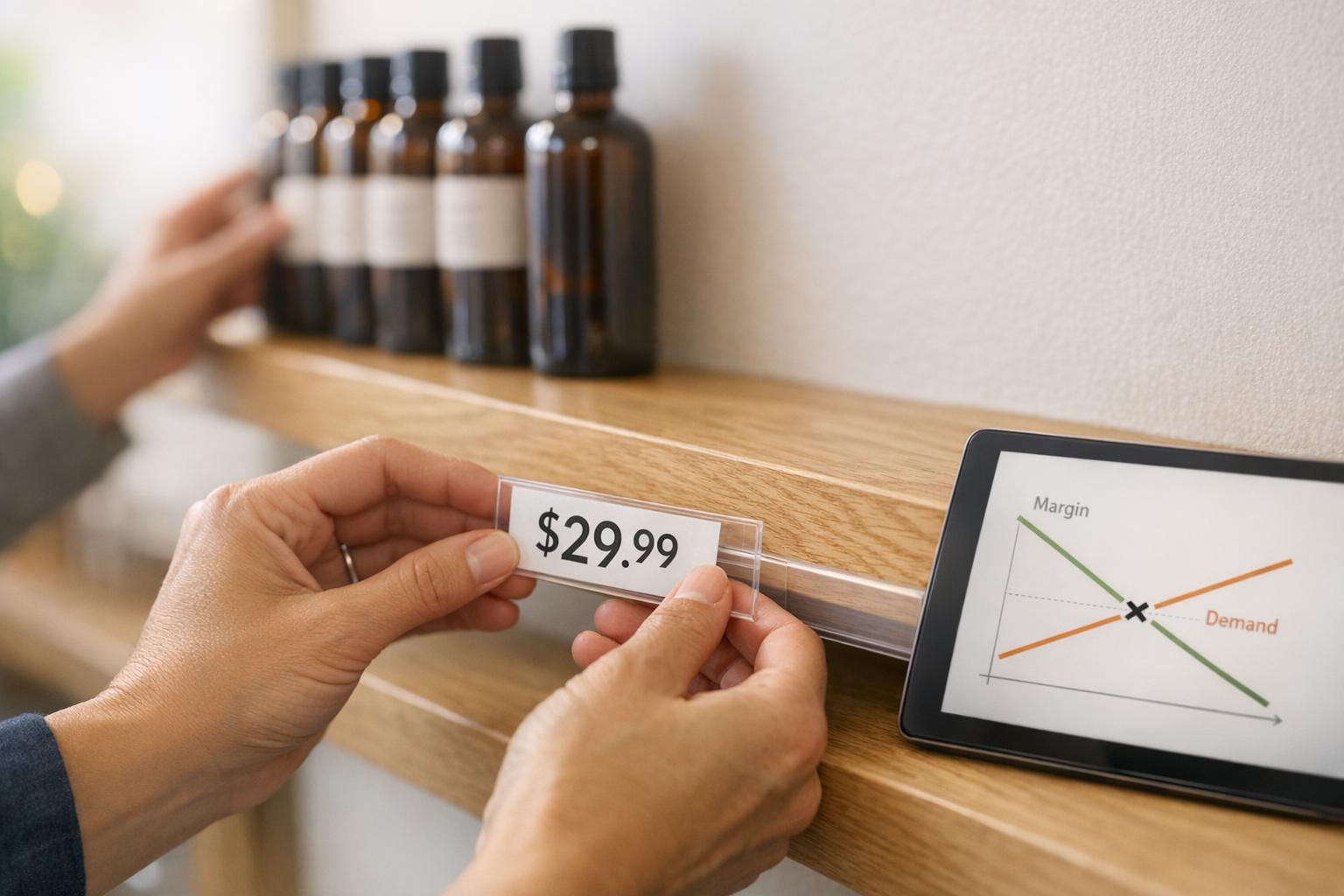
- Use psychology: Techniques like charm pricing ($29.99 vs. $30) and anchoring (showing higher-priced options first) influence buying decisions.
- Test and tweak: Regularly A/B test price points and monitor metrics like margins, sales volume, and customer retention.
Even a small price change (like a 1% increase) can boost profits by up to 11%. Tools like IdeaFloat can help streamline cost tracking, pricing research, and financial projections to refine your strategy. The key is to align prices with what customers value while ensuring profitability.
How To Price Your Product Correctly (Complete Pricing Strategy Guide)
sbb-itb-08dd11e
Calculate Your Costs First
Before you set prices, it’s crucial to understand all your costs - from production to delivery - to avoid losing money.
"Cost of goods sold (COGS) is the direct cost to produce or purchase the goods you sell. It represents the actual expenses tied to creating your products, not the overhead costs of running your business." - Lena Hanna, CPA, Xero
Your total costs break down into two categories: direct costs (the expenses tied to making one unit) and indirect costs (the overall costs of running your business). Direct costs include things like raw materials, labor, and packaging. Indirect costs, on the other hand, cover rent, utilities, marketing, software subscriptions, and insurance. Both categories are essential to calculate if you want to price your products for profitability.
Calculate Cost of Goods Sold (COGS)
COGS includes the direct costs of producing or purchasing the products you sell. To calculate it, use this formula:
Beginning Inventory + Purchases During the Period - Ending Inventory = COGS
Here’s what typically falls under COGS:
- Raw Materials: The components or wholesale costs of your products.
- Direct Labor: Wages paid to workers directly involved in production.
- Production Overhead: Costs like factory rent, utilities, and equipment upkeep.
- Product-Related Logistics: Freight-in (shipping materials to you), storage, and packaging.
However, not everything makes it into COGS. For example, marketing expenses, office rent, administrative salaries, legal fees, and shipping products to customers are excluded.
| Cost Category | Included in COGS? | Examples |
|---|---|---|
| Direct Materials | Yes | Raw materials, components, wholesale prices |
| Direct Labor | Yes | Wages for production workers |
| Production Overhead | Yes | Factory utilities, rent, equipment upkeep |
| Fulfillment/Logistics | Partial | Freight-in (Yes), Packaging (Yes), Shipping to customers (No) |
| Operating Expenses | No | Marketing, office rent, administrative wages |
For service businesses, COGS - often called "cost of services" - includes subcontractor fees, direct labor hours, and any tools used specifically for delivering services.
It’s a good idea to perform regular inventory counts to account for losses due to damage or spoilage. Additionally, negotiating better terms with suppliers can help lower your costs per unit.
Include Overhead and Operating Expenses
Overhead costs are the fixed expenses that keep your business running but aren’t tied to any specific product. These include rent, utilities, insurance, software subscriptions, marketing, and administrative costs. Unlike direct costs, overhead remains steady regardless of how much you sell.
To allocate overhead effectively:
- Calculate an Overhead Rate: Divide your total overhead by an allocation base, like labor hours or machine hours. For instance, if your monthly overhead is $5,000 and you work 200 hours, your overhead rate is $25 per hour.
- Determine Fully Loaded Costs: Add your direct costs (materials and labor) to the allocated overhead per unit.
- Factor in Owner Compensation: Don’t forget to include your own compensation. For example, if you aim to earn $60,000 annually, that’s about $5,000 per month that needs to be covered in your pricing.
To establish your Price Floor, use this formula:
Price = Total Cost / (1 - Desired Gross Margin %)
Accurately assessing your costs ensures you can set prices that maintain healthy profit margins while staying competitive. Once you have a clear picture of your expenses, you can use tools like IdeaFloat to make cost tracking and analysis easier.
Using IdeaFloat for Cost Analysis
After you’ve nailed down your costs, IdeaFloat’s tools can simplify the process of tracking and managing them.
With IdeaFloat’s Cost Analysis feature, you can input all your direct and indirect expenses in one place. This tool calculates your total monthly burn rate and breaks down your cost per unit by dividing your total overhead by your projected sales volume.
Additionally, IdeaFloat integrates with its Product & Service Creator, helping you determine how many units you need to sell each month to cover costs and hit your profit goals. Regularly reviewing your data through IdeaFloat’s dashboard allows you to catch increases in supplier prices or overhead costs early, ensuring your pricing stays aligned with your actual expenses.
Pick the Right Pricing Model
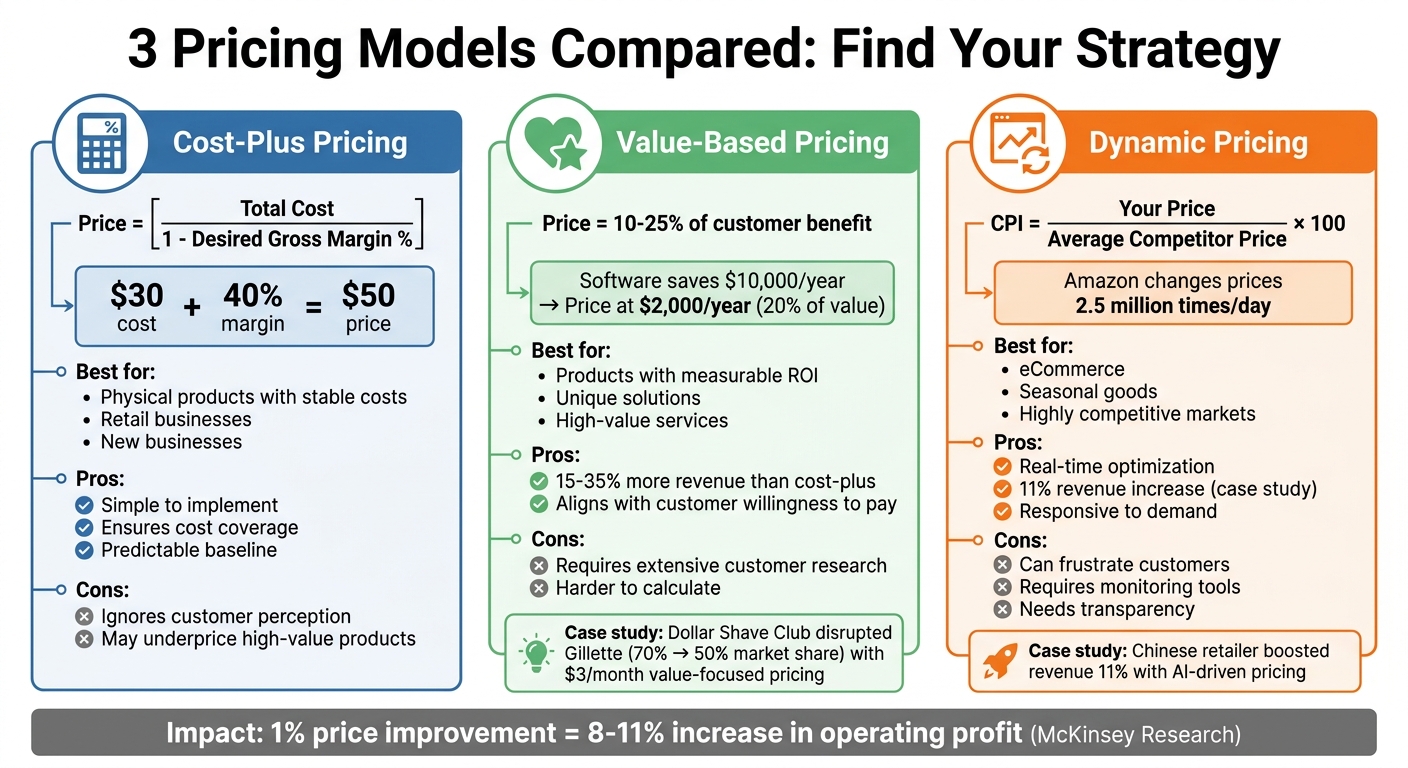
Product Pricing Models Comparison: Cost-Plus vs Value-Based vs Dynamic Pricing
Finding the right pricing model is about striking a balance between profitability and what customers are willing to pay. Your pricing strategy sets the boundaries: the minimum you need to cover costs and the maximum value customers see in your product. The ideal model depends on your product type, market position, and competition.
"A 1% price improvement produces an 8-11% increase in operating profit. Not revenue. Operating profit." - McKinsey Research
There are several approaches to pricing, each with its strengths. Cost-plus pricing ensures you cover your expenses and make a profit by adding a fixed markup to your costs. Value-based pricing focuses on the benefits your product delivers to customers, often leading to higher margins. Dynamic pricing adjusts in real time, reacting to market changes, competitor strategies, and demand. By understanding when and how to use these models - individually or in combination - you can maximize revenue while maintaining customer trust. A solid cost analysis paired with these strategies ensures your prices reflect both your expenses and the value customers perceive.
Cost-Plus Pricing for Simple Margins
Cost-plus pricing is one of the easiest methods to implement. You calculate your total cost per unit (including COGS and overhead) and then add a fixed markup percentage to determine your price.
The formula is straightforward: Price = Total Cost / (1 - Desired Gross Margin %). For example, if your total cost per unit is $30 and you aim for a 40% gross margin, your price would be $30 / (1 - 0.40) = $50.
This model works well for physical products with stable costs, retail businesses, and situations where customers expect consistent pricing. It’s particularly useful for new businesses needing a dependable baseline. However, cost-plus pricing doesn’t account for customer perception or willingness to pay. If your product offers exceptional value, you might underprice it. On the flip side, if competitors offer similar products at lower prices, justifying your markup could be challenging. That’s where customer-focused strategies come into play.
Value-Based Pricing for Customer Perception
Value-based pricing shifts the focus from costs to the value your product delivers to customers. Instead of asking, "What does it cost to make?" the question becomes, "What is it worth to the customer?".
This approach sets prices based on measurable benefits, such as time saved or revenue generated, and typically charges a percentage of that benefit (often 10-25%). For instance, if your software saves a business $10,000 annually in labor costs, you might price it at $2,000 per year, capturing 20% of the value while still leaving the customer with significant savings.
Take Dollar Shave Club, for example. In 2012, they disrupted Gillette, which dominated 70% of the market, by offering a $3/month subscription. By 2019, Gillette’s share dropped to 50%, and parent company P&G had to write down $8 billion. Dollar Shave Club didn’t just compete on price - they emphasized convenience and simplicity, proving that perceived value often outweighs production costs.
Value-based pricing can generate 15% to 35% more revenue than cost-plus models, but it requires thorough customer research. You need to understand your audience’s pain points, willingness to pay, and how they measure ROI. Tools like Van Westendorp surveys, which ask customers about price thresholds (e.g., "too expensive" or "a bargain"), can help pinpoint the optimal price range. Once you’ve established perceived value, dynamic adjustments can refine your strategy even further.
Dynamic Pricing with Competitor Analysis
Dynamic pricing is ideal for industries like eCommerce, seasonal goods, and highly competitive markets. This approach adjusts prices in real time based on factors such as competitor pricing, demand shifts, inventory levels, and customer behavior.
Amazon, for instance, updates prices approximately 2.5 million times per day. A Chinese online retailer tested an AI-driven pricing model for its top 30 feeding bottle SKUs. By analyzing competitor stockouts and price elasticity, they boosted revenue by 11% while maintaining a 10% gross margin.
Tools like IdeaFloat’s Advanced Pricing Research make dynamic pricing more accessible. This tool analyzes competitor prices across the web and applies proven pricing theories to optimize your strategy. It calculates your Competitive Price Index (CPI) with the formula: (Your Price / Average Competitor Price) x 100. A CPI above 100 suggests a premium position, while a CPI below 100 indicates a discount strategy.
However, dynamic pricing isn’t without challenges. Constant price changes can irritate customers if they feel manipulated. Between 2016 and 2023, Salesforce held a price freeze before introducing gradual increases - 9% in 2023 and 6% in 2025. Over time, this strategy raised the price of Sales Cloud Enterprise by 40%, leveraging the high switching costs of enterprise CRMs. The lesson? Transparency is key. Customers are more likely to accept price changes when they see clear reasons, such as rising costs or added value.
Apply Psychological Pricing Tactics
Once you've decided on a pricing model, how you present those prices can make a huge difference in how customers perceive them. Small tweaks, like ending a price with .99 instead of .00, can influence buying decisions. These tactics are rooted in how our brains process numbers.
"Pricing isn't math - it's perception." - DimeADozen.AI
The psychology of pricing often relies on mental shortcuts we use without even realizing it. For instance, thanks to the left-digit effect, we process numbers from left to right. This means $29.99 feels much cheaper than $30.00, even though the difference is just a penny. Similarly, showing a high-priced option first can reframe how other prices are viewed, making them seem like better deals. These methods have been shown to increase conversion rates by 6% to 12% for items priced under $100.
Charm Pricing and Anchoring
Charm pricing - using endings like .99 or .97 - is a widely used strategy in retail. Because we focus on the leftmost digit, $29.99 is often perceived as "twenty-something", creating a bigger mental gap from $30.00 than the actual one cent difference. Research from MIT and the University of Chicago found that a $39 price tag outperformed $34 and $44 for the same product. Another test showed that dropping a price from $100 to $99 led to a 60% sales boost, even though it was just a 1% reduction. Charm pricing also signals a bargain, which can create urgency to buy.
Anchoring takes this a step further. By presenting the highest-priced option first, the rest of the prices appear more reasonable. For example, showcasing a $299 Enterprise plan before a $99 Professional plan makes the latter feel like a steal. Highlighting discounts - like showing a crossed-out original price next to the sale price - also encourages customers to feel they're getting a deal.
To effectively use charm pricing, tailor it to your product category. Everyday items like shampoo might end in .99 (e.g., $14.99), electronics could use .95 (e.g., $149.95), and luxury products often stick to round numbers (e.g., $50). For high-priced items, breaking it down into smaller costs - like "less than $1/day" - can make the price feel more manageable. Interestingly, removing the dollar sign altogether (e.g., "24.99" instead of "$24.99") can also reduce the psychological sting of spending.
Beyond tweaking individual prices, bundling and tiered pricing are great ways to enhance perceived value.
Bundling and Tiered Pricing
Bundling and tiered pricing let you cater to different customer needs while increasing your average order value. Bundling combines multiple products at a slight discount, while tiered pricing offers different versions of your product - like Basic, Standard, and Premium - so customers can pick what suits them best.
The Rule of Three, also known as the Goldilocks Effect, is a proven approach. Offering three pricing tiers can boost revenue per visitor by 31%, with 55% to 70% of customers typically choosing the middle option. This happens because the middle tier feels "just right" - it avoids the perceived low quality of the cheapest option and the high cost of the premium one. For instance, a SaaS company might offer plans at $19/month (Starter), $49/month (Professional), and $99/month (Enterprise), with most users opting for the $49 plan.
To prevent overlap between tiers, maintain a 50% to 100% price gap between them. This ensures clear value differences and avoids cannibalizing sales. When bundling, aim for the total price to be around 80% to 85% of the combined cost of individual items. This creates a discount of 15% to 25%, signaling a deal without heavily cutting into profits. For items under $100, percentage-based discounts (e.g., "25% off") work better, while for higher-priced items, flat dollar discounts (e.g., "$50 off") feel more impactful. You can also use the decoy effect by introducing a less appealing option to nudge customers toward your preferred choice. For example, if you offer a Basic plan at $19, a Professional plan at $49, and a "Professional Lite" plan at $45 with fewer features, most customers will choose the full Professional plan for its better value.
Using IdeaFloat's Product & Service Creator
Applying these pricing strategies can be time-consuming, but IdeaFloat's Product & Service Creator simplifies the process. This tool helps you design product tiers and calculate how many units you need to sell each month to stay profitable.
You can manually create your product and service list or let the AI do it for you. The tool gives you a clear breakdown of how many units you need to sell to hit your revenue targets, making it easy to experiment with different pricing structures. For example, if you're selling a subscription service, you could test three tiers - Starter at $19/month, Professional at $49/month, and Enterprise at $99/month - and quickly see which combination maximizes revenue without overwhelming customers with too many choices.
The interactive interface allows you to adjust configurations and immediately see their impact on your margins. By combining IdeaFloat's tools with the strategies discussed here, you can create a pricing structure that not only appeals to your customers but also keeps your business profitable.
Test and Adjust Your Prices
Setting prices isn’t a one-and-done task. Even after choosing a pricing model and applying psychological strategies, it’s crucial to regularly test and tweak your pricing to see how customers react. What works for one product or audience might flop for another, especially as market dynamics shift. Angela Sokolovska, an Ecommerce Expert, emphasizes this point:
"Pricing is one of the highest-impact decisions an ecommerce team makes, yet it is often validated last or not at all".
The stakes are high. A small price increase - just 1% - can result in an 8% boost in operating profit, assuming demand holds steady. On the flip side, a pricing misstep can ripple across every sale. Testing helps you validate your pricing assumptions and align them with actual customer behavior, bridging the gap between initial decisions and long-term gains.
A/B Test Different Price Points
Once you’ve chosen a pricing model, the next step is to test it with real customers. A/B testing is a powerful way to experiment with different price points, allowing you to see which one drives the best results. The trick? Keep everything else - product, messaging, checkout flow - consistent and change only the price.
Start by setting a clear goal. Are you trying to maximize revenue, improve profit margins, or attract more customers? For instance, you could test monthly subscription prices of $19, $29, and $39, then track revenue per visitor (RPV) to measure both conversion rates and customer spending.
How you present the price also matters. Roma Designer Jewelry, for example, saw a 21% jump in average order value by experimenting with bundle pricing strategies. Similarly, Going (formerly Scott’s Cheap Flights) increased trial sign-ups by 104% just by updating their call-to-action from "Sign up for free" to "Trial for free".
Timing is everything. Avoid running tests during high-pressure periods like Black Friday or major holidays, as customer behaviors during these times might not reflect normal patterns. Consider segmenting your audience - testing different prices for first-time versus returning customers - and let your experiments run for at least two full business cycles (typically 2–4 weeks) to collect reliable data.
Track Margins and Sales Volume
After testing, take a close look at both your margins and sales volume. A lower price might attract more buyers, but it could also eat into your profit per unit. To figure out if the trade-off is worth it, track metrics like gross and contribution margins alongside conversion rates and sales velocity.
If a price increase results in fewer sales, use this formula to calculate whether the higher margin makes up for the drop in volume:
Break-Even Volume Change = −(Price Increase %) ÷ (Gross Margin % + Price Increase %)
Don’t just focus on the short term. Keep an eye on metrics like Customer Lifetime Value (LTV), churn rate, and retention to ensure your pricing changes don’t hurt your business down the line. For example, if a price hike leads to a churn rate spike of 15% or more within 60 days, it might be time to reconsider. Keep in mind that 51% of shoppers check multiple sites to compare prices before buying.
Using IdeaFloat's Financial Tools
To refine your pricing strategy further, leverage tools like IdeaFloat’s Financial Model and Projections. These tools let you simulate different pricing scenarios and track the financial impact of your decisions in real time.
- Financial Model: Tracks every dollar - both incoming and outgoing - to help you determine if your business is profitable.
- Projections & Breakeven Analysis: Provides monthly revenue and cost forecasts, complete with interactive graphs. You can visualize how changes, such as raising a price from $29 to $39, affect your break-even point and cash flow over the next year.
With these insights, you can make informed adjustments, identify financing needs, and better understand when your business might hit profitability. These tools take the guesswork out of pricing, helping you stay nimble and data-driven as your business evolves.
Conclusion
Pricing is all about finding the sweet spot between profitability and keeping customers engaged. Start by calculating your costs and choosing a pricing model that works for your business. Use cost-plus pricing as your baseline, value-based pricing to set the upper limit, and dynamic pricing to remain competitive in the market.
Don't underestimate the power of pricing psychology. Techniques like charm pricing can increase purchase likelihood by 24%, while anchoring can boost conversions by 18%. Even a small change - like improving pricing by just 1% - can lead to an 11.1% increase in operating profit.
Testing your pricing strategy regularly is essential. With 72% of shoppers comparing prices in real time, staying ahead requires constant adjustments. Quarterly testing alone has been shown to increase revenue by 8-15%. Use A/B testing to validate your approach and make data-backed adjustments.
Once you've tested and validated your strategy, refine it further with tools that take the guesswork out of pricing. Platforms like IdeaFloat offer AI-powered solutions such as Advanced Pricing Research to optimize price points and Financial Model and Projections to map out break-even points and cash flow.
Above all, focus on the value you bring to your customers. As Eric Dolansky, Associate Professor of Marketing at Brock University, explains:
"How much the customer is willing to pay for the product or service has very little to do with the seller's production and distribution costs. Rather, the price relates to the value a person places on the product or service they're buying".
FAQs
What’s the best way to pick the right pricing model for my business?
To pick the best pricing model, you need to start by clearly defining your business goals, identifying your target market, and understanding your product or service. Dive into your costs, consider how customers view your offering, and check out what your competitors are charging. You can explore strategies like value-based pricing (charging based on perceived value), cost-plus pricing (adding a markup to your costs), or psychological pricing (using pricing tactics that influence buying behavior).
Don’t forget to test your pricing strategy to find the right balance between making a profit and attracting customers. Rely on data and thorough research to guide your decisions, ensuring your approach aligns with both your objectives and your audience's expectations.
How do I raise prices without losing customers?
To increase prices without alienating your customers, focus on clear communication and showcasing the value you provide. Start by giving customers 60 to 90 days' notice about the upcoming change. Frame the price adjustment as a way to improve your product or service, emphasizing how it will enhance their experience. Transparency is key - be upfront about why the increase is necessary.
Make sure to highlight the quality and results your product delivers. This helps justify the adjustment and reinforces the benefits of staying with your brand. You can also use psychological pricing strategies, like rounding just below whole numbers (e.g., $9.99 instead of $10), to make the change feel less significant. Finally, tailor your approach to different customer segments, ensuring that your loyal customers feel appreciated and valued throughout the process. This thoughtful strategy can help you retain demand and maintain customer loyalty.
What should I measure to know if a price change worked?
To determine whether a price change worked, keep an eye on sales volume, revenue, and profit margins. Sales volume helps you understand changes in customer demand, while revenue and profit margins reveal how the change impacts overall profitability. Tools like iterative price testing or A/B testing can help you analyze these metrics and see if the adjustment meets your objectives.
Related Blog Posts
- How to Price Your Product: A Beginner's Guide
- The Pricing Strategy That Doubled My Conversion Rate Overnight
- Idea to Pricing: A Simple Formula for Your First 3 Offers
- How to Test Your Pricing Before a Full Launch