If you’re thinking about starting a catering business, here’s the key to success: get your pricing right and follow the rules. Many catering startups fail because they either underprice their services or overlook legal requirements. Here’s what you need to know upfront:
- Pricing Basics: Food costs should be 25–35% of your revenue. Don’t forget to include labor, overhead, and transportation costs. Use methods like per-person pricing, cost-plus, or food cost percentage to ensure profitability.
- Compliance Must-Haves: Secure licenses like an EIN, food service permits, and health certifications. Follow food safety rules, including temperature control and proper handling.
- Finding Your Niche: Weddings dominate the market (50%), followed by corporate events (45%). Consider diet-specific options like vegan or gluten-free to stand out.
- Startup Costs: Expect to spend on kitchen rentals, insurance ($2,000–$5,000 annually), and permits. Use tools to track costs and streamline operations.
Starting a catering business involves balancing detailed cost management with meeting local, state, and federal regulations. Get these steps right, and you’ll be on track for a profitable venture.
Full Course Walkthrough - How to Start a Catering Business from Home | Guide to Launch Your Venture!
sbb-itb-08dd11e
Validating Your Catering Idea
Before diving into expenses like equipment, licenses, and inventory, make sure your idea is something people will actually pay for. This step is crucial - it helps you avoid costly mistakes by testing your assumptions about demand, pricing, and your chosen market niche. Skipping this process can lead to big problems, like discovering too late that your audience doesn’t exist or that your pricing is off. With around 102,000 catering businesses already active in the U.S., it’s essential to understand how you’ll fit into this competitive landscape. Think of this validation phase as the bridge that takes your concept from idea to tested reality.
Choosing Your Catering Niche
Your niche shapes everything - your menu, your marketing, and even your operations. In the U.S., wedding catering dominates with 50% of the market, while corporate events bring in 45% of revenue. Corporate catering often means frequent weekday deliveries on short notice, while weddings involve months of planning, larger guest counts, and seasonal unpredictability. Interestingly, corporate catering was the top growth area for 48% of catering companies in 2023.
There’s also growing demand for diet-specific catering, which has jumped 25% in just three years. Niches like vegan, gluten-free, and allergen-friendly options are gaining traction. Consider the success of Michael Attias, founder of CaterZen, who earned over $6,000 in a single day by targeting Black Friday retail events. His advice?
"Find a need and be the one to fill it." – Michael Attias, Founder, CaterZen
To pick your niche, start by researching competitors on platforms like Yelp, Google Maps, and Facebook. Look for gaps, such as a lack of vegan options or slow delivery times for corporate events. Also, consider which cuisines are popular in your area. Nationally, American cuisine leads with 35% of catering popularity, followed by Italian (20%) and Mexican (15%). If your local market is already saturated with Italian caterers, you might focus on underserved cuisines or unique event types like "lunch and learns" for professionals or back-to-school events for teachers.
Tools for Testing Demand and Pricing
Once you’ve identified a niche, it’s time to confirm that people will actually pay for your service. Digital tools like IdeaFloat make this process easier. The Problem Validator helps you confirm customer needs, while the Consumer Insights tool analyzes what potential customers are saying about catering in your area, giving you a clearer picture of their expectations. The Smart Market Sizing tool goes a step further by calculating your total addressable market (TAM), serviceable addressable market (SAM), and serviceable obtainable market (SOM) based on real data. These insights provide a realistic view of your potential customer base.
But don’t rely solely on digital tools - direct outreach is just as important. Reach out to HR managers at local companies or wedding coordinators to learn about their current catering challenges. You can also test your concept by catering a small event for a friend or a non-profit at cost. This approach allows you to gather valuable data on prep times, ingredient costs, and customer feedback. Think of it as a trial run to refine your process before charging full rates. The insights you gain here will directly inform your business plan.
Building a One-Page Business Plan
A one-page business plan is a simple yet powerful tool to clarify your goals and spot potential challenges before you invest heavily. As UF/IFAS explains:
"A business plan is also an important analytical tool, which helps you define reasons for starting the business, assess the prospect for business success, and identify potential issues you may face."
Your plan should focus on five key areas: target customers (e.g., corporate clients within a 15-mile radius), service format (drop-off, buffet-style, or on-site cooking), menu concept (signature dishes and dietary options), pricing structure (per-person, cost-plus, or tiered packages), and startup cost estimates.
Use your first three clients to fine-tune this plan. Track the time it takes to prepare each dish, calculate ingredient costs at wholesale prices, and ensure your pricing includes a 20% to 30% profit margin. Update this document as you gather more data. Tools like IdeaFloat’s Lean Canvas can simplify this process, auto-generating a one-page summary from your workspace that’s easy to share with mentors or potential investors. The platform can also create a full business plan with visuals and financials, ready to export as a PDF, Word document, or PowerPoint presentation.
Menu Math: Pricing for Profit
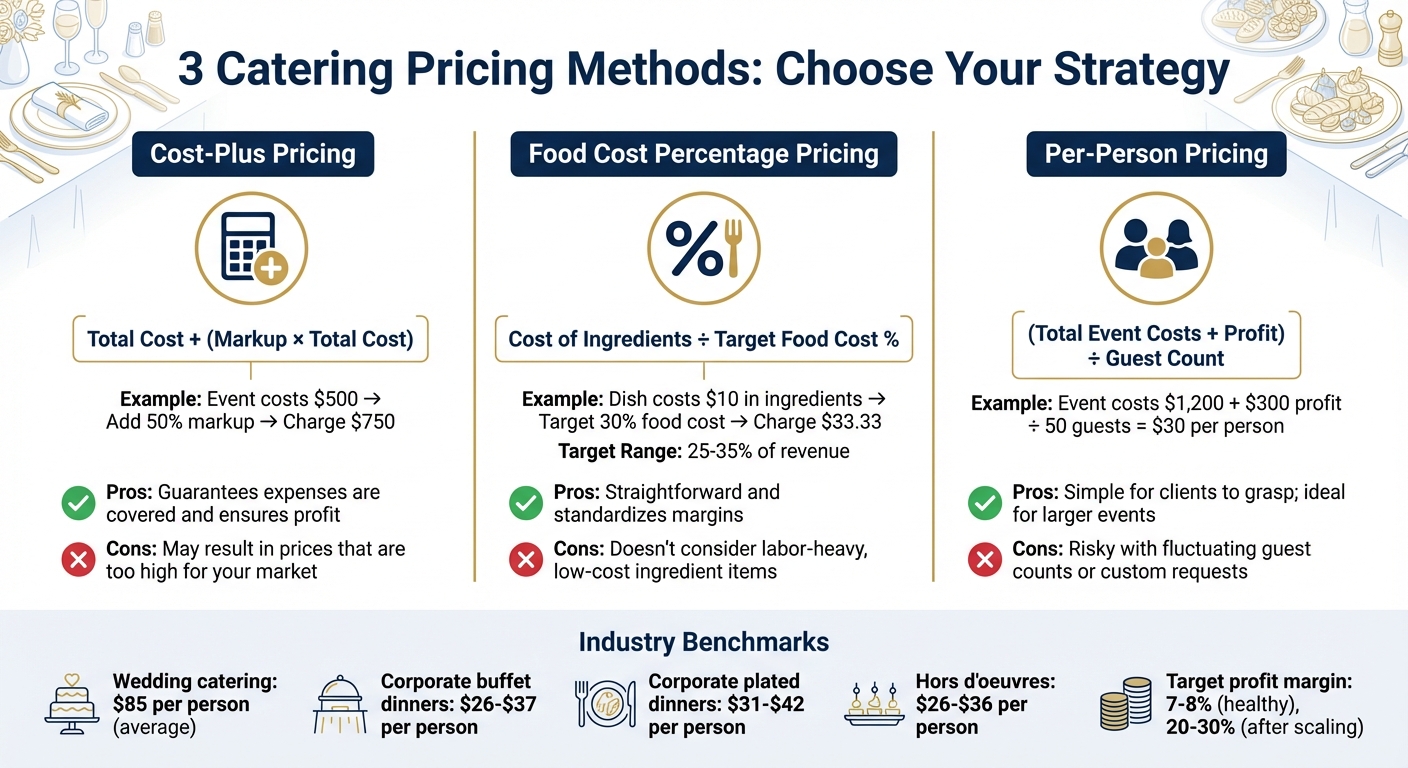
Catering Business Pricing Methods Comparison: Cost-Plus vs Food Cost Percentage vs Per-Person
After you've confirmed your niche, the next step is figuring out how to price your offerings. Pricing isn’t just about picking numbers - it’s about making sure every cost is covered while leaving room for profit. To get it right, you need to break down your expenses, choose the best pricing strategy, and calculate the exact cost of producing each portion.
Breaking Down Your Costs
Catering expenses generally fall into four main categories.
- Direct Costs: These are your ingredient costs - everything from proteins and produce to spices and garnishes. Even small quantities matter, especially for large events. Aim to keep food and labor costs between 25%–35% of your revenue . Ian Christopher from Galley Solutions points out:
"Labor costs are often overlooked by new caterers, leading to beautifully priced menus that actually lose money once staffing is factored in."
- Overhead Costs: These are your fixed monthly expenses, such as rent, utilities, insurance, marketing, and vehicle maintenance. To allocate these costs per event, divide your total monthly overhead by the number of events you cater. For instance, if your monthly overhead is $3,000 and you handle 20 events, each event would carry $150 in overhead costs .
- Event-Specific Costs: These include rentals (like linens, china, and glassware), bar services, transportation, and packaging. Rentals typically range from $2 to $6 per person, while bar services average $2 to $4 per person.
Tracking your food costs over time is crucial. Use this formula:
(Beginning Inventory + Purchases - Ending Inventory) / Total Food Sales.
For example, Samantha's, a Boston-based food service company, discovered in 2024 that their food costs had risen from 36.5% to 37.1%, resulting in a $10,000 profit loss. The culprit? Cooks were serving portions 11% larger than recipes required. By enforcing strict portion control, they reduced food costs to 35.5%.
Once you have a clear understanding of your costs, you can select a pricing method that aligns with your market and profit goals.
3 Pricing Methods for Catering
There are three common ways to price catering services, each with its own pros and cons:
- Cost-Plus Pricing: Add a fixed markup percentage to your total costs. For example, if an event costs $500 in food, labor, and overhead, and you apply a 50% markup, you charge $750. This ensures a profit but may make you less competitive if your costs are high.
- Food Cost Percentage Pricing: Divide your ingredient costs by your target food cost percentage (usually 25%–35%). For instance, if a dish costs $10 in ingredients and you aim for a 30% food cost, you’d charge about $33.33. While simple, this method doesn’t account for labor-intensive dishes with inexpensive ingredients.
- Per-Person Pricing: Divide your total event costs plus desired profit by the guest count. For example, if an event costs $1,200 and you want $300 profit for 50 guests, you’d charge $30 per person. This method is easy for clients to understand but can be risky if guest counts change or custom requests add unexpected costs.
| Method | Formula | Pros | Cons |
|---|---|---|---|
| Cost-Plus | Total Cost + (Markup × Total Cost) | Guarantees expenses are covered and ensures profit. | May result in prices that are too high for your market. |
| Food Cost % | Cost of Ingredients / Target Food Cost % | Straightforward and standardizes margins. | Doesn’t consider labor-heavy, low-cost ingredient items. |
| Per-Person | (Total Event Costs + Profit) / Guest Count | Simple for clients to grasp; ideal for larger events. | Risky with fluctuating guest counts or custom requests. |
To stay competitive, use industry benchmarks. Wedding catering averages around $85 per person. For corporate events, buffet dinners typically cost $26–$37 per person, while plated dinners range from $31–$42 per person. Hors d'oeuvres generally fall between $26 and $36 per person. A healthy catering profit margin is usually 7%–8%, though some businesses achieve 20%–30% after scaling .
Scaling Recipes and Calculating Cost Per Portion
When scaling recipes for large groups, start by nailing down an accurate guest count. For a standard plated meal, plan for 4–6 ounces of meat, two side dishes, one appetizer, and one dessert per person. For children, portions are typically half the size of an adult’s.
To calculate the cost per portion, add up the total cost of all the ingredients in a recipe and divide by the number of servings. For example, if a $45 batch of chicken marsala serves 30, the cost per portion is $1.50.
Using U.S. measurements and wholesale pricing will help maintain accuracy. Setting up accounts with restaurant supply stores can save 20%–30% compared to retail prices. Another cost-saving strategy is cross-utilizing ingredients. Pam Schwartz, Co-founder and General Manager of Ranch 45, shares:
"Cross-utilizing ingredients across different times of day... effectively reduces waste and maximizes ingredient usage."
For instance, if you purchase 20 pounds of chicken for a corporate lunch, you can use the leftovers in a different dish later in the week. This approach can cut inventory costs by 10%–15%. Standardizing portions also prevents overages that eat into your margins. Lastly, always follow the 4-hour rule for food safety.
Compliance: Meeting U.S. Regulations
Once you've finalized your pricing, the next step is ensuring your catering business complies with all legal requirements. Regulations exist at the federal, state, and local levels, and obtaining the necessary permits and insurance is crucial to avoid fines, lawsuits, or even being shut down.
Required Licenses and Permits
Start by getting an Employer Identification Number (EIN) from the IRS. This is a must-have for securing other permits and handling taxes. Then, apply for a general business license and a food service (catering) permit from your local authorities. Depending on your location and the size of your business, a food service license could cost anywhere from $100 to $1,000.
If you're planning to operate from home, be aware of Cottage Food Laws. Many regions prohibit using a private residence for commercial food prep unless you have a separate, inspected kitchen. The FDA Food Code (2017) clearly states:
"A private home, a room used as living or sleeping quarters, or an area directly opening into a room used as living or sleeping quarters may not be used for conducting food establishment operations".
Additionally, you'll need a resale certificate (or sales tax permit) from your state to buy ingredients tax-free and collect sales tax from customers. These are typically inexpensive - often less than $50 or even free. If you plan to serve alcohol, a liquor license from your state's control board is required. Lastly, check with your local fire department to see if you need an occupancy permit, which ensures your facility meets fire safety standards.
| License/Permit | Issuing Agency | Description |
|---|---|---|
| Employer Identification Number (EIN) | IRS (Federal) | Needed for taxes, opening business accounts, and hiring employees. |
| General Business License | City or County | Authorizes business operations in a specific area. |
| Food Service License | Local Health Department | Confirms compliance with health codes for food service. |
| Food Handler's Permit | Accredited Provider | Ensures employees understand safe food handling. |
| Liquor License | State Liquor Control Board | Necessary for serving or selling alcohol at events. |
| Resale License | State Tax Authority | Allows tax-free ingredient purchases and sales tax collection. |
| Occupancy Permit | Local Fire Department | Certifies fire safety compliance and maximum capacity. |
Once you've secured these permits, focus on meeting health and safety standards to run your business smoothly.
Health and Food Safety Standards
Health departments inspect everything from ingredient storage to waste disposal. At least one person on your team - usually the owner or manager - must hold a Certified Food Manager (CFM) certificate from an accredited program like ServSafe. It's a good idea to certify multiple staff members to ensure someone qualified is always on-site during operations.
Most areas require catering businesses to use a commercial kitchen rather than a home kitchen for large-scale operations. Commercial kitchen rentals typically range from $15 to $50 per hour. Before using a home kitchen or leasing a space, confirm zoning rules with your local government. Also, schedule a pre-operational health inspection to verify your kitchen meets safety standards before starting operations.
Temperature control is a top priority. Keep hot foods at 140°F or above and cold foods at 40°F or below. Proper handwashing facilities, allergen labeling, and strict protocols to prevent cross-contamination are also essential. The FDA oversees most food ingredients and interstate commerce, while the USDA regulates meat, poultry, and specific processed egg products. Additionally, maintain "one up, one down" records to track where ingredients came from and where finished products are sent.
Once your health and safety measures are in place, protect your business further by securing proper insurance.
Insurance and Legal Requirements
Many event venues require proof of general liability insurance before allowing you to cater. This insurance covers injuries and foodborne illnesses, offering essential protection for your business.
You'll also need commercial property insurance to safeguard kitchen equipment, tools, and inventory against fire, theft, or damage. If your business involves transporting food and staff to events, commercial vehicle insurance is necessary. For businesses with employees, most states mandate workers' compensation, which covers medical expenses and lost wages for work-related injuries like burns or falls. If alcohol is part of your services, liquor liability insurance protects against claims involving intoxicated guests. Comprehensive insurance coverage typically costs between $2,000 and $5,000 annually.
It's also crucial to classify workers correctly as employees or contractors to comply with payroll and workers' compensation laws. Consider forming an LLC or corporation instead of operating as a sole proprietorship. This can shield your personal assets from business-related lawsuits. Lastly, federal OSHA regulations require you to provide safety measures like hand, eye, and face protection for staff, along with safe walking surfaces.
Creating Your Launch Plan
With your menu priced and compliance requirements sorted, it’s time to bring everything together and plan your launch. Here’s how to get started:
Launch Steps in Order
Begin by registering your business as an LLC or Corporation and obtaining your EIN, a process that usually takes one to two weeks. Next, secure a kitchen space that fits your budget and needs. Options include operating under Cottage Food Laws (costing under $2,000), renting a shared commercial kitchen (ranging from $5,000 to $10,000), or setting up a private facility (costing over $50,000). Once your kitchen is ready, schedule and pass your health inspection and obtain your Food Handler's Permit or ServSafe certification, which typically takes about a week.
With certifications in hand, the next step is securing insurance. Plan to spend around $2,000 to $5,000 annually for general liability, property, and vehicle coverage. After that, implement a three-step client strategy to build your customer base. Start with a "Portfolio Builder" event for friends at cost, move on to a "Referral Partner" event with planners, and finally, target an "Online Searcher" through your Google Business Profile, offering services at full price. From business formation to your first paying client, this entire process usually takes 30 to 45 days.
Once these steps are complete, your focus should shift to tracking your performance and fine-tuning your operations.
Tracking Performance and Adjusting
After laying the groundwork, consistent performance monitoring becomes key to maintaining profitability. Track essential metrics like food cost percentages (aim for 25%–35%), profit margins per event (target 10%–20%), and cash reserves (keep at least six months of operating costs on hand to weather seasonal shifts). Regularly evaluate your food costs and enforce portion controls to avoid overspending that could eat into your margins.
Use digital tools like the IdeaFloat Financial Model to link vendor pricing directly to your recipes, enabling real-time cost tracking and helping you protect your margins. Build relationships with two or three suppliers for each ingredient category - this approach can help you save 20%–30% compared to retail prices. Additionally, review supplier contracts and menu pricing every quarter. Rotating dishes seasonally can also be a smart move, as it allows you to take advantage of local, in-season ingredients and reduce procurement costs.
As Ian Christopher, Co-founder of Galley Solutions, wisely points out:
"Pricing is not a one-time task, but an ongoing process that requires regular review and adjustment".
Conclusion
Building a successful catering business rests on four key steps: confirming demand before making investments, carefully tracking all costs, setting prices that ensure profitability, and adhering to U.S. compliance regulations. As Christine Colling from Durable emphasizes:
"The biggest mistake new caterers make is underpricing. Understand your costs before setting prices".
This means you need to calculate your breakeven point early on. It’s essential to know how many events you’ll need to cover both fixed expenses - like rent and insurance - and variable ones, such as labor and ingredients. This approach helps create a strong foundation for sound financial and operational planning.
In 2022, the U.S. catering market reached $60.4 billion, with an expected annual growth rate of 7.7%. To prepare for success, separate your business and personal finances, get an EIN, form an LLC, and allocate funds for insurance, which typically ranges from $2,000 to $5,000 per year. Operationally, strict food safety practices are critical, especially during transport and service.
Compliance isn’t just about meeting legal requirements - it’s about protecting your customers and your business. From obtaining ServSafe certifications to securing health permits and liability insurance, these steps safeguard your reputation and bottom line.
Leveraging advanced tools can streamline your operations. For instance, IdeaFloat's Financial Model links vendor pricing directly to your recipes, enabling real-time cost tracking. Instead of relying on spreadsheets or guessing your profit margins, you can maintain profitability from day one and adapt as ingredient prices fluctuate. Combined with tools for market analysis, competitor research, and launch planning, IdeaFloat simplifies the technical challenges that new caterers often face.
Start your catering business with confidence: validate your niche, set profitable prices, meet regulatory standards, and keep a close eye on your performance. By pairing precise cost management with strict compliance, you create a solid foundation for a thriving and sustainable business. The catering industry rewards those who balance the numbers and the rules - and now you have the blueprint to succeed.
FAQs
What licenses and permits do I need to start a catering business in the U.S.?
To legally kick off a catering business in the United States, you'll need to secure several key licenses and permits. Start by registering your business as an LLC, corporation, or sole proprietorship, and obtain a business license from your local city or county. Next, you'll need a food-service establishment permit from your county health department, along with a food handler’s permit for anyone involved in food preparation or serving. Planning to serve alcohol? You'll also need a state-issued liquor license or a temporary event permit. Don't forget a sales tax permit to handle the collection and payment of sales tax for your services.
If you're working out of a commercial kitchen, a zoning permit and possibly a fire department inspection will be required to ensure you're meeting local regulations. For home-based caterers, compliance with your state’s Cottage Food Law is essential, and you may need specific exemptions. If your business involves meat, poultry, or dairy, additional registration with the USDA/FSIS or a meat processing license might be necessary. Always double-check with your local and state authorities to make sure you're covering all the legal bases.
What are the best ways to test my catering business idea before investing too much?
Before diving headfirst into your catering business, you can test the waters with a few simple and budget-friendly steps:
- Estimate your market potential: Crunch some numbers to figure out how many events or clients you'd need each month to cover costs and turn a profit. For example, if you plan to charge $25 per plate, calculate how many plates you'd need to sell based on the demand in your area.
- Get feedback from your audience: Reach out to potential customers - friends, coworkers, or even local businesses. Use tools like surveys or social media polls to learn about their preferences for cuisines, price points, and services they’re likely to book.
- Run a small-scale test: Organize a low-cost trial, such as a pop-up event, a tasting night, or even a pre-sale page where customers can place deposits. Monitor the interest and sales to see if there’s genuine demand for your offerings.
These steps can help you fine-tune your concept, confirm there's a market for your services, and reduce risks before investing heavily in equipment or a dedicated space.
What’s the best way to price your catering menu for profitability?
To price your catering menu wisely, consider starting with a cost-plus markup approach. This means calculating the total cost of ingredients for each dish and adding a markup of 200%–300% (price = cost × 2–3). This method typically achieves a 30% food cost percentage and helps maintain an average 7%–10% profit margin, which is standard for catering businesses.
Keeping your business profitable requires regular monitoring of food, labor, and overhead costs. Be prepared to adjust your prices if ingredient costs rise. It's also a good idea to compare your pricing with local competitors to ensure you're competitive while still covering all your expenses. For larger events, you might want to offer per-person pricing or bundled packages that include food, service, and equipment. This simplifies the pricing process for your clients while safeguarding your profit margins. By following these practices, you can avoid underpricing and set your catering business up for long-term success.
Related Blog Posts
 Report an issue
Get the newest tips and tricks of starting your business!