
Struggling to rank on Google? If your SEO efforts aren’t delivering results, it might be time to reassess your strategy. The article highlights how keyword research is not just an SEO tool - it’s a business viability test. Here’s the gist:
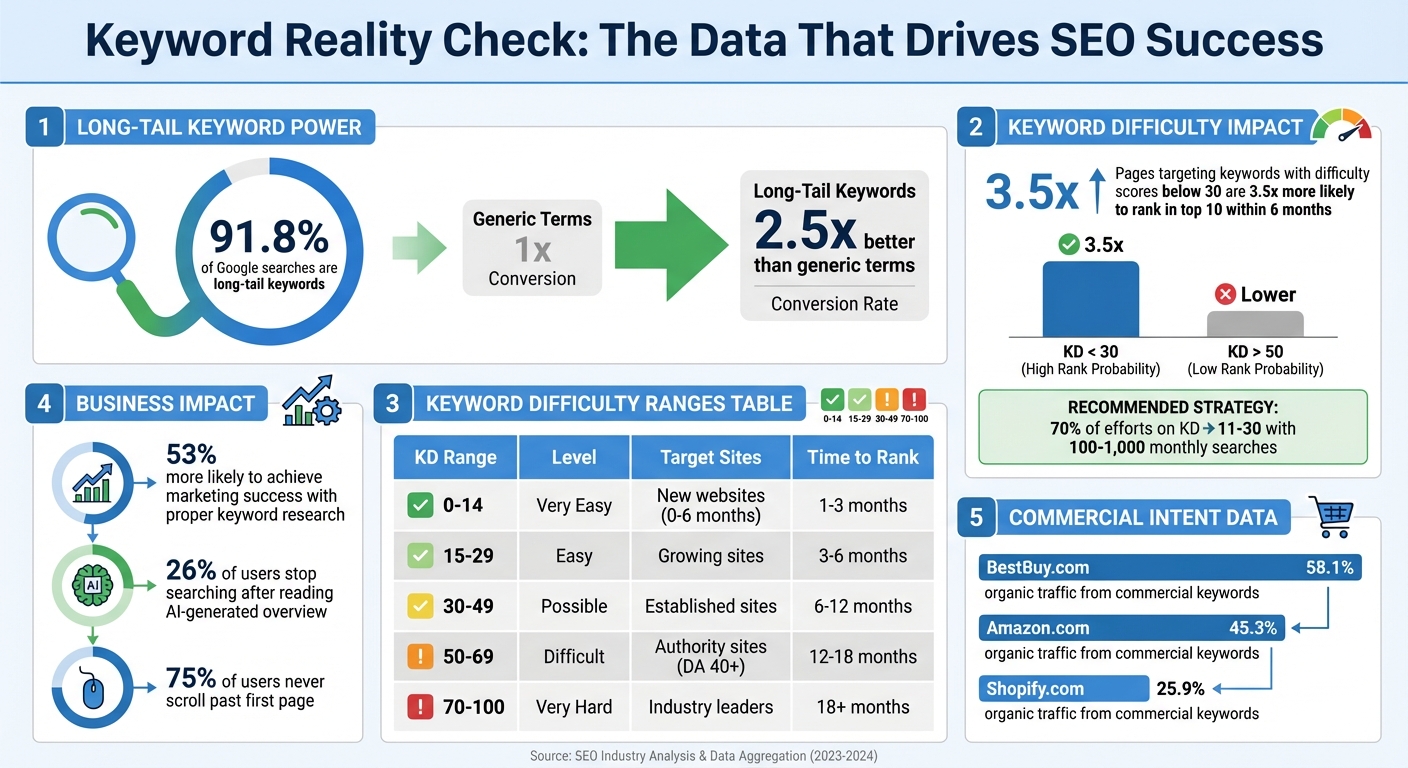
- 91.8% of searches are long-tail keywords that convert 2.5x better than generic terms. If you’re chasing overly competitive terms (difficulty score above 70), you’re wasting time.
- Use Google Search Console and competitor analysis tools to find keywords you can realistically rank for.
- Focus on long-tail keywords with lower difficulty and high intent, like “CRM for small nonprofits.”
- If your niche lacks search demand or realistic opportunities, explore adjacent markets or pivot your business model.
Key takeaway: Keyword research reveals what’s achievable and where your business stands. If the data shows no clear path forward, it’s time to pivot or refine your approach.
Long-Tail Keywords Statistics: Search Volume, Conversion Rates, and Ranking Success
Keyword Research Tutorial: From Start to Finish
sbb-itb-08dd11e
How to Identify Your Core Niche Keywords
Your core niche keywords are the bridge between your business and the people actively searching for what you offer. These keywords reflect the exact terms and phrases your audience uses when looking for solutions like yours.
Start by identifying the basic terms that describe your business. Then, expand your list with tools like ChatGPT to brainstorm related topics, customer needs, and subtopics. Another goldmine for insights is your Google Search Console data - focus on queries with high impressions but low clicks. These often highlight customer interests that your content hasn’t fully addressed yet.
Competitor analysis is another key step. Look at your top three competitors and use tools like "Keyword Gap" to identify high-intent keywords they rank for that you’re missing. These terms are already driving traffic in your industry, giving you a clear direction for content opportunities. Once you’ve gathered potential keywords, validate them by analyzing the Search Engine Results Pages (SERPs). Check for content type (e.g., blog vs. product page), format (e.g., listicle vs. tool), and angle (e.g., "easy" vs. "professional"). A manual search in an incognito window can help confirm whether your content aligns with user intent.
Finally, refine your list by paying attention to how customers naturally talk about these topics.
Find Keywords from Customer Conversations
The way customers describe your product can differ significantly from how you might describe it. This gap can hurt your visibility. Listening to customer conversations is essential to uncovering the language they actually use.
Start by talking to client-facing employees - salespeople and customer support teams often hear the exact questions and terminology customers use. You can also poll your audience via email or social media with direct questions like, “What’s the hardest thing about finding [Product]?” These responses often reveal regional or community-specific terms you might not have considered.
Online platforms like Reddit, Quora, and niche Facebook groups are treasure troves for identifying recurring phrases and pain points that traditional keyword tools miss. Jonathan Berthold, VP of Revenue at Moz, highlights this shift in approach:
Prompt tracking is about understanding how your audience thinks, asks questions, and explores problems in their own words. Build prompt lists using real customer language from Search Console, existing keywords, and community discussions.
Voice search queries are another valuable resource since they tend to mirror natural, conversational language. These queries are often longer and more question-focused than traditional typed searches. Tools like Google Autocomplete can also provide real-time suggestions based on what users are actively searching for.
Before committing to any keyword, ensure it meets four essential criteria: Does it address something your audience cares about? Does it solve a problem or fulfill a need? Can you offer a solution? And can you create meaningful content around it?
Once you’ve gathered insights from customer conversations, it’s time to focus on long-tail keywords for a sharper competitive edge.
Why Long-Tail Keywords Matter
Long-tail keywords can give startups a real advantage. While big players dominate broad terms like "project management software", you can target specific phrases like "project management software for remote creative agencies under 10 people."
Here’s why they’re so powerful: 91.8% of Google searches are long-tail, and these keywords have conversion rates 2.5 times higher than broader terms. For example, someone searching for "organic coffee beans for espresso" is much closer to making a purchase than someone simply typing "coffee."
Real-world examples back this up. In July 2025, the SaaS company Wave created a landing page for "free accounting software for nonprofits." This page ranked in the top three results for 25 keywords - mostly long-tail - bringing in organic traffic worth approximately $2,600, according to Semrush data. Similarly, Choose Chicago targeted specific FAQs with attraction guides in June 2025. Their content ranked in the top three results for 482 keywords, half of which were long-tail phrases with four or more words.
Long-tail keywords also face less competition since they’re relevant to fewer websites. Plus, they align with modern search behavior. AI-powered search engines like Google AI Mode often break a single query into multiple related sub-queries. By targeting long-tail terms, you increase your chances of appearing in these expanded results.
Rachel Handley, Senior Content Writer at Semrush, explains it best:
Long-tail keywords are highly precise search engine queries people use when they're searching for something specific or searching conversationally.
To make the most of long-tail keywords, group them by search intent into keyword clusters. Target these clusters on a single page to capture a broader search volume. Use Google Search Console to find long-tail keywords where you already rank on pages 2 or 3 (positions 11–30). Updating this content can push it to page 1. This approach - often called the "beachhead principle" - involves targeting easier long-tail variations first to build enough authority to rank for more competitive keywords later on.
How to Measure Keyword Competition
Once you've pinpointed your core and long-tail keywords, the next step is figuring out how competitive they are. This is crucial - it helps you avoid wasting time chasing keywords that are out of reach and instead focus on those you can realistically rank for.
Keyword Difficulty (KD) is a metric ranging from 0 to 100 that estimates how hard it is to rank on the first page. It’s based mainly on the backlink strength and authority of the top-ranking pages. However, it’s important to note that general KD scores don’t account for your website's specific authority. For instance, a keyword with a KD of 50 might be unachievable for a new website but manageable for an established one with strong topical relevance.
This is where Personal Keyword Difficulty (PKD) comes into play. PKD evaluates how competitive a keyword is specifically for your site, factoring in your existing authority, backlink profile, and topical strength. Tim Soulo, CMO at Ahrefs, offers a useful analogy:
Think of the KD Score like the speed limit on a highway. The sign might say "70 MPH" (High Difficulty), which applies to everyone. But your personal difficulty depends on the car you're driving.
The numbers back this up. Pages targeting keywords with difficulty scores below 30 are 3.5 times more likely to rank in the top 10 within six months compared to those targeting scores above 50. A good rule of thumb: dedicate 70% of your efforts to keywords with KD scores between 11–30 and search volumes of 100–1,000 per month.
Manually analyzing the SERPs can reveal opportunities that automated tools might miss. Look for outdated or thin content - pages over two years old, articles under 1,000 words, or low-authority sites (Domain Authority under 30) ranking in the top 10. If you see forums like Reddit or Quora in the top results, it’s often a sign that Google lacks quality content for that query, giving you a chance to step in.
By aligning keyword difficulty with your website’s strengths, you can validate market demand and refine your strategy.
How to Score Keyword Difficulty
To start, benchmark your site’s current performance. Identify keywords where you already rank in positions 1–10 and note their KD scores. This will give you an idea of the difficulty range you can realistically target right now.
Here’s a simple breakdown of KD ranges and what they mean:
| KD Range | Level | Target Sites | Time to Rank |
|---|---|---|---|
| 0–14 | Very Easy | New websites (0–6 months) | 1–3 months |
| 15–29 | Easy | Growing sites building topical authority | 3–6 months |
| 30–49 | Possible | Established sites with quality backlinks | 6–12 months |
| 50–69 | Difficult | Authority sites with strong DA (40+) | 12–18 months |
| 70–100 | Very Hard | Industry leaders and major brands | 18+ months |
To uncover hidden opportunities, calculate a "Top 10 Weakness Score." Assign points for weaknesses in the top 10 results: +10 for forum posts, +8 for content older than two years, +7 for articles under 1,000 words, and +6 for competitors with Domain Authority under 30. A score over 30 suggests a keyword where you might have a shot, even if the KD score seems high.
Also, watch for intent mismatches - situations where the content type doesn’t align with what users are looking for. These gaps often signal an opportunity to create better-targeted content. Omid Ghiam, Founder of Marketer Milk, highlights this approach:
I like to make the lowest DR to something like 10 or 15... In theory, if those pages are ranking for that specific keyword, we can also rank for it (with a better piece of content, that is).
Don’t ignore "zero-volume" keywords either. These can often be discovered through Google Autocomplete or "Related Searches." Despite tools reporting no search volume, these terms can carry high intent and low competition, making them valuable for conversions.
With a clear understanding of keyword difficulty, you can focus on finding and exploiting competitors' weaknesses.
Find Gaps Where Competitors Are Weak
Keyword gap analysis is a powerful way to spot opportunities where competitors rank well, but your site doesn’t. This process highlights areas where you’re missing out and helps refine your content strategy. There are two main types of gaps to focus on:
- "Weak" keywords: Keywords where you already rank (positions 2–20) but are being outranked by competitors. These are quick wins that often require only minor adjustments.
- "Missing" keywords: Keywords where your site doesn’t rank at all. For newer sites, prioritize keywords with KD scores of 49 or lower to find realistic opportunities.
Start by analyzing your top three SEO competitors. These aren’t necessarily your business rivals; instead, they’re the websites ranking for your target keywords. For example, they could be blogs or review sites rather than direct competitors. Dr. Peter J. Meyers, Marketing Scientist at Moz, explains:
Keyword gap analysis is a powerful tactic to make sure you're on the right track... Why just mind the gap, when you can mine the gap?
Pay close attention to SERPs with ambiguous intent. If Google is showing a mix of blogs, product pages, and other content types, it’s often easier to break into the rankings with well-crafted, expert content. Also, keep an eye out for "AI Visibility Gaps", where competitors appear in AI-generated search summaries, but your brand doesn’t. Around 26% of users stop searching after reading an AI-generated overview, so if your competitors are being cited and you’re not, it’s time to optimize. Add clear definitions, FAQ sections, and structured data to improve your chances.
Use Keywords to Validate Market Demand
Keyword research isn’t just about finding terms you can rank for - it’s also about confirming there’s genuine interest in what you’re offering. While keyword difficulty helps you assess ranking potential, search volume reveals the level of demand. Together, these metrics can help you determine if your business idea aligns with real customer needs.
Use Search Volume to Measure Interest
Search volume reflects the average number of times a keyword is searched each month in a specific location. It’s a solid indicator of demand: if people aren’t searching for solutions like yours, they’re unlikely to buy them.
However, don’t put all your faith in a single high-volume keyword. A better approach is to look at the combined search volume of related keywords, including long-tail and mid-range terms. For example, if you’re launching a project management tool for remote teams, don’t just focus on “project management software.” Broaden your scope to include terms like “remote team collaboration tools,” “team task management app,” and “async project tracking” to capture a fuller picture of demand.
As a general rule, aim for keywords with at least 100 monthly searches. Keep in mind, though, that search volume reflects the number of searches, not unique searchers - one person might perform the same query multiple times in a month. Use these numbers as a directional guide rather than absolute truths.
Trends are just as important as raw numbers. A keyword with 1,000 monthly searches might seem appealing, but if its popularity has been declining over the past year, it could indicate waning interest. On the flip side, a keyword with 300 searches but a steady upward trend might signal growing demand. Also, consider seasonal fluctuations - terms like “bathing suits” naturally spike in spring and summer.
Finally, focus on search intent. A keyword with 10,000 monthly searches might look promising, but if the intent is purely informational (e.g., “how to manage a remote team”), it’s less valuable than a transactional keyword like “buy remote team software”. As Rand Fishkin, Founder of Moz, explains:
A massively oversimplified version... is to look broadly at kind of AdWords groups... This is dead wrong. It's totally oversimplified. It's not taking into account all the things we have to do to really understand the market.
For a deeper understanding, consider running a short Google Ads campaign (10–15 days) targeting your chosen keywords. This can help you gauge click-through rates, conversion potential, and whether the search volume translates into actual business opportunities.
Match Keywords with Market Size Data
Search volume offers a snapshot of interest, but to assess the full business opportunity, you’ll need to conduct a market size assessment and connect it to broader market data. This involves understanding key metrics like Total Addressable Market (TAM), Serviceable Addressable Market (SAM), and Serviceable Obtainable Market (SOM).
- TAM represents the total monthly searches for all relevant keywords in your category. For example, if you’re building a live streaming platform, TAM would include searches like “live streaming software,” “streaming platforms,” and “broadcast tools.”
- SAM narrows this down to searches that fit your specific niche or geographic focus. If your platform targets U.S.-based businesses, SAM would reflect only U.S. search volume.
- SOM is the share of the market you can realistically capture, considering your current resources, marketing efforts, and competition.
To measure your Share of Search, divide your site’s estimated organic traffic by the total category search volume, then multiply by 100. For instance, if the category has 100,000 monthly searches and your site receives 5,000 visits, your Share of Search would be 5%. As Emily Wassell, SEO Specialist, explains:
If your traffic is up 5% year on year, but your category size has grown 10%, you're actually getting a smaller portion of the pie.
Another useful metric is Cost Per Click (CPC), which can act as a proxy for a keyword’s commercial value. A high CPC suggests advertisers see strong conversion potential. For example, a keyword with 500 searches and a $15 CPC might be more valuable than one with 2,000 searches and a $0.50 CPC. You can also calculate Customer Acquisition Cost (CAC) using CPC and conversion rates; for instance, a $6.50 click with a 5% conversion rate would result in a CAC of approximately $130.
Lastly, analyze whether search demand skews toward branded or generic terms. If most searches are tied to competitor brand names, the market may be saturated. But if generic terms like “team collaboration software” or “video conferencing tools” dominate, there could be room for a new player. A keyword gap analysis can help you identify high-volume generic terms that competitors might be neglecting.
| Metric | Definition in Search Context | Purpose |
|---|---|---|
| TAM | Total monthly searches for all category keywords | Measures total potential reach |
| SAM | Searches for keywords matching your niche/location | Identifies a realistic audience |
| SOM | Estimated traffic based on rankings and budget | Measures current market capture |
| Share of Search | (Your Traffic / Total Category Volume) × 100 | Tracks brand authority vs. competitors |
5 Types of Keywords You Must Rank For
Focusing on these five keyword types can help align your business with how customers search online. By targeting these categories, you can better understand market demand and shape your strategy accordingly.
Problem-Specific Keywords
These keywords reflect how customers describe their challenges, often phrased as questions, before they even know about your product. For instance, someone might search for "how to stop leads from going cold" or "automate follow-up emails without being spammy." To find these terms, dig into customer support tickets, sales call transcripts, and forums like Reddit or Quora. Google's "People Also Ask" and Autocomplete features can also reveal helpful insights. Even keywords with no search volume can be valuable if they address real customer concerns. These phrases allow you to connect with potential customers early in their search journey.
As Greg Gifford, VP of Search at Search Lab, puts it:
Now that Google has evolved and is providing search results based on the intent of the search query, keyword research is more important than ever... We have to understand how potential customers are searching - and specifically, the intent of their search query.
Buyer Intent Keywords
Once you've identified customer pain points, the next step is to reach those ready to make a purchase. Buyer intent keywords indicate that someone is close to buying, with searches like "buy [product]", "[product] pricing", or "[product] near me." While informational keywords may drive traffic, buyer intent terms often lead to higher conversion rates. For example, commercial keywords accounted for 58.1% of organic traffic to BestBuy.com, 45.3% to Amazon.com, and 25.9% to Shopify.com in October 2025. A jewelry retailer even saw 57.3% of its organic visits driven by these queries.
To find these keywords, use tools with filters for "commercial" or "transactional" intent, and prioritize those with high Cost Per Click (CPC) values, which often signal strong conversion potential. Collaborating with your sales team can also help identify common questions customers ask before purchasing. SEO expert Connor Gillivan emphasizes the importance of these terms:
I prioritize middle of the funnel (MOFU) and bottom of the funnel (BOFU) commercial keywords. Especially ones without AI Overviews.
Comparison Keywords
When customers start exploring solutions, they often compare options. This is where comparison keywords come into play, with searches like "[competitor] alternatives" or "[your product] vs [competitor]." These searches show a user is actively evaluating their choices. To capture this audience, create content that highlights your strengths without criticizing competitors. Include both branded comparisons and broader category comparisons like "best [product type] for [specific use case]." You might also aim to get featured in third-party "best of" lists, which can boost visibility.
Long-Tail Niche Keywords
Long-tail niche keywords target highly specific audiences, giving startups a chance to compete in less crowded spaces. These might include searches like "project management software for architecture firms" or "CRM for real estate agents in California." While individual terms might only attract 50–200 searches per month, they can collectively drive meaningful traffic and face less competition. Instead of going after broad terms like "project management software", focus on phrases like "async project tracking" or "remote team collaboration tools."
Use tools like Google Search Console to identify "striking distance" keywords - those ranking between positions 8–20. Nudging these terms onto the first page can significantly increase visibility, as 75% of users never scroll past the first page.
Emerging Trend Keywords
Stay ahead of the curve by targeting emerging trend keywords. These capture new topics that traditional tools might miss because they rely on historical data. For example, 15% of daily searches are estimated to be brand-new queries with no historical data. By focusing on these trends, such as "AI [your niche]" or "[product] 2026 trends", you can establish authority before competitors catch on.
As Digital Applied notes:
Search volume alone is no longer sufficient. In 2026, an estimated 15% of daily searches are brand new queries with zero historical data.
To find these opportunities, explore unconventional sources like customer support logs, niche Reddit threads, and Perplexity's Related Questions. AI tools like ChatGPT can also help generate keyword variations for emerging topics, especially given its popularity, with over 800 million weekly users as of early 2026.
When to Pivot: Warning Signs from Keyword Data
Keyword research helps validate whether your business strategy can gain traction in search. But sometimes, the data makes it clear that a shift in direction is necessary. Here are three key indicators that it’s time to rethink your approach.
When Keyword Difficulty Is Too High
If the top search results for a keyword are dominated by websites with Domain Ratings of 70–90+ while your site has significantly less authority, you're facing a steep uphill battle. Closing that gap could take over 18 months and require more than 100 referring domains. Competing against household names like Apple, Amazon, or Wikipedia - who often dominate the first page - becomes nearly impossible for smaller brands.
"Most keyword research 'spreadsheet dumps' people make are NOT useful... Useful keyword research [includes] keywords you can actually win based on your current authority".
The key is to look for weaknesses in the search results. Are there outdated articles (over two years old), thin content (under 1,000 words), or low-authority sites ranking in the top 10? If these cracks don’t exist or if the results are monopolized by government sites, universities, or major publications unrelated to your business, the keyword is likely out of reach.
A good rule of thumb: if ranking for a keyword would take more than a year and you need faster results, pivot to related long-tail variations with less competition. This approach ensures your efforts align with achievable goals.
When Search Volume Is Too Low
Low search volume isn’t always a dealbreaker, but it becomes a problem when you can’t find enough related terms to support a solid content strategy. Keywords with fewer than 100 monthly searches are generally not worth pursuing. Since most keywords have very low search volume, focus on those with at least 100 searches to ensure your content has a viable audience.
To verify search interest, use Google Search Console to check actual impressions, as keyword tools often underestimate volume. Then, assess whether a small number of high-intent visitors would justify the time and resources spent on the content. If the math doesn’t add up, consider a broader approach. For example, instead of targeting "facial ice roller", shift to addressing broader problems like "how to combat puffiness". This strategy ensures you’re addressing real user needs rather than forcing a fit where interest is too limited.
When Long-Tail Options Don't Exist
Long-tail keywords are often your best entry point into competitive markets. But if you can’t find low-difficulty long-tail variations of your main keywords, it could mean the niche is either too narrow or dominated by major players.
Without viable long-tail keywords, it becomes nearly impossible to build a growth strategy based on achievable wins.
"Keyword difficulty isn't meant to tell you that it's impossible to rank... Rather, it's there to help you determine whether the reward will be worth the effort".
If your research consistently turns up no low-difficulty long-tail terms, it’s a strong signal that the niche might not be sustainable. In this case, consider exploring adjacent markets or reevaluating your business model entirely.
Conclusion
Keyword research goes beyond simply finding terms - it’s about assessing whether your business idea has the potential to compete effectively. The data helps you determine if you’re setting yourself up for success or wasting time chasing rankings that are out of reach. This step is critical to understanding if your business can tackle market challenges. In fact, businesses that take the time to conduct proper keyword research are 53% more likely to achieve marketing success compared to those that skip it.
Start by evaluating your current authority using the Keyword Difficulty (KD) scores of keywords ranking in the top positions (1–3). If your target keywords have much higher KD scores than your current capabilities, it’s a sign that your goals might not align with reality. Instead of competing for broad, high-volume keywords, focus on owning niche, problem-solving phrases that match your unique offerings. Tools like Google Search Console can help you identify "striking distance" keywords - those sitting in positions 8–20 - where small optimizations could push your content onto the first page.
FAQs
How can I tell if a keyword is too competitive for my website to rank for?
To determine if a keyword is too competitive for your website, start by examining its keyword difficulty score. This score gives you an idea of how challenging it might be to rank for that term. Keywords with scores closer to 100 usually indicate stiff competition, often dominated by established websites, which can make it harder for newer or smaller sites to break through.
It’s also important to evaluate your website’s authority. Factors like domain strength and the number of high-quality backlinks play a big role here. If your site is relatively new or lacks a strong backlink profile, it’s smarter to aim for keywords with lower difficulty scores. Another helpful tactic is to review the websites currently ranking for the keyword. If those sites have significantly higher authority, it may be more practical to focus on less competitive keywords that better match your site’s capabilities. By targeting terms that align with your strengths, you’ll have a better chance at achieving meaningful results without wasting effort on overly ambitious goals.
Why should I focus on long-tail keywords for SEO success?
Focusing on long-tail keywords can give your SEO strategy a real boost by zeroing in on highly specific search queries. These keywords tend to attract visitors who already know what they’re looking for - whether that’s buying a product, signing up for a service, or diving into your content.
What makes long-tail keywords so appealing? For starters, they usually have less competition, which means it’s easier to climb the search rankings. Plus, they help you tap into niche audiences, setting you apart from competitors in your space. By prioritizing these more targeted phrases, you can increase visibility and achieve solid results without the uphill battle of competing for broad, high-traffic terms.
How can keyword research indicate when it’s time for a business to pivot?
Keyword research can be a wake-up call for businesses, signaling when it might be time to shift strategies. If ranking for key terms in your niche feels like an uphill battle due to stiff competition from well-established players, it’s worth considering less competitive long-tail keywords or exploring untapped market segments.
By digging into metrics like keyword difficulty, search volume, and market demand - using tools like AI-driven platforms or keyword planners - you can uncover opportunities where your business has a better shot at standing out. Adjusting your focus based on this data allows you to target niches with realistic potential, ensuring your efforts are aimed at goals you can actually achieve.
Related Blog Posts
 Report an issue
Get the newest tips and tricks of starting your business!