If you're looking to start a local service business and aim for $10,000/month quickly, here’s what you need to know:
- Residential Cleaning: Low startup costs ($1,350–$3,200). You can secure recurring clients fast and scale to $10,000/month in 3–6 months by hiring help.
- Mobile Car Detailing: Startup costs range from $2,000–$5,000. With high-ticket services and upsells, you can potentially hit $10,000/month within weeks, especially with fleet contracts.
- Lawn Care: Moderate startup costs ($1,500–$4,500). Recurring weekly clients make it a steady option, but seasonal demand can be a challenge.
- Handyman Services: Start with $1,000–$4,000. High hourly rates and upsells allow you to reach $10,000/month quickly, but a broad skill set is key.
- Home Organization: Startup costs are $1,000–$3,000. High margins but slower to scale unless you expand services or hire subcontractors.
Quick Comparison
| Business Model | Startup Cost | Time to $10k/Month | Key Advantage | Key Challenge |
|---|---|---|---|---|
| Residential Cleaning | $1,350–$3,200 | 3–6 months | Recurring revenue | Physically demanding |
| Mobile Car Detailing | $2,000–$5,000 | 1–4 weeks | High-ticket services | Weather-dependent |
| Lawn Care | $1,500–$4,500 | Moderate | Steady weekly clients | Seasonal income |
| Handyman Services | $1,000–$4,000 | Fast | High upsell potential | Requires broad skills |
| Home Organization | $1,000–$3,000 | Moderate | High margins | Slower to scale solo |
For a fast start, mobile car detailing is ideal due to quick cash flow and upsell opportunities. If you prefer steady growth, residential cleaning is a great choice. Choose based on your skills, budget, and local market demand.
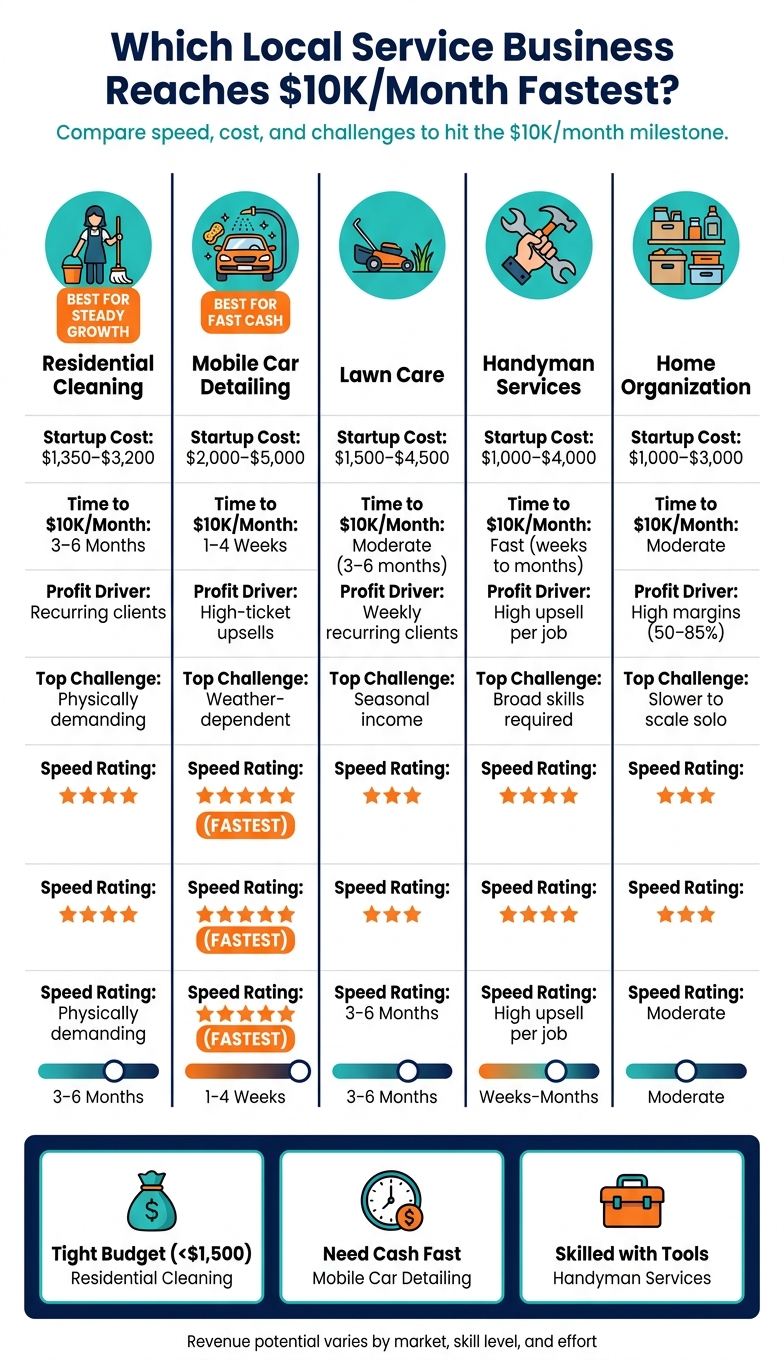
Local Service Business Comparison: Fastest Path to $10K/Month
The Most Overlooked $10k/Mo Business You Can Start Remotely
sbb-itb-08dd11e
1. Residential Cleaning Services
Residential cleaning is one of the easiest local service businesses to get off the ground. The U.S. cleaning services industry pulls in over $90 billion annually, with steady demand fueled by dual-income households and older homeowners who either lack the time or physical ability to handle cleaning themselves.
Startup Costs
Getting started doesn’t require much upfront investment. A solo cleaner can begin with as little as $1,350 to $3,200, which covers essentials like registration, insurance, basic equipment, and some marketing. The most critical early expense isn’t a high-end vacuum - it’s general liability insurance, costing about $30–$60 per month. Without it, even one damage claim could wipe out months of hard-earned profits.
| Item | Solo Operator | Team/Scale Launch |
|---|---|---|
| Registration & Licensing | $50 – $500 | $150 – $1,000 |
| Insurance & Bonding | $800 – $1,300 | $1,500 – $2,300 |
| Equipment (Vacuum, Mops, etc.) | $300 – $600 | $1,000 – $3,000 |
| Initial Supplies/Chemicals | $100 – $300 | $500 – $1,000 |
| Marketing (Flyers, Ads, Site) | $100 – $500 | $1,000 – $2,500 |
| Total Estimated Startup | $1,350 – $3,200 | $4,150 – $9,800 |
Time to $10k/Month
A solo cleaner working three jobs a day, five days a week, at a flat rate of $150 per job can gross around $8,000 per month. While this schedule is physically demanding and leaves little room for growth, hitting $10,000 monthly revenue becomes feasible within 3–6 months by hiring a part-time employee or forming a small two-person team.
"One of the most common mistakes new business owners make is underpricing. New owners usually want to be the cheapest and that doesn't leave any margin at all. Price for value, not volume." - Brian Davis, CEO, HandyRubbish
Customer Demand
Landing your first clients can happen quickly with simple outreach strategies, like messaging 50+ contacts or posting in local Facebook groups. Securing a single recurring biweekly client can generate $3,900 annually. With just 10 of these clients, you could be looking at $39,000 a year - before even adding new customers.
Operational Complexity
While starting out is straightforward, managing a growing business introduces challenges. Coordinating schedules, maintaining supplies, and ensuring quality across multiple cleaners require systems to keep everything running smoothly. From the start, creating detailed room-by-room cleaning checklists can help maintain consistency, build customer trust, and drive referrals faster than paid advertising. The low startup costs and manageable growth hurdles make residential cleaning an appealing option for entrepreneurs.
Next, we’ll dive into mobile car detailing and see how it stacks up in terms of revenue potential.
2. Mobile Car Detailing
Mobile car detailing stands out as a high-margin business, with solo operators often keeping 60–80% of their revenue thanks to minimal overhead costs. The market for mobile and on-demand detailing is thriving, growing at an impressive 19.35% annually - nearly four times faster than the broader car care industry. Like residential cleaning, this business model offers a straightforward path to reaching $10,000 a month in revenue, driven by low operating costs and increasing demand.
Startup Costs
Starting a mobile car detailing business doesn't require a massive investment. Here's a breakdown of typical setups:
| Setup Tier | Investment | Water Source | Best For |
|---|---|---|---|
| Budget | ~$2,000 | Customer's hose | Residential only |
| Standard | ~$5,000 | Independent tank | Residential + fleet |
| Premium | $10,000+ | Independent (large system) | All types + specialist work |
A budget setup (around $2,000) is enough to serve residential clients who provide water and power. A standard setup, costing roughly $5,000, includes a 50–100 gallon water tank and generator, allowing work in areas without utilities. Premium setups, exceeding $10,000, feature commercial-grade equipment for advanced services like ceramic coatings and paint correction. Most operators invest between $3,000 and $6,000 and typically break even within 60–90 days.
Time to $10k/Month
Reaching $10,000 in monthly revenue is achievable with the right approach. A solo operator completing three full-service details per day at an average of $175 per job, working 20 days a month, can gross around $10,500. Adding upsells such as ceramic coatings (priced between $500 and $2,000+) and paint correction services ($300–$800) can significantly increase earnings. While the first year often involves operating at 60–70% capacity as reputation builds, consistent $10,000 months are typically within reach by the second year.
Customer Demand
Demand for professional car detailing is on the rise. In 1996, only 50% of U.S. drivers used professional car washing or detailing services, but that figure has climbed to 79% today. Busy professionals are willing to pay a 20–30% premium for same-day or next-day service. Suburban markets see Google Local Service Ads costing between $10 and $25 per lead, but a well-maintained Google Business Profile with 50+ reviews can generate steady leads without ongoing ad expenses. The model aligns well with strategies for quickly scaling to $10,000 a month in revenue.
Operational Complexity
While the business is lucrative, it does come with challenges. Weather delays and the physical demands of 6–8-hour workdays require careful scheduling and, in some cases, the use of waterless wash products. States like California, Colorado, and Washington impose municipal wastewater regulations, adding compliance requirements. Many detailers turn to rinseless or waterless solutions like Optimum No Rinse, which also appeal to eco-conscious clients. As job volume grows, field service software becomes essential for managing routing and invoicing efficiently.
3. Lawn Care and Landscaping
Lawn care is another straightforward way to grow a steady income, following mobile car detailing. In the U.S., this service business thrives due to consistent lawn growth and high demand. By 2025, the lawn care industry is projected to hit a market size of $189 billion, with an annual growth rate of about 6.5%. Many homeowners, especially older residents, busy dual-income households, and those in HOA communities, prefer to outsource this task.
Startup Costs
The cost of starting a lawn care business depends on how you approach it. If you're going for a budget-friendly setup, you can find used equipment on online marketplaces for as little as $755 to $1,500, which covers a push mower, trimmer, and blower. A more professional solo operation with commercial-grade gear and a trailer might require $3,000 to $8,000. For those aiming to scale up to a full-time business, expenses can reach $15,000–$35,000 or more, including a commercial zero-turn mower, truck, and enclosed trailer.
Here’s a quick breakdown of the costs:
| Startup Tier | Estimated Cost | What You Get |
|---|---|---|
| Budget/Side Hustle | $755 – $1,500 | Used push mower, basic trimmer/blower |
| Standard Solo Pro | $3,000 – $8,000 | Commercial walk-behind mower, trailer |
| Full-Time Operation | $15,000 – $35,000+ | Commercial zero-turn mower, truck, trailer |
For basic mowing services, a standard business license (usually $50–$200) will suffice. However, if you plan to apply fertilizers or pesticides, you'll need a state pesticide applicator certification.
Time to $10k/Month
A solo operator with about 40 regular clients, charging an average of $50 per mow, can earn roughly $2,000 per week - or $8,000 per month. To hit $10,000 monthly, you can add profitable seasonal services like aeration ($150–$300 per lawn) and mulch installation ($75–$125 per yard). Take Trevor Kokenge, for example. He started his lawn care business with just $300 in used equipment and, by March 2026, his team of two employees was generating $29,000 per month. Most operators recover their initial investment within 3 to 6 months.
Customer Demand
Lawn care services enjoy consistent and predictable demand. Weekly mowing clients provide recurring income for 30 to 48 weeks each year. By focusing on securing 10 clients within a 5-mile radius, you can reduce travel time and maximize efficiency. Simple strategies like yard signs and referral discounts ($20–$25 for each new client) help maintain a steady flow of customers.
Operational Complexity
While lawn care offers steady demand, it’s physically demanding and highly seasonal in northern regions, where the working season may only last 22 to 30 weeks. Fixed costs such as insurance, equipment payments, and software subscriptions remain year-round, even when income slows during the off-season. Once your client base grows beyond 20, managing scheduling and invoicing can become time-consuming. Investing in field service software like Jobber or Housecall Pro can streamline operations and save time.
Next, we'll look at another service model to compare its potential.
4. Handyman and Home Repair Services
Handyman services are a great business opportunity, offering strong demand, low startup costs, and no formal licensing requirements. In the U.S., the handyman market is valued at $265 billion and is expected to grow to $314.7 billion by 2028, with an annual growth rate of about 8%. One major factor driving this growth is the trend of homeowners choosing to improve their current properties rather than move, due to high home prices and rising interest rates. This makes handyman services a fast-growing alternative to other local business models.
Startup Costs
If you already have basic tools and a vehicle, you can start with just $1,000–$2,000. This budget covers essentials like hand tools, liability insurance (approximately $500 annually), and setting up an LLC ($50–$250). For a more professional setup, including commercial-grade tools and marketing, expect to spend $7,000–$11,800. To save money, skip pricey vehicle wraps and opt for magnetic signs ($75) on your personal vehicle.
| Item | Budget Start | Professional Setup |
|---|---|---|
| Power Tools (Drill, Saw, etc.) | $0 (existing) | $400 – $2,000 |
| Hand Tools | $100 – $300 | $300 – $800 |
| Insurance (General Liability) | $500/year | $1,200 – $1,500/year |
| LLC & Business License | $50 – $250 | $300 – $600 |
| Marketing (Initial) | $200 | $400 – $800 |
| Total Estimated Cost | ~$1,000 – $2,000 | ~$7,000 – $11,800 |
With a modest initial investment, it's possible to scale your revenue quickly.
Time to $10k/Month
A solo handyman working full-time and completing 3–4 jobs per day can generate $8,800–$13,200 per month in their first year. With hourly rates ranging from $50–$125, the numbers add up fast. Flat-rate services like TV mounting ($75–$200) or ceiling fan installation ($100–$250) can further increase earnings. Partnering with property managers and realtors can provide a steady flow of 5–10 jobs per month without additional advertising costs.
Customer Demand
Services in high demand include TV mounting, furniture assembly, drywall repair, faucet replacement, and ceiling fan installation. These tasks are quick, repeatable, and typically don't require a contractor's license in most states. With 45% of new inquiries coming from digital marketing, having a strong Google Business Profile is crucial. Quick responses are key:
"Speed beats perfection. Studies show the first handyman to respond gets 70% of jobs." - HandymanCan
Setting a $75–$150 minimum per visit ensures profitability for each job. With strong demand and efficient task management, hitting revenue goals becomes much easier.
Operational Complexity
Running a handyman business is straightforward but requires careful tracking of billable hours and applying a 15–30% markup on materials to maintain healthy margins. It's important to avoid tasks like electrical, plumbing, or structural work that require specialized licenses, as taking on these jobs can lead to fines or legal issues. As TradePilot explains:
"The biggest mistake new handymen make is trying to do everything. 'No job too big or too small' sounds good on a business card, but it's a terrible strategy."
Focusing on 5–8 core services allows you to build expertise, efficiency, and a solid reputation - key factors in reaching the $10k/month milestone quickly. This strategy mirrors the success of other fast-growing service businesses.
5. Home Organization and Decluttering Services
Home organization might not always be top of mind, but it’s a surprisingly lucrative business. Like cleaning and detailing, it requires minimal upfront investment and is relatively simple to operate, making it easier to scale quickly. For solo operators, profit margins typically range between 50% and 85%. In 2023, the U.S. market for home organizers hit $2,481 million, fueled by the fact that 54% of Americans feel overwhelmed by clutter, while 78% admit they don’t know where to start.
Startup Costs
Starting a home organization business doesn’t break the bank. Your main expenses will include business registration, liability insurance, a website, and basic organizing tools.
| Item | Budget | Professional |
|---|---|---|
| Business Registration & Permits | $100 | $300 |
| Professional Liability Insurance | $300 | $800 |
| Marketing Materials | $200 | $600 |
| Website & Branding | $300 | $1,000 |
| Organizing Supplies (starts at ~$1,000) | $100 | $400 |
| Software (CRM/Scheduling) | $30/mo | $100/mo |
| Total Estimated Startup | ~$1,000 | ~$3,000 |
While no formal certification is required, joining the National Association of Productivity and Organizing Professionals (NAPO) can boost credibility and help justify premium rates. The low startup costs make this an appealing option, but scaling the business effectively requires a solid strategy.
Time to $10k/Month
Charging $75 per hour, a solo organizer would need to log about 136 billable hours per month (roughly 34 hours per week) to hit $10,000. While this is feasible, most solo operators typically earn between $50,000–$80,000 per year (about $4,200–$6,600 per month). Reaching consistent $10,000 months often involves expanding the business. This could mean hiring subcontractors, offering corporate workshops (which can fetch $2,000–$5,000 per day), or introducing monthly maintenance memberships priced around $100. These strategies can significantly boost profitability, with some businesses seeing EBITDA rise from –$8,000 in Year 1 to $94,000 in Year 2.
Customer Demand
Demand for home organization services remains strong, particularly among busy professionals and those looking to downsize. Partnering with local real estate agents can be a powerful way to generate referrals. Companies with 200+ Google reviews often earn nearly double the revenue of their competitors, so building a strong online presence early is essential.
Operational Complexity
This business is one of the simplest to manage day-to-day. There’s no need for specialized tools, chemicals, or complex licensing. However, time spent on non-billable tasks, like preparation, can chip away at profits. Tools like HoneyBook or Dubsado can save 5–8 hours per week on scheduling and invoicing, freeing up more time to focus on clients. Offering tiered packages, such as a "Whole Room Transformation" for $1,050, can encourage larger bookings and provide more predictable revenue. This straightforward approach aligns with how streamlined service models often lead to faster growth.
Pros and Cons of Each Business Model
These business models provide clear paths to reaching $10,000 per month, but they come with different startup costs and growth hurdles.
| Business Model | Startup Cost | Profitability Speed | Key Advantage | Key Disadvantage |
|---|---|---|---|---|
| Residential Cleaning | $500–$2,000 | Very Fast | Built-in recurring revenue | High physical demand |
| Mobile Car Detailing | $2,000–$5,000 | 1–4 Weeks | Fastest break-even; strong cash flow | Weather-dependent; equipment upkeep |
| Lawn Care & Landscaping | $1,500–$4,500 | Moderate | High client density boosts efficiency | Seasonal income; equipment maintenance |
| Handyman Services | $1,000–$4,000 | Fast | High upsell potential per job | Requires broad skills and licensing |
| Home Organization | $1,000–$3,000 | Moderate | High margins, low competition | Slower to scale as a solo operator |
Let’s break down the nuances of each model to better understand their strengths and challenges.
Residential cleaning stands out for its low startup costs and the ability to quickly secure recurring clients. However, the work can be physically demanding, which may limit scalability for some operators.
Mobile car detailing is all about cash flow. With efficient operations, it's possible to gross around $10,500 per month. That said, weather disruptions and the cost of maintaining or upgrading equipment can pose challenges, especially for those aiming to secure commercial contracts.
In lawn care, efficiency is king. Grouping clients geographically reduces travel time and maximizes daily productivity. Once a loyal client base is established, reaching $10,000 per month becomes more attainable. On the flip side, seasonal demand and ongoing equipment maintenance can slow growth.
Handyman services offer a unique opportunity to increase revenue per visit. For instance, a $100 service call can easily turn into a $300+ job through upselling. However, this model requires a diverse skill set and may involve navigating licensing requirements, depending on the services offered.
Home organization offers high profit margins and faces less competition compared to other models. Still, scaling to consistent $10,000 months often requires hiring subcontractors or expanding the range of services, which can take time for solo operators.
For those looking to achieve profitability quickly, residential cleaning and mobile detailing are standout options. On the other hand, lawn care and handyman services provide more scalability for operators willing to invest in building efficient systems over time.
Conclusion
Every local service business has its own journey to hitting $10K per month, and the right choice depends on balancing quick cash flow with long-term stability.
If speed is your top priority, mobile car detailing is hard to beat. It offers one of the fastest break-even points - often just weeks - thanks to high-ticket services and steady fleet contracts. For example, a single dealership contract can generate $1,500–$6,000 in consistent monthly income.
On the other hand, businesses focused on steady, recurring work take a different route. Residential cleaning is a solid option for those seeking predictable growth. It’s a scalable model that doesn’t require advanced technical skills, but it does take time to build. Hitting $10K per month typically involves hiring your first team member, which most operators achieve within 6 to 12 months.
Here’s a quick breakdown based on your goals and resources:
- Working with a tight budget (under $1,500): Residential cleaning is a smart choice. It has low startup costs, quick bookings, and a clear path to growth.
- Need cash flow fast: Mobile car detailing is ideal. Securing just one fleet account early can stabilize your weekly revenue.
- Skilled with tools and hands-on work: Handyman services shine here. They offer strong upsell opportunities and steady work through flat-rate services and partnerships with property managers.
These paths are designed to help you align your resources and goals with a strategy that works.
No matter which model you choose, building recurring revenue and earning glowing reviews are essential for long-term success. As Tarik Khribech, CEO of AllBetter, wisely said:
"One 5-star review is worth more than $100 in advertising because it compounds - future homeowners read it before they ever contact you."
Ultimately, the quickest route isn’t about finding the "perfect" business - it’s about selecting a proven model that matches your skills and budget, then staying consistent from day one.
FAQs
How do I pick the best service for my local market?
Identifying the needs and demands in your community is the first step to starting a successful service-based business. Begin by looking into popular services like cleaning, lawn care, or handyman work - these are often in high demand. Conduct some basic market research by talking to neighbors or browsing local online groups to see what people frequently request or complain about not having.
Next, evaluate your own skills, the cost of starting the business, and the potential for profit. The goal is to choose a service that not only meets local demand but also fits within your budget and has the capacity to bring in consistent income - potentially reaching $10,000 per month with the right approach.
What prices do I need to charge to reach $10,000/month?
To earn $10,000 per month with a local service business, your pricing strategy should align with the number of clients you can realistically serve. Here’s how it breaks down:
- If you charge $75 per job, you’d need approximately 134 clients each month to hit your goal.
- On the other hand, increasing your rate to $150 per job would reduce the required client count to about 67 per month.
The key is finding the right balance between your pricing, service capacity, and the number of customers you can handle.
What’s the fastest way to get recurring clients and reviews?
Building a strong local reputation is one of the fastest ways to attract recurring clients and gather reviews. When your current customers are satisfied, they’re more likely to recommend your services to others. To expand your reach, consider focusing on entire neighborhoods with strategies that emphasize community engagement. Positive reviews from happy clients not only boost your credibility but also create a cycle where referrals and repeat business naturally follow.
Related Blog Posts
- How to Start a Mobile Car Detailing Business: Complete Guide
- How to Start a Mobile Car Detailing Business: From $0 to $5K/Month
- High-Demand, Low-Competition Service Businesses by City Size
- Mobile Car Detailing Business ROI in the First 90 Days