
Looking for profitable business ideas in 2026? This guide explores 31 low-competition ventures with high margins, requiring minimal startup costs (often under $1,000) and offering profit margins up to 95%. These ideas cater to underserved niches and leverage trends like AI, digital products, and hybrid local models.
Key Highlights:
- Service Businesses: Examples include Shadow AI Auditing ($5,000–$25,000/project) and Fractional CFO services ($1,500–$5,000/month).
- Digital Products: Ideas range from AI Prompt Kits ($9.99–$29.99) to SaaS Boilerplate Kits ($99–$499).
- Local/Hybrid Models: Concepts like Specialty E-Bike Repair and Senior Tech Concierge focus on blending online tools with in-person services.
- AI-Driven Ventures: Emerging opportunities include AI Governance Auditors ($5,000–$25,000/project) and AI Legal Document Reviewers ($49–$199/month).
Pro Tip: Before launching, validate demand and launch your business using tools like IdeaFloat to ensure your solution solves a real problem.
Below, you'll find a detailed breakdown of these business ideas by category. Each idea is tailored to specific needs, offering strong profit potential with minimal competition.
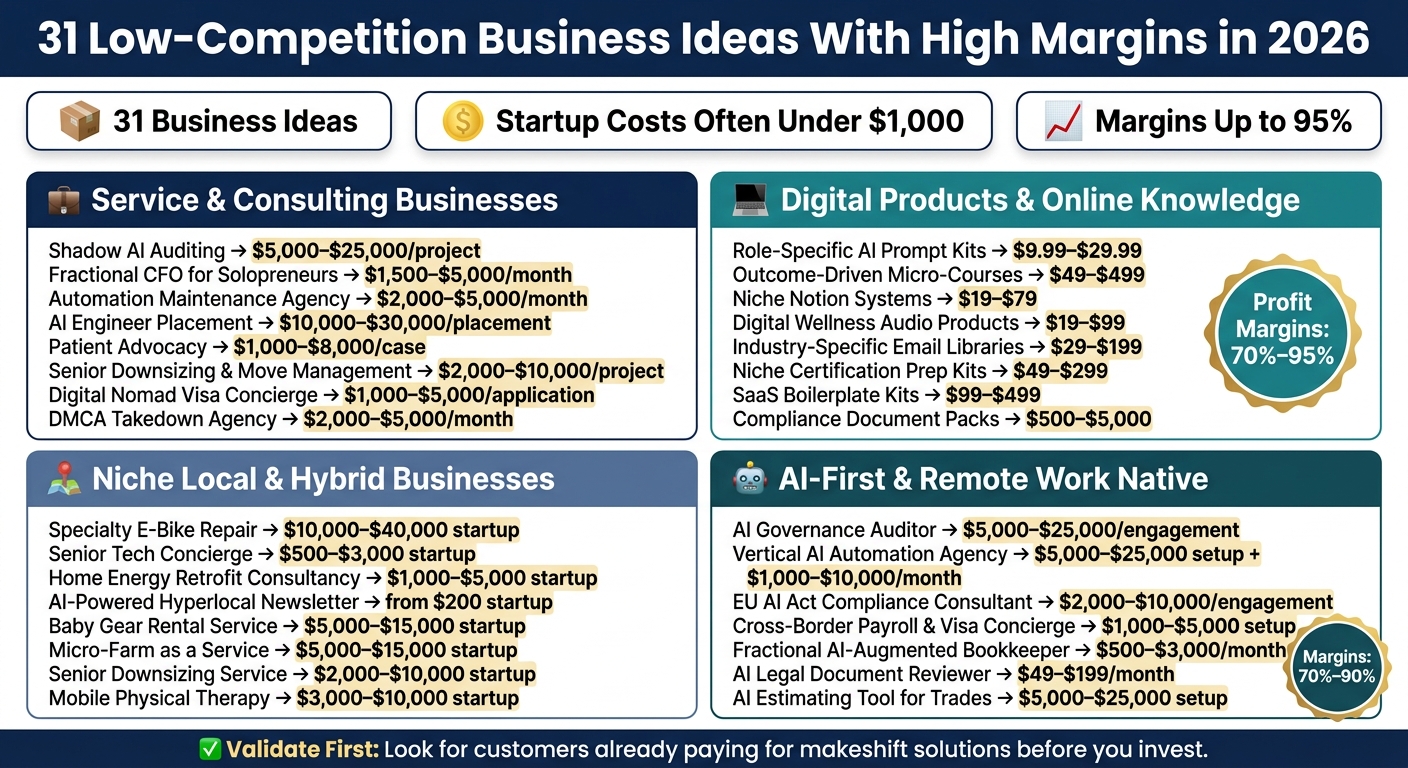
31 Low-Competition Business Ideas With High Margins in 2026
26 Profitable Business Ideas for 2026: High Income Strategies
sbb-itb-08dd11e
1. Service and Consulting Businesses
Service-based businesses often see early profits thanks to their low startup costs and high margins. They focus on solving specific problems for niche audiences, making them an attractive option for entrepreneurs.
"The bar is the expertise; AI is the multiplier." - Kathryn Finney, Founder and CEO
Here are eight service and consulting ideas projected to thrive in 2026:
- Shadow AI Auditing
With employees increasingly using unauthorized AI tools, companies face risks like data leaks. Shadow AI auditors step in to identify and regulate these tools. Typical projects range from $5,000 to $25,000. - Fractional CFO for Solopreneurs
Solo entrepreneurs often need financial expertise without hiring a full-time CFO. Fractional CFOs provide cash flow management, tax planning, and strategy on a retainer basis, charging $1,500 to $5,000 monthly. With the creator economy expected to hit $480 billion by 2027, this niche is expanding. - Automation Maintenance Agency
Businesses relying on tools like Zapier or Make need specialists to maintain these systems. These agencies charge $2,000 to $5,000 per month per client. The specialized nature of this work keeps competition low. - AI Engineer Placement
With AI talent in high demand, a recruiting firm focused solely on AI engineers can command $10,000 to $30,000 per placement. Specializing in this area sets these firms apart from general recruiters. - Patient Advocacy & Medical Bill Navigation
Navigating the U.S. healthcare system can be a nightmare, with errors in billing often leading to overpayments. Patient advocates help clients negotiate bills and navigate insurance, charging $1,000 to $8,000 per case. - Senior Downsizing & Move Management
As 10,000 Americans turn 65 daily, many seniors need help transitioning from family homes. Services include sorting belongings, coordinating movers, and managing the emotional side of moving, with fees ranging from $2,000 to $10,000 per project. - Digital Nomad Visa Concierge
With more countries offering digital nomad visas, the application process can be daunting. A concierge service handling paperwork and follow-ups charges $1,000 to $5,000 per application. The solo travel market, valued at $482 billion in 2024, highlights the demand for such services. - DMCA Takedown Agency
Content creators often face unauthorized use of their work online. A DMCA takedown agency deals with legal notices and disputes, charging $2,000 to $5,000 per month per client.
Here's a quick comparison of these ideas:
| Business Idea | Typical Pricing | Startup Cost | Time to Revenue |
|---|---|---|---|
| Shadow AI Auditing | $5,000–$25,000/project | $500–$2,000 | 1–2 months |
| Fractional CFO | $1,500–$5,000/month | $500–$2,000 | 1–2 months |
| Automation Maintenance | $2,000–$5,000/month | $500–$2,000 | 1–2 months |
| AI Engineer Placement | $10,000–$30,000/placement | $1,000–$3,000 | 1–3 months |
| Patient Advocacy | $1,000–$8,000/case | $500–$2,000 | 1–2 months |
| Senior Downsizing | $2,000–$10,000/project | $1,000–$3,000 | 2–4 months |
| Digital Nomad Visa Concierge | $1,000–$5,000/application | $500–$1,500 | 1–2 months |
| DMCA Takedown Agency | $2,000–$5,000/month | $500–$2,000 | 1–2 months |
These ventures demonstrate the potential for creative solutions to meet emerging demands in various industries.
2. Digital Products and Online Knowledge Businesses
Digital products offer incredible profit potential, with margins often ranging from 70% to 95% once they're created. The global e-learning market alone is expected to hit $400 billion by 2026. These products thrive on scalability, especially when targeting niche audiences. By focusing on specific needs, creators can build businesses that grow quickly without heavy ongoing costs.
"The biggest mistake people make when entering digital products is trying to appeal to everyone. The creators earning passive income in 2026 are doing the opposite - they are building focused solutions for focused audiences." - Gauri Walecha, Brand Strategist
This approach complements service and consulting businesses, leveraging technology to connect with highly specific audiences.
Here are eight promising ideas for digital products and online knowledge businesses in 2026:
- Role-Specific AI Prompt Kits
These bundles are tailored for specific roles like illustrators, legal reviewers, or real estate agents. AI prompt packs are currently one of the fastest-growing digital product categories, with typical pricing between $9.99 and $29.99. - Outcome-Driven Micro-Courses
Short, focused courses (under two hours) that help users achieve a tangible result, like creating a prototype. With learners increasingly favoring practical, result-oriented content, these courses are priced from $49 to $499. - Niche Notion Systems
Profession-specific workflow templates for virtual assistants, freelance designers, or solo creators. These templates, especially when integrated with popular tools, are priced between $19 and $79. - Digital Wellness Audio Products
From guided meditations to private audio coaching, these products cater to professionals dealing with burnout. Audio formats remain an underexplored yet effective medium in this space. - Industry-Specific Email Libraries
Packs of pre-written email templates designed for repetitive communication tasks in industries like real estate, healthcare, or legal. These address daily pain points and are particularly appealing to B2B buyers. - Niche Certification Prep Kits
Study aids and practice materials for certifications or trade licenses, offering a more affordable alternative to costly bootcamps. The rising demand for professional development tools supports this idea, with prices ranging from $49 to $299. - SaaS Boilerplate Kits
Starter code kits for developers and startup founders, complete with documentation and support. These premium products, priced between $99 and $499, are ideal for building common SaaS features. - Compliance Document Packs
Legal and compliance bundles tailored to specific industries or regions, such as GDPR or SOC 2 documents. These packs can command prices from $500 to $5,000, making them a lucrative option for B2B markets.
| Business Idea | Price Range | Startup Cost | Time to Revenue |
|---|---|---|---|
| Role-Specific AI Prompt Kits | $9.99–$29.99 | Under $500 | 2–4 weeks |
| Outcome-Driven Micro-Courses | $49–$499 | $500–$2,000 | 1–2 months |
| Niche Notion Systems | $19–$79 | Under $500 | 2–4 weeks |
| Digital Wellness Audio Products | $19–$99 | $500–$1,500 | 1–2 months |
| Industry-Specific Email Libraries | $29–$199 | Under $500 | 2–4 weeks |
| Niche Certification Prep Kits | $49–$299 | $500–$2,000 | 1–3 months |
| SaaS Boilerplate Kits | $99–$499 | $1,000–$3,000 | 1–3 months |
| Compliance Document Packs | $500–$5,000 | $1,000–$3,000 | 1–2 months |
Before diving into any of these ideas, it's crucial to validate demand. Platforms like Etsy and Gumroad can provide insights into what's already resonating with buyers. You can also test the waters by pre-selling your product through a simple landing page - this way, you gauge interest before committing significant time and resources.
3. Niche Local and Hybrid Online-Offline Businesses
Expanding on digital and service-based models, some of the most successful high-margin businesses in 2026 thrive on a mix of local presence and personalized service. While digital products can scale easily, these businesses rely on face-to-face interactions and local trust - qualities that are tough for large-scale competitors to replicate.
The secret to their success lies in blending online efficiency with in-person value. Back-office operations may run online, but the core of these businesses is built on direct, personal connections in the community. This hybrid approach creates a unique advantage.
Here are eight ideas for niche local and hybrid online-offline businesses:
- Specialty E-Bike Repair (Mobile): With the rise of e-mobility, traditional bike shops often lack the expertise to handle e-bike motors and batteries. A mobile repair service can fill this gap. Initial costs range from $10,000 to $40,000, but premium hourly rates and minimal competition make this a strong option.
- Senior Tech Concierge: Every day, 10,000 Americans turn 65, creating a growing need for in-home tech setup and remote support. This subscription-based service, targeting the adult children of seniors, can launch with just $500 to $3,000.
- Home Energy Retrofit Consultancy: Federal tax credits of up to $3,200 for energy-efficient home improvements make this a lucrative field. Consultants can manage audits, contractor coordination, and tax paperwork for homeowners, earning solid project-based fees. Startup costs are between $1,000 and $5,000.
- AI-Powered Hyperlocal Newsletter: By using AI to gather neighborhood news, events, and real estate data, then adding human curation, you can create a newsletter that sells sponsorships to local businesses. It’s a low-cost venture, with startup expenses starting at $200, and revenue comes from recurring ad sales.
- Baby Gear Rental Service: Traveling families often prefer to rent bulky items like car seats and strollers instead of lugging them across the country. A local rental service with delivery and pickup options meets this need. Startup costs are $5,000–$15,000, and repeat bookings offer strong margins.
- Micro-Farm as a Service: Small hydroponic systems installed in restaurants or community spaces can be managed through a hybrid model. Technology handles remote monitoring, while local visits ensure proper maintenance. Startup costs range from $5,000 to $15,000.
- Senior Downsizing Service: Baby Boomers retiring in large numbers need help navigating decades of belongings. By combining online resale platforms with physical moving coordination, this full-service offering becomes indispensable. Initial costs are $2,000–$10,000.
- Mobile Physical Therapy: With outpatient home therapy growing at a 7.3% annual rate through 2031, there's potential for a hybrid model that uses telehealth for assessments and in-home visits for treatments. This approach reduces overhead and serves patients who can’t easily travel. Startup costs are $3,000–$10,000.
Business Overview Table
| Business Idea | Startup Cost | Revenue Model |
|---|---|---|
| Specialty E-Bike Repair | $10,000–$40,000 | Per-service / hourly |
| Senior Tech Concierge | $500–$3,000 | Monthly subscription |
| Home Energy Retrofit Consultancy | $1,000–$5,000 | Project-based fees |
| AI-Powered Hyperlocal Newsletter | $200–$2,000 | Local sponsorships |
| Baby Gear Rental | $5,000–$15,000 | Per-rental / recurring |
| Micro-Farm as a Service | $5,000–$15,000 | Monthly maintenance fee |
| Senior Downsizing Service | $2,000–$10,000 | Per-project |
| Mobile Physical Therapy | $3,000–$10,000 | Per-session / insurance |
To test the viability of these ideas, start by gauging local interest. If at least three out of five potential customers express willingness to pay, it’s a good sign the business is worth pursuing. By combining local trust with a physical presence, these models create a competitive edge that purely digital businesses often struggle to achieve.
Next, we’ll dive into AI-first and remote work ventures that build on the strengths of these hybrid approaches.
4. Emerging AI-First and Remote Work Native Businesses
These next-gen businesses operate entirely on AI infrastructure and remote workflows, existing solely online with profit margins ranging from 70% to 90%.
"The barrier is not technology. It is knowing which problems to solve and for whom." - BigIdeasDB
Building on the success of hybrid local businesses, these AI-first ventures leverage digital tools to deliver highly targeted solutions, unrestricted by geography. They represent a shift from traditional service and digital models, moving toward specialized AI-driven operations that scale efficiently without the burden of physical overhead.
What sets 2026 apart? The focus is on vertical specialization. While basic AI tools are embedded in platforms like Google and Microsoft, the real potential lies in solving specific, industry-focused problems that these tech giants tend to overlook. Below are seven business concepts that align with this approach:
- Advanced AI Governance Auditor: With remote teams increasingly using unauthorized AI tools, companies face risks like data leaks. Auditors can charge $5,000–$25,000 per engagement to map tool usage, craft internal AI policies, and identify risks using advanced AI systems. The demand for this service is growing as compliance teams scramble to adapt.
- Vertical AI Automation Agency: Instead of offering broad automation services, these agencies focus on a single industry, such as HVAC dispatch, pest control scheduling, or roofing estimates. Projects typically cost $5,000–$25,000 to set up, with monthly retainers ranging from $1,000 to $10,000.
- EU AI Act Compliance Consultant: With the EU AI Act's enforcement deadline looming in June 2026 and non-compliance fines reaching €10 million, U.S.-based consultants can assist EU SaaS and fintech clients. Services like documentation management, risk classification, and audit trails can fetch $2,000–$10,000 per engagement. Many niches within this space have fewer than five serious competitors.
- Cross-Border Payroll & Visa Concierge: As remote-first startups expand globally, managing payroll, tax compliance, and visa logistics becomes increasingly complicated. A productized service targeting these startups can charge $1,000–$5,000 for initial setup, with recurring fees for ongoing compliance management.
- Fractional AI-Augmented Bookkeeper: By using AI to automate tasks like reconciliation and reporting, this model offers CFO-level insights at a fraction of the cost. Monthly retainers typically range from $500 to $3,000.
- AI Legal Document Reviewer: Many small businesses and freelancers sign contracts without fully understanding their terms. This subscription service uses AI to flag risky clauses, summarize obligations, and suggest edits, priced at $49–$199 per month. The AI handles most of the work, allowing providers to focus on client interactions and complex cases.
- AI Estimating Tool for Trades: In construction and trades, where quotes often rely on spreadsheets or intuition, this micro-SaaS uses AI to generate precise estimates by factoring in material costs, labor rates, and local market data. These tools can charge $5,000–$25,000 for setup, plus a monthly SaaS fee. With minimal competition, even a single accurate estimate can justify the tool's annual cost.
Each of these concepts tackles specific industry pain points using flexible, remote workflows. However, here's a key consideration: if a major platform could integrate your product as a feature within three months, its standalone potential might be limited. The enduring appeal of these opportunities lies in their deep integration with workflows, reliance on specialized data, or niche compliance expertise - areas where general-purpose AI tools fall short.
Conclusion
Choosing the right business idea can be overwhelming for many entrepreneurs. But there’s a simple way to narrow it down: focus on the overlap between what you’re skilled at, what the market is willing to pay for, and what you can stick with through the tough early days. Trevor Fenner, Owner of Ecommerce Paradise, sums it up perfectly:
"The biggest mistake I see people make is chasing the 'hottest' opportunity instead of finding the intersection of what they're good at, what the market needs, and what they can sustain."
This highlights the importance of aligning personal strengths with market needs.
When evaluating opportunities, pay attention to three critical factors: startup cost, gross margin, and competition level. A low-cost business (under $500 to start), with high margins (70%+), operating in an unglamorous niche that big players avoid, carries a much lower risk than diving into a crowded, venture-backed market. For instance, AI tools currently see 1,213 startups battling over a median monthly recurring revenue (MRR) of just $7. Compare that with sales tools, which average $6,091 MRR across only 52 startups. The numbers speak volumes.
However, low competition only matters if there’s proven demand. Before you invest, confirm that customers are already paying for makeshift solutions in your target market. If they are, the demand is real. If not, the lack of competition might indicate that no one cares enough to pay for a solution.
This is where tools like IdeaFloat come into play. It uses live market data to validate your idea, compares it against revenue benchmarks from similar startups, and helps you create a financial model before you spend a dime. It’s the difference between launching with confidence and launching on a hunch.
"Fit beats potential. A B-grade idea you'll actually execute for two years beats an A-grade idea you abandon in month three because it never suited you." - Abdullah, founder of Cristioa
The opportunities in 2026 are immense, but success will favor founders who validate their ideas first and build second. For those willing to explore overlooked niches, the rewards could be even greater.
FAQs
How do I validate demand before I start?
Start by identifying genuine customer pain points. A great way to do this is by diving into platforms like Reddit or Upwork to explore complaints and feedback. Look for patterns - are people frustrated enough to pay for manual solutions? If so, you might be onto something.
Take it a step further by talking directly to potential customers. Ask questions that reveal whether they'd not only use your solution but actually pay for it. Their responses can be a game-changer.
Want to test the waters? Create a simple landing page or offer presales to gauge interest. This is especially handy for SaaS or B2B ideas. For these, you’ll also want to dig into reviews and recurring issues to ensure there’s a steady demand. Consistent problems often point to opportunities for long-term solutions.
Which idea fits my skills and budget best?
Digital and affordable business ideas are set to shine in 2026. Options like niche SaaS tools, automation utilities, or templates stand out because they need little upfront investment and can deliver impressive profit margins - often between 70% and 90%.
Service-based ventures are another cost-effective and scalable choice. Think about freelance consulting, social media management, or even online courses. These ideas let you leverage your expertise without breaking the bank.
If hands-on work appeals to you, consider fields like pet grooming, health coaching, or senior downsizing services. These businesses can start on a small scale, focusing on your local community, and gradually grow as demand increases.
How can I tell if 'low competition' is a red flag?
Low competition in a market could hint at potential problems, such as limited demand or a lack of profitability. To steer clear of these pitfalls, look for clear indicators of real demand. These might include the presence of paying customers, frequent complaints that suggest unresolved issues, or gaps where needs aren't being met. Evaluating these factors can help you determine if the opportunity is worth your time and effort.
Related Blog Posts
- 27 Low-Competition Business Ideas With High Margins (2025)
- The Cheapest Businesses to Start in Australia That Still Have Margin
- 19 Low-Cost Business Ideas in Australia With High Profit Potential
- Business Ideas With Low Competition and Low Startup Cost