If you want steady income without chasing one-off jobs, these 10 business models are the main options worth looking at. The best fits in this article are low-cost digital models like template subscriptions, membership groups, website care plans, and small SaaS tools. Physical models like vending routes and laundromats can take less weekly time later, but they need much more cash up front.
Here’s the short version:
- You’re looking at 10 ideas
- Startup cost ranges from about $500 to $500,000+
- Weekly time can range from about 3 to 30 hours
- In Australia, GST often kicks in at AU$75,000 turnover
- Auto-renewal, refunds, privacy, and contract terms matter from day one
In other words: the best low-maintenance business is usually the one you can standardize, bill monthly, and keep within a fixed scope.
The list covers:
- Idea validation and launch support
- Niche subscription boxes
- Paid membership communities
- Template and resource vault subscriptions
- WordPress care plans
- Managed IT subscriptions
- Vending machine routes
- Self-service laundromats
- Booking and appointment micro SaaS
- Home maintenance memberships
My main takeaway: if I wanted the simplest path to first revenue, I’d start with a service or digital subscription, not a heavy equipment business.
10 REALISTIC Subscription Business Ideas for 2025
sbb-itb-08dd11e
Quick Comparison
| Idea | Startup Cost | Weekly Time | Revenue Style | Best Fit |
|---|---|---|---|---|
| Idea validation service | $1,000–$5,000 | 5–15 hrs | Retainer or package | Solo service operator |
| Subscription box | $5,000–$20,000 | 10–25 hrs | Monthly subscription | Product curator |
| Membership community | $1,000–$7,000 | 5–15 hrs | Monthly or annual | Niche audience builder |
| Template vault | $500–$5,000 | 3–10 hrs | Monthly or annual | Digital product seller |
| WordPress care plan | $1,000–$4,000 | 5–20 hrs | Monthly retainer | Web freelancer |
| Managed IT | $3,000–$15,000 | 10–30 hrs | Per-user monthly fee | IT provider |
| Vending route | $20,000–$150,000+ | 5–20 hrs | Refill-based sales | Route operator |
| Laundromat | $150,000–$500,000+ | 3–15 hrs | Pay per use | Capital-heavy owner |
| Micro SaaS | $5,000–$50,000 | 5–20 hrs | Monthly software fee | Technical founder |
| Home maintenance membership | $3,000–$20,000 | 10–25 hrs | Monthly or quarterly plan | Service route operator |
Bottom line: if you want low cost and less day-to-day work, start with digital files, memberships, or care plans. If you want location-based income and have more money to put in, look at vending or laundromats.
Now let’s get into what makes these models work.
What Makes a Business Low-Maintenance With Recurring Revenue
Not every recurring-revenue business is low-maintenance. That only happens when the work is standardized, billing runs on autopilot, and odd one-off requests stay rare.
The business model you pick shapes the day-to-day workload.
Product-based models, like subscription boxes or vending routes, run on repeat restocking. That means inventory control and logistics matter a lot. But once the process is dialed in, restocking turns into routine work instead of daily chaos.
Service-based models, like website care plans or managed IT support, bundle set tasks into monthly retainers. The trick is simple: keep the work inside a fixed scope. If it starts spilling into custom projects, the model gets harder to run and margins can slip.
Software-based models, like a micro SaaS booking tool, often scale the best because delivery stays digital. You’re not shipping goods or doing hands-on service each time a customer pays. The trade-off is that setup, maintenance, and support can be more technical.
For solo operators, digital and service models usually make the most sense. Ideas that depend on heavy labor or logistics often need contractors or a small team.
| Model type | How revenue recurs | Margin profile | Best operator fit |
|---|---|---|---|
| Product-based | Monthly or replenishment-based subscriptions | Moderate; depends on logistics and inventory costs | Solo operator or small team with systems |
| Service-based | Retainers, memberships, maintenance plans | Lower if labor-heavy; improves with standardization | Owner-operator with contractors or small team |
| Software-based | Monthly or annual subscriptions | Typically highest because delivery is digital and marginal costs stay low | Solo founder early, then small team as it scales |
It’s also worth being clear about one thing: recurring revenue is not passive income. A website care plan still needs backups, updates, and check-ins. The point is to build work that’s predictable enough to document, delegate, or automate over time.
And the admin side doesn’t disappear either. GST, business registration, consumer law, and state rules still apply. Recurring billing may smooth out cash flow, but it doesn’t cut compliance work.
With those filters in place, the ideas below show what tends to work best in Australia.
1. IdeaFloat-Powered Niche Validation and Launch Service
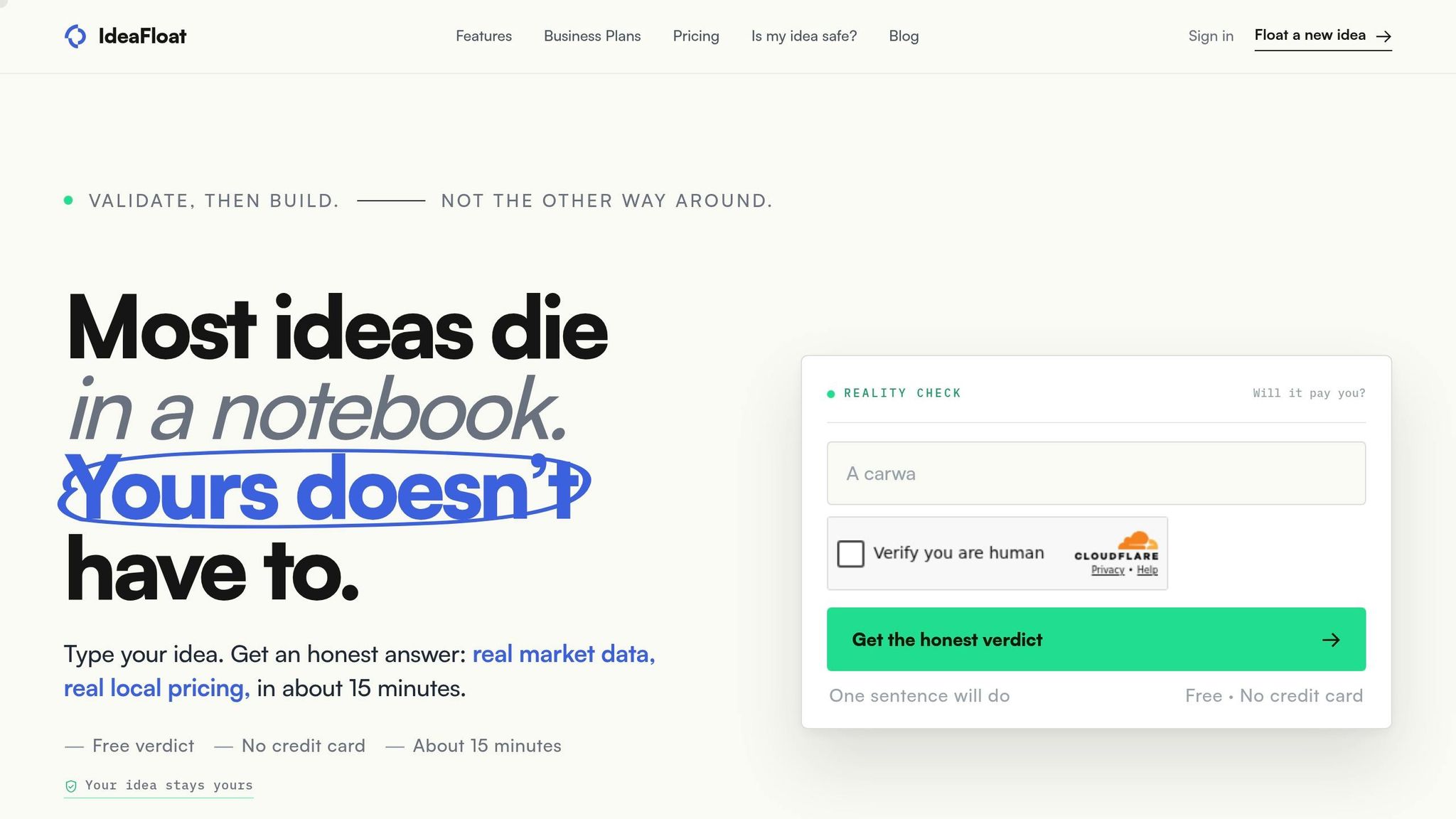
IdeaFloat is a Brisbane-based AI platform that helps entrepreneurs validate and launch business ideas using real data, pricing benchmarks, and competitor analysis. That makes it a strong starting point for a productized validation service aimed at Australian founders and small businesses. The draw is pretty clear: the inputs are repeatable, the deliverables are fixed, and clients keep needing this kind of help.
Here’s how the model works. You use IdeaFloat’s tools - Problem Validator, Competitor Analysis, Smart Market Sizing, and Advanced Pricing Research - to run a structured validation process for a client’s niche idea. Then you turn that work into a validation report and a business planning launch plan. Once you standardize the workflow, the service gets much easier to run, and delivery becomes far more repeatable.
The setup cost stays low. An IdeaFloat Pro plan, a simple website, and a starter marketing budget to reach Australian founders through LinkedIn or Meta ads will usually keep total setup well under A$3,000.
Revenue can come from two clear tiers:
- A one-off Idea Validation & Launch Blueprint package priced at A$1,500–A$3,000
- A monthly advisory retainer priced at A$600–A$1,500 per month for implementation support
Use standard Australian business setup and GST compliance from day one. That keeps the offer productized, simple to sell, and easier to deliver at scale.
From a digital validation service, the next model shifts into a physical subscription business with inventory and fulfillment.
2. Australian Niche Subscription Box Business
This model is a step up from a service retainer because it brings in inventory and fulfillment. You’re shipping a curated box of products to customers on a set schedule, usually monthly, though some brands ship quarterly or annually. Customers are billed automatically each cycle, which gives you more predictable cash flow.
Startup costs often land between AU$2,000–AU$8,000 for inventory, AU$1,000–AU$3,000 for packaging, and another AU$1,000–AU$3,000 for launch marketing. A lot of founders lower that upfront risk by pre-selling. In plain English, they collect orders and payment before buying stock.
Some of the strongest Australian niches include:
- beauty and skincare boxes with Australian or clean-beauty brands
- artisan food and snack boxes featuring local producers
- hobby, craft, or fitness and wellness boxes
These niches tend to work best when the products are lightweight, non-perishable, and easy to source in repeatable batches. That matters more than it might seem. Heavy or fragile items can eat into margins fast, and perishable goods add pressure every single month.
You should expect to spend around 8–20 hours a week on packing, supplier management, customer support, and billing. If you outsource fulfillment, bookkeeping, and support, that workload can shrink to about one day a week.
Pricing usually works best at AU$30–AU$50 per month, with product costs kept to 30%–40% of revenue. Even then, most businesses need around 200 to 500 active subscribers before margins start to look meaningfully profitable. That’s the part many people miss. The model sounds simple, but subscriber volume does a lot of the heavy lifting.
Before you launch, get your checkout flow, renewals, and refund terms in order. Since November 9, 2023, Australia’s unfair contract terms rules ban unclear auto-renewal terms, and company penalties can reach AU$50 million. Your checkout should clearly show renewal dates, pricing, and cancellation terms. Refund and cancellation terms also need to follow Australian Consumer Law.
You’ll also need to register for GST once annual turnover is expected to hit AU$75,000. Set up cost tracking from day one so you can watch per-box profitability closely. A box business can look healthy on the surface while quietly losing money on shipping, packaging, or failed payments.
To keep the business easier to run, stick with non-perishable, lightweight products, batch-pack on one fixed day each month, and automate billing with subscription software that handles renewal reminders and failed-payment workflows.
If you want recurring revenue without inventory, the next model moves fully online.
3. Niche Membership Community for Australian Professionals or Hobbyists
A paid membership community puts useful content, peer networking, and shared resources behind a recurring fee. Unlike a subscription box, there’s no inventory to buy, no packing, and no shipping. That means your main asset is your know-how and the way you keep members involved. In plain English: it’s one of the lowest-overhead options on this list.
This model tends to work best when the group has repeat learning or networking needs. Think Australian small firm accountants or bookkeepers, regional real estate agents, wedding photographers, or hobby groups like home brewers.
Startup costs are fairly modest. A lean launch usually costs about AU$1,000–AU$3,000, which covers hosting, a domain, a WordPress membership plugin or hosted platform, and your first batch of content. If you want a more polished setup with email automation, a course library, and pro design, costs can land around AU$5,000–AU$10,000.
Monthly software costs are also pretty predictable. For example:
- TidyHQ starts at about AU$79/month
- Member Jungle starts near AU$89/month
Pricing depends a lot on who you serve. Professional communities often charge AU$49–AU$99/month, while hobbyist groups usually do better at AU$15–AU$49/month. Annual plans with a 10%–20% discount can help cash flow and cut churn.
After launch, many operators can run the community in about 5–10 hours per week. Most of that time goes to updates, light moderation, and member support. The catch is simple: it stays low-maintenance only if you keep your content schedule and moderation within a fixed scope. If you promise too much, this can turn into a part-time job fast.
There are also a couple of compliance points to watch. Once turnover hits AU$75,000, GST registration may apply. Member data is also covered by the Privacy Act and the Australian Privacy Principles.
If you want a more automated digital model, the next option is a subscription resource vault.
4. Digital Templates and Resource Vault Subscription
This model is different from a membership community. Instead of paying for access to people, customers pay for access to downloadable files.
A digital template vault is a monthly or annual subscription that gives people a library of assets like invoice templates, HR forms, Canva kits, and work health and safety (WHS) checklists, plus new additions each month. In plain English: it takes the subscription setup of a membership model and applies it to digital files. You get repeat billing, light fulfillment, and delivery that can scale without much extra work. Once the library is built, most of the delivery runs on autopilot.
The cost to get started is fairly low. A simple niche landing page and 10 to 20 strong templates can be enough to launch for under AU$1,000, with total startup capital usually falling between AU$500 and AU$5,000. Monthly platform costs often sit around AU$20 to AU$150.
Pricing usually lands between AU$19 and AU$49 per month. Annual plans with a discount can help cut cancellations. Day-to-day upkeep is often light too, usually around 3 to 8 hours a week, mostly spent on support, new uploads, and a short newsletter.
The vaults that tend to do best are built for a narrow Australian market, like:
- Real estate agents
- Tradies
- Small businesses that need Fair Work-aligned HR forms
A tighter niche usually makes pricing easier and marketing simpler. If the offer speaks to one clear group, the value is easier to explain.
There are also a few tax and legal points to get right. Once turnover reaches AU$75,000, you need to register for GST. If you're GST-registered, you must charge 10% GST on Australian sales. Sales to customers outside Australia may count as GST-free exports if the rules are met, but they still need to be reported the right way on your BAS.
You’ll also want clear terms of use. Spell out whether subscribers can use the templates only in their own business, for client work, or for resale. That line matters because it helps protect your IP.
If you want recurring revenue based on service work instead of digital files, the next idea moves into maintenance retainers.
5. Website Care Plan and WordPress Maintenance Retainer
If you already look after WordPress sites, this model lets you turn routine work into steady monthly retainers for local businesses. The job is simple: keep the site updated, backed up, secure, and online. It sits in the middle ground between digital product subscriptions and full managed IT retainers.
The day-to-day work usually covers updates, backups, uptime checks, security scans, and small content fixes. That makes it a good fit for small businesses like tradies, clinics, real estate agents, accountants, and solo operators. They need their websites to work, but they usually don’t have in-house web support. The upside for you is that the work is fixed-scope, which means you can standardize it and automate a lot of it.
Startup costs usually land between AU$500 and AU$2,000, mostly for managed hosting, backups, security tools, uptime monitoring, and a basic site setup. In Australia, many operators also want hosting and backups kept in Australian or nearby APAC data centers.
Pricing is often set up in tiers:
- Basic plans may start at around AU$27 to AU$75 per month
- Standard small-business plans often sit at AU$100 to AU$200+ per month
- Advanced or high-support plans can range from AU$500 to AU$2,800+ per month
The math is pretty clear. If you have 20 clients on a AU$250 per month plan, that’s about AU$5,000 a month in revenue. Use one standard stack, automate the repeatable tasks, and you can keep troubleshooting lower while holding steadier margins.
In terms of workload, managing 10 to 20 sites usually takes about 5 to 10 hours a week. Most of that time goes to batch updates, alert checks, and monthly reports.
There’s also the compliance side. Once turnover hits AU$75,000, you need to register for GST and issue tax invoices. And if you can access client data while maintaining sites, the Privacy Act 1988 may apply. So it’s smart to handle personal information with care and use contracts that spell out responsibilities, response times, and what counts as billable work outside the plan.
That fixed-scope setup also makes it easier to step into the broader managed IT support model next.
6. Managed IT Support Subscription for Small Businesses
Managed IT support takes the idea of a website care plan and stretches it across a client’s whole tech setup. That means computers, software, security, backups, and cloud tools like Microsoft 365, all wrapped into a fixed monthly fee per user. For most providers, the best-fit clients are small businesses with 5 to 50 employees.
In Australia, this is usually sold as a monthly per-user subscription. If you're new to this space, a simple three-tier setup is a solid way to start:
| Tier | Price Range (per user/month) | Typical inclusions |
|---|---|---|
| Basic | AU$80–AU$120 | Helpdesk, monitoring, patching, basic endpoint security, backups |
| Standard | AU$120–AU$160 | Adds Microsoft 365 management, EDR, email security, vendor management, reporting |
| Premium | AU$160–AU$200+ | Adds 24/7 support, vCIO advisory, security awareness training, compliance reporting |
Here’s what that can look like in practice: a Brisbane provider supporting 30 users across three small businesses at AU$150 per user per month would bring in about AU$4,500 in monthly recurring revenue.
Startup costs often land between AU$10,000 and AU$50,000. That usually covers RMM and PSA tools, backup and security platform licenses, insurance, and early marketing spend. Most providers also charge an onboarding fee that’s about equal to one month of service, which helps pay for discovery, documentation, and the initial setup work.
Once systems are in place, the day-to-day workload can stay fairly light. Patching, monitoring, and backup checks are usually handled through automation, so weekly labor stays low. That’s a big part of the appeal: you do the heavy lift up front, then let the systems do much of the routine work.
That said, this only stays low-maintenance if the scope stays tight. If you let every client pull you in a different direction, the model can get messy fast. A few compliance points matter here:
- Match service baselines to the Essential Eight
- Protect client data under the Privacy Act and Notifiable Data Breaches scheme
- Use SLAs to spell out what’s included and what gets billed as extra support
Those guardrails help keep the service clear, the workload under control, and client expectations in check.
For a less client-heavy model, the next ideas move away from services and toward physical recurring-income businesses.
7. Vending Machine Route Business
Unlike service retainers, vending turns recurring revenue into a simple, location-based restocking routine. It’s one of the more hands-off physical recurring-revenue models on this list. Instead of dealing with client work, you manage a route. You own several machines, place them in spots with steady foot traffic, and make money each time someone buys a snack or drink.
Once placement and stocking are dialed in, the weekly work is usually pretty simple: restocking, basic maintenance, and the occasional location check. You’re not dealing with staff schedules or day-to-day customer support.
Startup costs in Australia can vary a lot based on whether you buy new or used machines. A new machine often costs about A$3,000–A$12,000, while used machines may cost around A$1,000–A$6,000. On top of that, you’ll need to budget for stock, insurance, ABN registration, and any placement fees. That’s why many operators build the route slowly instead of going all in at once.
On the income side, a well-placed machine can gross about A$700–A$1,000 per month. Net profit often lands around A$400–A$500 per month after product costs, commissions, and overhead. So if you build a route of 10 solid machines, you could realistically be looking at about A$4,000–A$5,000 in net profit per month.
The time side depends on sales volume. Machines earning under A$600 per month can often be checked every 14–21 days. Higher-volume machines may need weekly service. This is where route planning matters a lot. If your machines are clustered in the same area, the work gets much easier. Telemetry can help too by flagging low stock or machine faults, which cuts down on wasted trips.
Compliance is fairly simple, but you do need to take it seriously. Food and drink vending machines are usually treated as food premises under state and territory laws, so you’ll likely need to notify or register with your local council. In Victoria, low-risk packaged items like chips and bottled drinks are Class 4 and only need statewide notification. But if you want to stock higher-risk items like fresh juice, sandwiches, or pies, the rules get stricter and food safety requirements go up. Machines also need test-and-tag compliance under AS/NZS 3760. Before placing a machine, check local council rules, since food registration, public-land permits, and electrical safety rules may all come into play.
If you like the idea of recurring income but don’t want to handle as much inventory, the next model moves in that direction: a self-service laundromat.
8. Self-Service Laundromat
Like vending, laundromats turn a good location and repeat foot traffic into steady cash flow. The big draw is simple: customers do the work themselves. They come back week after week, and the store can keep earning without constant day-to-day staffing.
The catch is the upfront spend. In Australia, startup costs usually fall between A$100,000 and A$400,000, which covers lease fit-out, machines, plumbing, electrical work, permits, insurance, and working capital. Commercial washers often cost around A$2,000 to A$15,000+ each, while dryers are often A$3,000 to A$20,000 each. If you're looking at Sydney or Melbourne, expect pricing near the top end. Smaller suburban or regional stores can come in lower.
A store in the right spot can bring in A$8,000 to A$20,000+ per month, with operating costs of about A$3,000 to A$7,000. Utilities alone, mostly water and electricity, often land between A$1,000 and A$3,000 per month. On the customer side, standard washes usually cost A$5 to A$7 for a regular load. Larger machines tend to sit at A$8 to A$12, and dryers often charge about A$1 to A$2 per 6 to 10 minutes.
Once the store is running smoothly, the time commitment is often lighter than people expect. A streamlined laundromat usually takes about 10 to 20 hours a week, or 5 to 10 hours if you outsource cleaning and routine checks. Cashless payments and remote monitoring help a lot here. They cut down on site visits and make it easier to spot faults before they turn into bigger problems.
Compliance has a few moving parts, but it's not some impossible maze. You'll need council zoning approval, trade-waste approval from the local water utility, and plumbing and electrical work completed to Australian Standards. Public liability insurance is a must. It also pays to bring in a qualified plumber, electrician, and, if possible, a laundromat fit-out specialist before you sign a lease. Why so early? Because drainage and three-phase power can make or break a site, even if the location looks great at first glance.
If you'd rather skip the heavy equipment and high setup cost, the next option moves away from machines and toward booking automation.
9. Micro SaaS for Booking and Appointment Management
If equipment and leases don’t appeal to you, a micro SaaS can be a different route to recurring revenue. It’s a small software product built to solve one clear problem, then sold on a monthly or annual subscription. In Australia, booking and appointment management fits that model well. Salons, physio clinics, mobile tradies, yoga studios, and NDIS support providers all depend on scheduling tools, and many already pay monthly software fees without much hesitation. If you want recurring income without premises or heavy equipment, software is the logical next move.
The main thing is to choose one niche and stay focused. Australia already has plenty of booking platforms, so you need a clear angle. That usually means serving a segment that doesn’t get much attention, like mobile allied health practitioners or boutique beauty salons with one to five staff. Then you build around what they need day to day: AEST/AEDT scheduling, GST-compliant tax invoices, SMS reminders, and online deposits.
Startup costs are much lower than the physical businesses covered earlier. A technical founder using existing frameworks and low-code tools can often get started for around A$3,000 to A$7,000. That usually covers hosting, payment gateway setup, SMS credits, and a basic marketing site. If you’re non-technical and need freelance developers, expect more like A$10,000 to A$25,000 for development, UX design, integrations, and early marketing. Pricing usually follows a tiered subscription setup, such as:
- Solo: about A$29/month
- Team: about A$79/month
- Multi-location: about A$149/month
That lines up with what many Australian businesses already pay for booking software.
Once the product is stable, the workload can drop to around 5 to 15 hours per week. Onboarding, reminders, renewals, and much of first-line support can be automated. Failed-payment retries also help keep admin work under control. If support starts to pile up, a part-time virtual assistant can handle the first wave of customer questions.
Privacy needs attention from day one. Booking tools deal with personal data and, at times, health data, so the Australian Privacy Principles (APPs) under the Privacy Act should be built into your compliance plan from the start. This isn’t the kind of thing you patch later and hope for the best. Privacy law reforms are also set to bring an estimated 2.5 million additional Australian businesses under full APP obligations by December 10, 2026, so it makes sense to put clean consent flows, strong access controls, and a clear privacy policy in place early.
Use a PCI-compliant payment processor for card data, and make sure vendor contracts include clear cross-border data clauses so you can meet your duties around cross-border data transfers. Next comes a recurring model tied to property maintenance rather than software.
10. Recurring Home Maintenance Membership
A recurring home maintenance membership turns routine property upkeep into a subscription-style service. Members pay a fixed monthly or annual fee for a set bundle of work, which often includes lawn mowing, garden care, gutter cleaning, minor exterior repairs, and seasonal checks.
The money side is pretty simple: this model works when the service bundles stay fixed and visit routes stay tight. If the scope keeps changing from one home to the next, margins can slip fast. So the low-hassle version only works when each plan has clear limits.
Australian operators already offer plans that range from lower-cost annual options to higher-tier monthly maintenance bundles. That shows the model can work for landlords, seniors, and busy homeowners.
For an independent operator, startup costs can land around $5,000 to $25,000 for equipment, registration, insurance, and a basic booking site. Leave out electrical, plumbing, and gas work unless you hold the right licenses. Once you hire staff, add workers' compensation. With those exclusions spelled out, the business starts to look less like a custom handyman service and more like a route-and-schedule operation.
A simple setup usually works best:
- Keep plans to two or three bundles
- Use fixed visit schedules like fortnightly, monthly, or quarterly
- Limit the service area to about 25 kilometers to keep routes under control
Job software can handle billing and route planning, which cuts admin time and makes performance easier to track. It also helps when you want to compare labor, cost, and revenue across plan types.
The best-fit customers are landlords, property managers, seniors, and busy dual-income households. Monthly or annual billing paired with a 12-month minimum term can help cut churn.
Cost, Workload, and Revenue Potential: A Quick Comparison
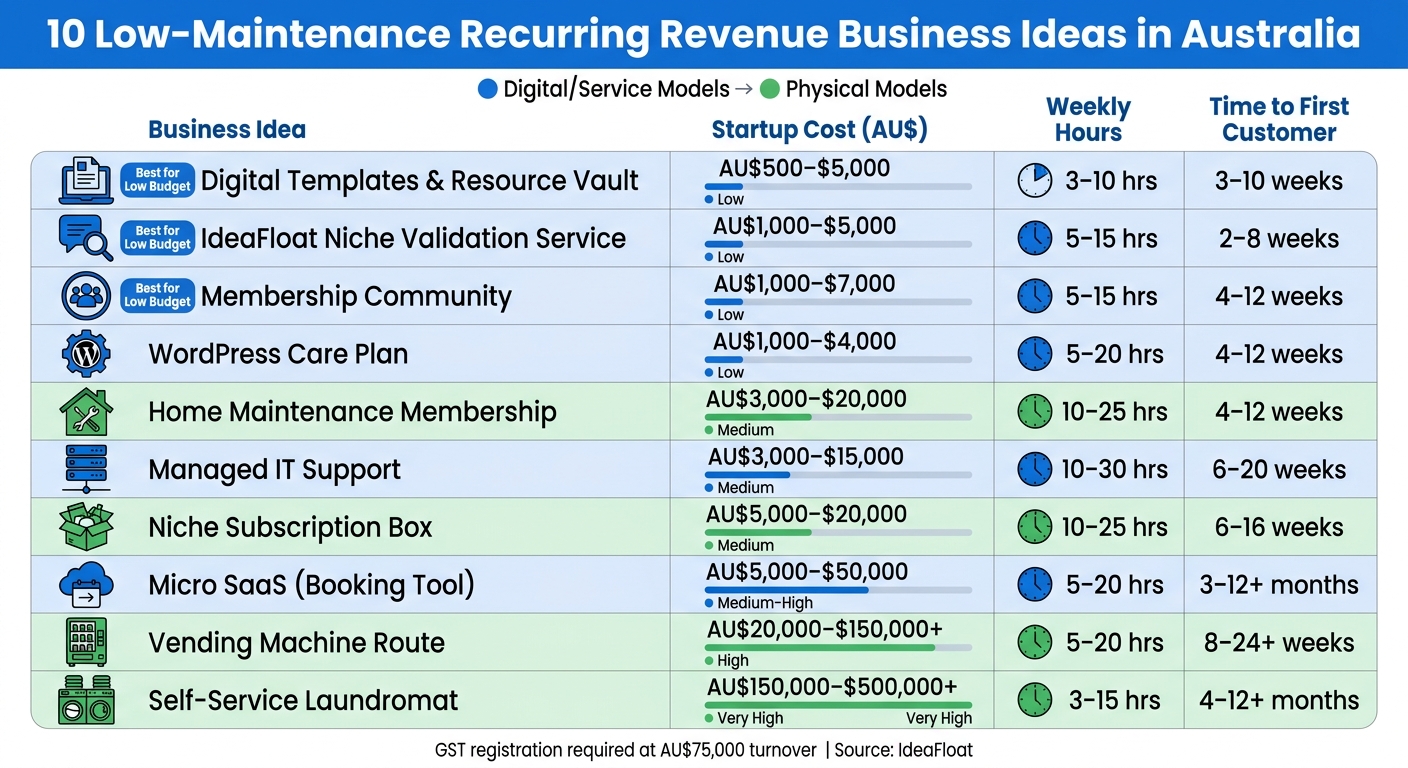
10 Low-Maintenance Recurring Revenue Business Ideas in Australia: Cost, Time & Revenue Compared
This comparison helps you narrow the field based on cost, weekly time, and how soon money can start coming in.
If you want the shortest path to a first customer, digital-first models tend to have the lowest starting cost and the fastest payback. Vending lands somewhere in the middle. Laundromats, on the other hand, need the most cash up front, even though they can take the fewest weekly hours once they're up and running.
Here’s the side-by-side view:
| Business Idea | Startup Capital (AU$) | Typical Weekly Hours | Customer Payment Model | Time to First Paying Customer |
|---|---|---|---|---|
| IdeaFloat niche validation service | AU$1,000–AU$5,000 | 5–15 hrs | Monthly retainer (AU$500–AU$3,000+/client) | 2–8 weeks |
| Niche subscription box | AU$5,000–AU$20,000 | 10–25 hrs | Monthly subscription (AU$30–AU$120/box) | 6–16 weeks |
| Membership community | AU$1,000–AU$7,000 | 5–15 hrs | Monthly or annual membership (AU$15–AU$90/mo or AU$150–AU$800/yr) | 4–12 weeks |
| Digital templates & resource vault | AU$500–AU$5,000 | 3–10 hrs | Subscription library (AU$15–AU$60/mo or AU$150–AU$500/yr) | 3–10 weeks |
| WordPress care plan | AU$1,000–AU$4,000 | 5–20 hrs | Monthly care plan (AU$50–AU$150 basic; AU$200–AU$600 standard; AU$600–AU$2,200+ premium) | 4–12 weeks |
| Managed IT support | AU$3,000–AU$15,000 | 10–30 hrs | Per-user monthly fee (AU$80–AU$250+/user) | 6–20 weeks |
| Vending machine route | AU$20,000–AU$150,000+ | 5–20 hrs | Recurring product sales (AU$300–AU$3,000+/machine/mo) | 8–24+ weeks |
| Self-service laundromat | AU$150,000–AU$500,000+ | 3–15 hrs | Pay-per-use (AU$4–AU$12/cycle) | 4–12+ months |
| Micro SaaS for booking and appointment management | AU$5,000–AU$50,000 | 5–20 hrs | Monthly SaaS tiers (AU$30–AU$150+/business) | 3–12+ months |
| Recurring home maintenance membership | AU$3,000–AU$20,000 | 10–25 hrs | Monthly or quarterly membership (AU$40–AU$250+/household) | 4–12 weeks |
A few patterns stand out:
- Fastest paths to cash flow: IdeaFloat validation, digital templates, and home maintenance
- Lowest startup cost: digital templates, IdeaFloat validation, and membership-style offers
- Highest upfront cost: self-service laundromat, followed by vending at the upper end and some Micro SaaS builds
Once one option starts to look like a fit, test demand before you put money into it. That small step can save you from backing the wrong horse.
How to Test a Business Idea Before You Commit
Choosing an idea from the comparison table above is only part of the job. Before you put money into inventory, equipment, or software development, you need proof that people will pay for what you’re selling. Interest is nice. Commitment is what matters.
Start by validating the problem. Get clear on who your target customer is and what exact problem you’re solving. Then test whether that problem shows up often, hurts enough, and feels worth paying to fix. Talk to actual target customers, not friends or family, and pay attention to patterns in what they say. If the same pain points keep coming up, that’s a good sign.
A small ad test can help here too. Send traffic to a landing page and set a hard pass/fail benchmark, like 50 sign-ups or 5 pre-orders. That gives you something concrete to judge instead of going with gut feeling. IdeaFloat can help turn that early signal into a fast yes-or-no call.
Use IdeaFloat to test the problem, review the words customers use, and check competitors in one place instead of bouncing between surveys, spreadsheets, and a pile of browser tabs.
Once you know the problem is real, shift to market size and pricing. Estimate the market, test what people will pay, and model your break-even point before spending on inventory, software, or a lease. Then connect those numbers to the lowest-maintenance, most repeatable option on your shortlist - the one with the clearest demand and the healthiest margins at a realistic customer or subscriber count.
If the signal comes back weak, don’t force it. That usually means the idea is too custom, too expensive, or too hard to keep running as a recurring-revenue business. In that case, tighten the niche or test the price again before putting capital on the line.
Conclusion
None of these ideas are passive in the pure sense of the word. Every recurring-revenue model - whether it's a subscription box, a vending route, or a micro SaaS - takes setup at the start and steady attention over time. The pattern is simple: recurring revenue cuts down day-to-day chaos, but it doesn't remove the work.
The right fit depends on your money, your skills, and how much hands-on work you're willing to do. If you're strong on the technical side and don't have much saved, a digital template subscription or a website care plan may make more sense than a laundromat. If you have capital and want a more hands-off physical asset, a vending route or self-service laundromat may be a better long-term match.
After you find a fit, test it before you spend too much. A small pilot - a founding-member offer, a pre-sale, or one test location - can show you demand, price tolerance, and whether people come back to buy again. That kind of test replaces guesswork with evidence.
The best businesses start small, test demand, and get better fast.
FAQs
Which idea is best for beginners?
For beginners, service-based businesses like virtual assistant services, freelance content creation, or local cleaning services are often the best place to start. They usually need little upfront investment, often under $1,000, and can bring in income fast.
The big draw is simple: you focus on work people already need done. That makes it easier to test your idea, land your first clients, and build steady cash flow without turning your day into chaos.
Stick to core, repeatable tasks at the start. It keeps the work easier to manage and gives you room to grow as you learn what clients want.
How do I choose between digital, service, and physical models?
Choose based on your startup budget, how much day-to-day complexity you can handle, and how big you want the business to get.
- Digital: lowest startup costs and the easiest to scale, with no inventory or shipping.
- Service: faster income and lower barriers, but more hands-on time or staff oversight.
- Physical: higher setup costs and more logistics, but a good fit for niche markets or automation.
What should I test before investing money?
Before you spend a dollar, validate your business concept so you know people want it.
Start with the basics: check platform search results, competitor pricing, customer reviews, and the complaints that keep coming up. That gives you a plain-English view of demand, pricing pressure, and what buyers feel is missing.
For service or subscription ideas, go a step further. Use keyword research to gauge search demand, then run the numbers with financial modeling. Estimate your costs, calculate your break-even point, and project Customer Acquisition Cost (CAC) so you can tell whether the model has a path to profit.
Related Blog Posts
- Recession-Proof Service Businesses With Everyday Demand
- Business Ideas in Australia With Low Startup Cost and High Repeat Customers
- 21 Australian Business Ideas That Work Even in a Slow Economy
- Business Ideas With Low Competition and Low Startup Cost