Word-of-mouth referrals are powerful - 92% of people trust recommendations from friends over ads. But while 83% of customers are open to referring, only 29% actually do without a prompt. This gap is where micro-prompts come in. These small, well-timed triggers help turn satisfied customers into active advocates by making referrals easy and rewarding.
Here are four proven strategies that use psychology to drive referrals:
- Referral Incentive Generator: Offers mutual rewards (e.g., "Give $20, Get $20") to leverage reciprocity and instant gratification. Timing these prompts right after a purchase can boost referrals by up to 150%.
- Viral Hook Creator for Advocates: Pre-written, shareable templates focus on helping friends, reducing friction in sharing. This approach can double referral conversions.
- Micro-Commitment Referral Funnel: Breaks the process into small steps, using progress bars and simple asks to increase participation. This method can boost follow-through by 700%.
- Community Activation Booster: Creates exclusive, invite-only communities to drive referrals through social proof and exclusivity. Leads generated this way often have a 16% higher lifetime value.
These strategies are cost-effective, rely on smart timing, and use psychological principles like reciprocity, social proof, and commitment to encourage action. By integrating them into your customer journey, you can build a referral engine that drives growth without a big ad budget.
9 Surprisingly Easy Referral Marketing Strategies for Your Business
1. Referral Incentive Generator
The Referral Incentive Generator works by using structured double-sided rewards that tap into reciprocity - a natural human tendency to return favors.
Let’s break down the psychological principles behind this approach.
Psychological Triggers at Play
This strategy leverages reciprocity, social currency, and instant gratification. Offering a reward upfront creates a sense of obligation to reciprocate. Social currency comes into play as people love sharing opportunities that make them look helpful or savvy to their peers. And instant gratification ensures the reward is delivered right away - delays can weaken its impact.
How It Impacts Referral Behavior
Here’s how this approach translates into results:
- In 2010, Dropbox famously used double-sided incentives (extra storage for both referrer and referee) to expand by an incredible 3,900% over 15 months, generating 2.8 million referrals in just one month.
- Myles Apparel’s "Give $20, Get $20" campaign fueled 17% of new customer growth in just one quarter.
- Honeylove took it a step further with a "Give 20%, Get $20" offer and paired it with a post-purchase referral prompt, boosting referred customer lifetime value by 23%.
Timing is everything. Asking for referrals immediately after a purchase - when customers are still excited - can help ease buyer’s remorse by reinforcing their decision. A checkout pop-up asking for referrals is 16 times more effective than a delayed request. Plus, advocates are 300% more likely to share when the prompt appears on the same page, rather than being redirected to another landing page.
How to Set It Up
Setting up this system is straightforward. Start by selecting your reward type - options like store credit, cash, or discounts work well. Next, create a double-sided incentive (e.g., "Give $20, Get $20") and automate the reward delivery process. To keep your top advocates engaged, consider tiered rewards. For example, offer VIP perks or higher-value gifts for hitting milestones like 5, 10, or 25 referrals.
The statistics back it up: 50% of people are more likely to refer when there’s a direct incentive involved, and 39% say monetary rewards like discounts or gift cards make them significantly more likely to share.
Up next: the Viral Hook Creator for Advocates.
2. Viral Hook Creator for Advocates
The Viral Hook Creator takes referral sharing to the next level by turning your most loyal customers into enthusiastic promoters. It does this with ready-to-share, platform-specific templates that make the process seamless and effective.
Psychological Trigger Used
This strategy leans heavily on altruism and removing effort. By framing the referral as an opportunity to "give" a reward to a friend instead of focusing on "getting" something yourself, it eliminates the discomfort of feeling like you're exploiting your network. For instance, Airbnb's A/B testing revealed that messages highlighting a $25 gift for a friend performed better than those emphasizing the advocate’s own $25 reward. This subtle shift in messaging can make a big difference in how people respond and share.
How It Affects Referral Behavior
One of the biggest barriers to sharing is the mental effort of crafting a message. Pre-written hooks solve this problem. For example, Myles Apparel introduced a "Give $20, Get $20" referral program with one-click sharing buttons, which doubled their referral conversions and contributed to 17% of their total first-time customer growth. Timing is also crucial - triggering the referral prompt right after a positive experience ensures you're catching customers at their most enthusiastic, during that "aha moment."
How Easy It Is to Set Up
You don’t need technical skills to set this up - no-code tools make it simple. Start by identifying the exact moment when your customer feels most delighted, whether it’s after checkout, completing a project, or hitting a milestone. Then, create short, personalized message templates tailored for platforms like WhatsApp, email, or social media, focusing on the friend’s benefit first. Automate the process by delivering unique referral links and ensuring rewards are instantly fulfilled when a friend takes action. With the right tools, you can have this entire system up and running in just a few hours.
How to Use with IdeaFloat Tools
With IdeaFloat, you can easily design custom viral hooks that align with your brand. Automate unique tracking links, set up dual-sided rewards, and time your referral prompts to hit during peak moments in the customer journey. Experiment with different messaging styles - whether altruistic or transactional - to find what resonates most with your audience. Plus, real-time analytics let you fine-tune your hooks for even better performance. Once these effortless hooks are in place, you’ll have a solid foundation to further engage your community with the next micro-prompt.
3. Micro-Commitment Referral Funnel
The Micro-Commitment Referral Funnel simplifies the referral process by breaking it into small, sequential steps that feel like a natural conversation instead of a hard sales pitch. Instead of asking for all the details - like names, emails, and phone numbers - upfront, it guides users through a series of easy actions that gradually build momentum.
Psychological Trigger Used
This method leverages the Consistency Principle, which suggests that once people make a small commitment - like clicking a button - they’re more likely to continue. For instance, studies have shown that even a simple verbal commitment, such as agreeing to volunteer for a cause like the American Cancer Society, can increase participation rates by 700%. It also uses the Foot-in-the-Door Technique, where small initial agreements pave the way for bigger ones, and the Goal Gradient Effect, which motivates people to push harder as they see themselves getting closer to completing a task.
How It Affects Referral Behavior
While 83% of customers report being open to referring others after a good experience, only 29% actually do so without a structured process. Long, static referral forms often see abandonment rates exceeding 80%. By splitting the process into small, manageable steps - each displayed on its own screen with a progress bar - you reduce the mental effort required, making it easier for users to follow through. This approach also taps into the sunk cost bias, where people feel compelled to complete what they’ve started. A great example of this is Dropbox’s one-click referral system, which significantly boosted their growth.
How Easy It Is to Set Up
Start with a simple, low-barrier action, like a "Yes/No" question or a "Start" button that doesn’t ask for personal information. Then, break the referral process into individual steps, requesting one piece of information per screen. Midway through, add value with a personalized tip or insight to trigger reciprocity before making your final ask. Use a progress bar to show users how close they are to finishing, and time your referral request to follow a positive moment - like completing a purchase or hitting a milestone.
How to Use with IdeaFloat Tools
IdeaFloat simplifies the creation of these funnels with its one-question-per-page layouts and conditional logic, tailoring the journey to each user’s responses. You can add dynamic content mid-funnel - such as helpful tips or personalized insights - to provide value before asking for the referral. Progress indicators keep users motivated, and automated triggers can launch your funnel at optimal moments, like right after checkout or when customers leave glowing feedback. Experiment with different sequences to find what resonates most with your audience, and rely on real-time analytics to fine-tune every step. Up next, learn how the final micro-prompt can further activate your community.
sbb-itb-08dd11e
4. Community Activation Booster
The Community Activation Booster shifts the focus from discounts to exclusivity, turning community membership into a sought-after reward. By restricting access to special communities, content, or products, this strategy encourages referrals and builds a sense of belonging. Watching others participate reinforces the decision to join, transforming passive users into active advocates.
Psychological Trigger Used
This approach relies on Social Proof and Exclusivity. With 92% of consumers trusting personal recommendations, this strategy sparks action. The gated model also taps into Social Currency, as people naturally want to share things that enhance their status or expertise. By making your community invite-only, you create a sense of privilege and connection. The Reciprocity Principle further strengthens the system with two-sided rewards - both the referrer and the new member gain something, eliminating the discomfort of appearing self-serving. Together, these elements build trust and create a referral experience that feels rewarding.
How It Affects Referral Behavior
A gated community changes the game by making referrals essential. For example, in early 2021, Clubhouse adopted an invite-only model, giving existing users a limited number of invites. This exclusivity created such high demand that invites were sold on eBay for as much as $400. Similarly, Robinhood used a referral-based waitlist, where users could move up the queue by inviting friends, leading to over 1 million signups before the product even launched. The trick lies in setting the right referral threshold: for general communities, 1–3 referrals work well, while professional networks might benefit from a 3–5 referral requirement.
How Easy It Is to Set Up
Start by closing off open signup options - disable public forms, password-protected content, or open channels like Discord. Instead, implement a referral gate as the primary way to join. A simple waitlist landing page can help you collect emails and build excitement, framing the referral program as a fast pass to "skip the line." Offer two-sided rewards to align motivations, which can double referral rates. Automate the reward process so advocates are rewarded immediately when their referral converts, reinforcing their behavior.
How to Use with IdeaFloat Tools
IdeaFloat makes it easy to integrate gated features into your strategy. With its conditional logic and gated access tools, you can enforce referral milestones for community entry. Unique referral links allow real-time tracking of conversions, and automated triggers ensure rewards are distributed instantly when someone qualifies. Pre-filled messaging templates and social sharing buttons simplify the process, as advocates are 300% more likely to share when prompted directly on the page, rather than being redirected elsewhere. Add progress indicators and tiered rewards to keep users engaged, and time referral prompts to coincide with "peak happiness" moments, like after a purchase or completing a project milestone. Real-time leaderboards can also boost commitment by showing users their progress and motivating them to reach the next goal.
Comparison Table
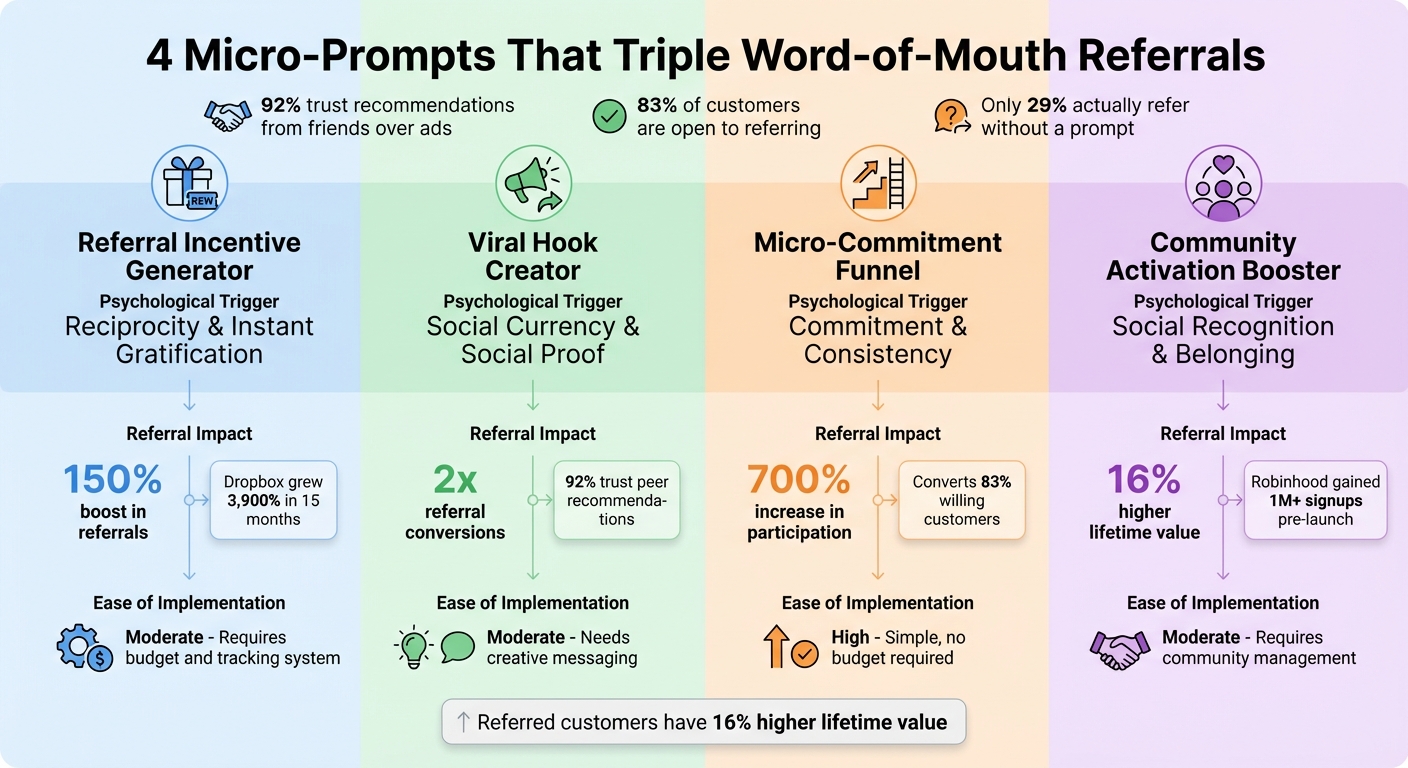
4 Micro-Prompts to Triple Word-of-Mouth Referrals: Comparison Guide
Below is a streamlined comparison of four micro-prompts, outlining their psychological triggers, referral outcomes, and usability. Each approach taps into different motivators to achieve specific results, making it easier to select the one that aligns with your goals and resources.
The Referral Incentive Generator uses reciprocity and instant gratification to generate immediate leads. By offering mutual rewards, it can boost referral rates by an impressive 150%. However, it does require a budget and tracking system to manage rewards effectively.
The Viral Hook Creator prioritizes expanding reach over immediate conversions. It appeals to advocates by providing content that enhances their social standing - leveraging the fact that 92% of people trust peer recommendations over traditional advertising. While effective, it demands creative and personalized messaging.
The Micro-Commitment Funnel works by encouraging small, initial actions, such as asking, "Would you be willing to refer us?" This strategy can turn passive supporters into active referrers, with participation rates increasing by 700%. It's a straightforward method that doesn’t require a budget.
Lastly, the Community Activation Booster focuses on nurturing high-quality leads. By fostering a sense of belonging and recognition within an exclusive community, it delivers leads with a 16% higher lifetime value. However, maintaining such a community requires consistent effort and relationship management.
Here's a quick comparison to help you decide:
| Prompt Name | Trigger Used | Referral Impact | Ease of Use |
|---|---|---|---|
| Referral Incentive Generator | Reciprocity & Instant Gratification | High lead generation; boosts first-time purchases via mutual rewards | Moderate: Needs budget and tracking |
| Viral Hook Creator | Social Currency & Social Proof | Expands reach; improves brand awareness and viral potential | Moderate: Needs creative copy |
| Micro-Commitment Funnel | Commitment & Consistency | Very high participation; 700% lift in active referrals | High: Simple, no budget required |
| Community Activation Booster | Social Recognition & Belonging | High-quality leads with 16% higher lifetime value | Moderate: Requires community management |
Conclusion
Word-of-mouth thrives when you create the right opportunities and make sharing effortless. The four micro-prompts discussed here work because they tap into core psychological principles like reciprocity, social currency, and commitment. By weaving these prompts into your customer journey - right after a purchase, during a milestone, or following a positive support experience - you can turn satisfied customers into enthusiastic advocates. These moments create a natural flow from customer satisfaction to advocacy.
What’s great is that these strategies are simple to implement and don’t require large budgets. With AI-powered workflows, you can automate the process: identifying your most valuable advocates, personalizing outreach, and triggering these prompts at the perfect time. Whether it’s using two-sided incentives to remove hesitation or leveraging micro-commitments to encourage action, these methods can align smoothly with your current operations.
Here’s a key stat to keep in mind: referred customers often boast a 16% higher lifetime value compared to those acquired through other channels. By building a referral engine now, you’re creating a growth asset that will continue to pay off in the future.
Start with the micro-prompt that aligns best with your current customer touchpoints. Measure its impact, refine your approach, and gradually layer in additional prompts for even greater results. There’s no better time to begin turning happy customers into your most powerful advocates.
FAQs
What’s the best way to set up and run the Referral Incentive Generator?
To get the most out of the Referral Incentive Generator, start by designing a reward system that truly grabs attention. Think about what your audience values most - whether it’s discounts, free products, or exclusive benefits - and make sure the rewards are appealing enough to encourage participation.
Then, streamline the referral process. Use automation tools or no-code platforms to make it quick and hassle-free for customers to join and claim their rewards. Once your system is in place, spread the word. Share details about the program on social media, through email campaigns, and at key customer interaction points. Make sure to explain everything clearly - what’s in it for them and how they can get started.
By keeping things straightforward, offering meaningful rewards, and communicating effectively, you can inspire your satisfied customers to become loyal advocates, driving growth through word-of-mouth referrals.
What psychological principles make the Viral Hook Creator effective?
The Viral Hook Creator taps into key psychological principles to ramp up customer engagement and encourage referrals. One of the driving forces behind this is reciprocity - offering rewards or incentives motivates customers to share or refer others, creating a win-win cycle for everyone involved.
Another powerful principle at play is social proof. By showcasing referral activities, testimonials, or even leaderboards, it highlights that others are actively participating. This visibility nudges new users to jump on board, driven by the idea that "if everyone else is doing it, maybe I should too."
To make things even more effective, the tool simplifies the sharing process with one-click options and clear prompts. This taps into the human desire for instant gratification - people are far more likely to act when it only takes a moment of their time. Together, these strategies create a smooth, engaging experience that naturally fuels growth through word-of-mouth.
Why is timing so important when asking for referrals in the Micro-Commitment Referral Funnel?
Getting the timing right is crucial when asking for referrals. Why? Because people are more likely to share positive experiences when they’re feeling satisfied and happy. This often happens right after a milestone - like completing a purchase, receiving stellar service, or hitting a goal with your product or service.
Take this example: Asking for a referral right after a customer finalizes a transaction or settles into their new home can lead to a much higher chance of a positive response. But if you ask during a stressful or inconvenient moment - like in the middle of a move or after a negative experience - you’re setting yourself up for disappointment. Choosing the right moment not only encourages positive word-of-mouth but also leaves a lasting good impression.
Another tip? Send gentle reminders at well-timed intervals. This way, you stay on their radar without being pushy, increasing the chances they’ll respond over time.
Related Blog Posts
 Report an issue
Get the newest tips and tricks of starting your business!