Starting a business in Australia with $500 in 2026 is achievable thanks to affordable tools, free resources, and growing market opportunities. Here’s a quick breakdown of 15 ideas across four categories:
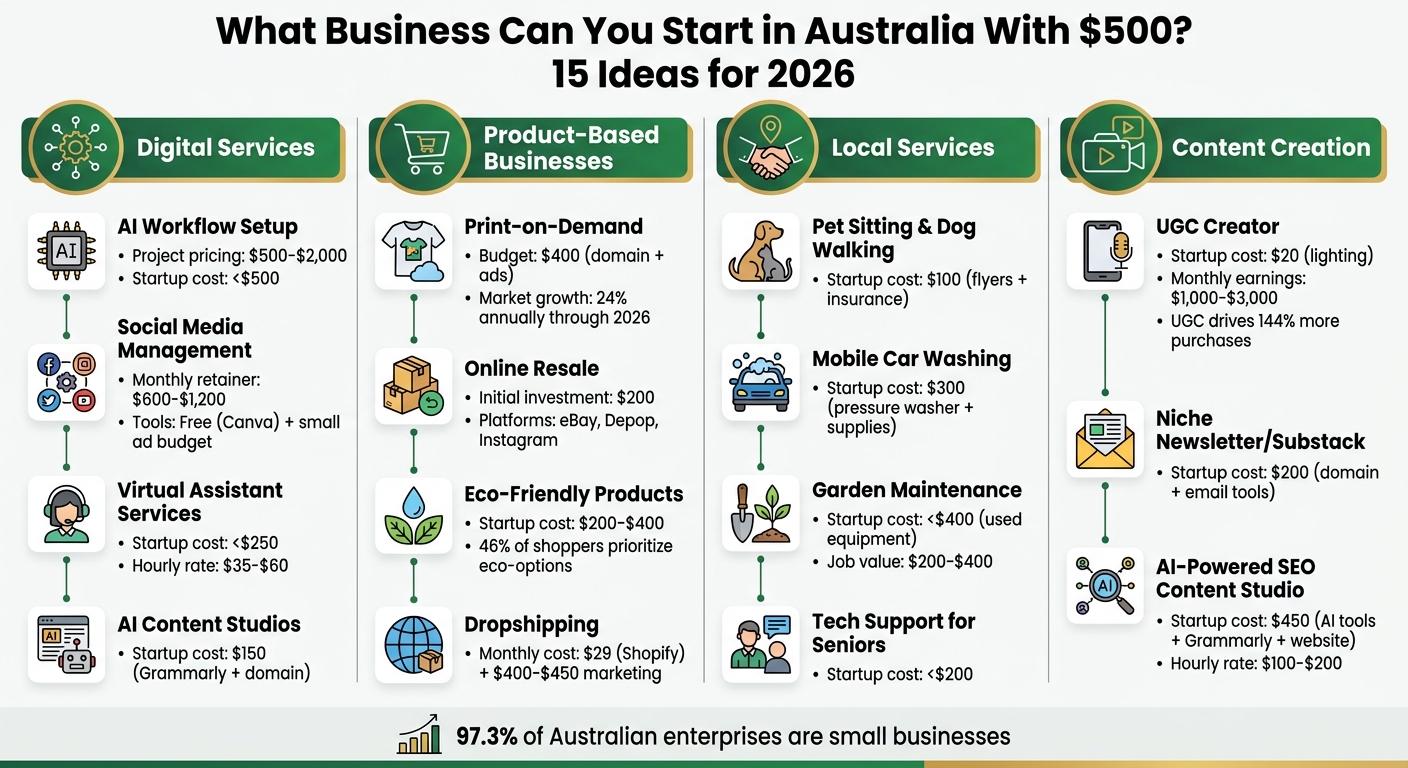
- Digital Services: Offer AI workflow setups, social media management, virtual assistance, or AI content creation.
- Product-Based Businesses: Try print-on-demand, online resale, eco-friendly products, or dropshipping.
- Local Services: Start pet sitting, mobile car washing, garden maintenance, or tech support for seniors.
- Content Creation: Create user-generated content, niche newsletters, or AI-powered SEO content.
These ideas leverage low-cost tools and focus on real customer needs, making it easier to start small and grow over time.
15 Low-Cost Business Ideas in Australia Under $500 by Category
Start A Risk Free Business In Australia in 2026
sbb-itb-08dd11e
1. Digital Services
Digital services have become a go-to for entrepreneurs looking to build businesses with minimal upfront costs. With as little as $500, you can launch a venture without worrying about inventory or renting physical space.
One exciting option is AI Workflow Setup. Small businesses often need help automating tasks like customer responses, bookings, and invoicing. By using tools such as Zapier, ChatGPT, and Make.com, you can complete projects priced between $500 and $2,000. Startup expenses are minimal - usually just a domain name and subscriptions to these platforms - keeping your initial costs well below $500.
Social Media Management is another lucrative path, particularly for local businesses like cafes, gyms, and real estate agencies. Monthly retainers for these services typically fall between $600 and $1,200. Starting out, you can use free tools like Canva and allocate a small budget for ads. To stand out, consider specializing - for instance, offering Instagram Reels creation tailored to cafes.
Virtual Assistant Services are in high demand, especially among Australian tradespeople such as electricians, plumbers, and builders. These professionals often need assistance with quoting, scheduling, and invoicing but can’t afford full-time admin staff. You can start this service for under $250 by investing in a professional website (around $150) and a reliable VPN (about $100). Hourly rates for virtual assistants range from $35 to $60, making this a reliable income source.
Lastly, AI Content Studios combine AI tools with human editing to deliver SEO-friendly blog posts for small businesses. To get started, invest in a $50 Grammarly Premium subscription and a $100 professional email domain. This setup allows you to provide high-quality, optimized content that meets client needs effectively.
2. Product-Based Businesses
Product-based ventures are another great way to start a lean business, turning creative ideas into physical goods that people can buy and use.
These businesses can generate profit without needing expensive inventory or warehouse space. With $500, you can dive into Australia’s booming e-commerce market, which is expected to hit $108.16 billion by 2030. Here are four low-cost product-based business models that align with current trends.
Print-on-Demand is a fantastic entry point. You create designs for items like t-shirts, mugs, or phone cases, while a third-party supplier handles the printing and shipping when orders come in. This approach allows you to test designs without having to stock inventory. Budget around $150 for a domain and $250 for initial social media ads to gauge interest. The print-on-demand market in Australia is expected to grow by over 24% annually through 2026.
Online Resale taps into the growing interest in vintage and curated items, especially among younger Australians. With an initial investment of about $200, you can source inventory from thrift stores, Gumtree, or Facebook Marketplace. Then, sell these items on platforms like eBay, Depop, or Instagram Shop. Since 76% of Australian shoppers are willing to pay more for locally sourced products, focusing on unique Australian vintage pieces or sustainable fashion could give you an edge.
Eco-Friendly Products cater to the increasing demand for sustainability. Nearly half of Australian shoppers (46%) prioritize eco-conscious options, and 42% are willing to pay extra for ethical products. With $200–$400, you can start crafting items like reusable beeswax wraps, natural cleaning products, or upcycled accessories. Platforms like Etsy or Instagram Shop are ideal for reaching this audience.
Dropshipping keeps costs low - around $29 per month for a Shopify store and $400–$450 for marketing. In this model, a third-party supplier handles inventory and shipping, while you focus on marketing. Targeting niche categories, such as pet products, can be particularly effective since nearly 70% of Australian households have pets.
These models provide flexibility and scalability without requiring a large upfront investment, making them perfect for aspiring entrepreneurs.
3. Local Services
Local services offer practical ways to address everyday needs while keeping startup costs low. These ventures succeed by focusing on specific gaps often ignored by bigger companies, avoiding hefty overheads like long-term leases and expensive equipment.
Pet Sitting and Dog Walking is a simple way to get started. With just $100, you can cover essentials like $30 for flyers to distribute locally and $70 for liability insurance. Build your client base through local Facebook groups and word-of-mouth recommendations. Since the job requires minimal gear - just leashes and waste bags - you can easily operate within a tight budget while setting competitive rates.
Mobile Car Washing is another great option, requiring about $300 upfront. This includes $250 for a portable pressure washer and $50 for cleaning supplies. It’s perfect for busy suburban professionals or apartment dwellers who appreciate the convenience of on-site service. By focusing on one neighborhood at a time, you can streamline your schedule and maximize your earnings - all without the cost of a fixed location.
Garden Maintenance caters to aging homeowners who need help with lawn care and seasonal yard work. You can keep startup costs under $400 by buying a second-hand mower and trimmer from platforms like Facebook Marketplace or Gumtree, leaving some budget for fuel and basic tools. Small jobs worth $200–$400 often get overlooked by larger companies, giving solo operators a chance to carve out a niche.
Tech Support for Seniors meets the growing demand for in-home help with tasks like setting up Wi-Fi, configuring smart TVs, or teaching smartphone basics. Many retirees living outside big cities need this kind of assistance. You can start with under $200, covering a professional domain and some basic tools. By marketing through community centers and senior groups, you can quickly build trust and a steady client base.
4. Content Creation
Content creation has become an accessible and flexible way to dive into entrepreneurship, especially with the growing preference for genuine, relatable content over polished, high-budget productions. With just a smartphone and some basic tools, you can get started for less than $500 and tap into a market hungry for authenticity.
One option is becoming a UGC (User Generated Content) Creator, where you produce customer-style videos and photos for brands. Unlike traditional influencers, you don’t need a large following - just a smartphone, a $20 lighting setup, and the ability to craft content that feels like authentic customer experiences. It’s a lucrative field, too. Shoppers who engage with UGC-based reviews are 144% more likely to make a purchase and generate 162% more revenue per visitor. Many part-time creators earn between $1,000 and $3,000 a month while building their portfolios.
If writing is more your style, consider starting a Niche Newsletter or Substack Publication. Focus on highly specific topics, like local tourism, family budgeting tips, or community updates. Launching one is affordable - about $200 covers the cost of a domain name ($10–$20) and email marketing tools. As interest in hyper-local content grows, you can monetize through paid subscriptions and sponsorships from nearby businesses. The trick is to pick a focused niche that fills a gap in the market, rather than trying to cover broad topics.
Another avenue is an AI-Powered SEO Content Studio, catering to small businesses like cafes, gyms, or real estate agencies that need blog posts and website content but lack big budgets. Using AI tools for drafting, combined with your editing and strategic input, allows you to deliver high-quality work efficiently. Initial costs include $300 for AI subscriptions, $50 for Grammarly Premium, and $100 for a professional website. You can charge $100–$200 per hour for your services. By 2026, AI tools will enable solo entrepreneurs to handle workloads that used to require teams of 3–5 people.
These content-driven opportunities make it easier than ever to start a business on a small budget while meeting the growing demand for personalized, engaging content.
Conclusion
Starting a business in Australia with just $500 in 2026 is entirely possible with thoughtful planning and a focus on practicality. The key is to choose ideas that align with your skills, require minimal upfront costs, and meet genuine market needs. With 97.3% of Australian enterprises falling under the small business category, you'll be stepping into a dynamic, supportive environment. Advances in AI tools, free online resources, and a growing preference for local, authentic brands make this an opportune time to launch.
To set yourself up for success, it's important to validate your idea and streamline your operations. Start by talking to at least five potential customers to confirm demand, then keep your launch lean by cutting unnecessary expenses and leveraging free or affordable tools. If you're offering a service, factor in around $300 for public liability insurance to safeguard yourself from potential risks.
In 2026, the Australian market is leaning toward businesses that emphasize authenticity and adaptability. Whether you're starting a mobile pet grooming service, creating user-generated content, or running an AI-driven content studio, the tools available today make it easier than ever to manage and scale your operations. With 55% of small business leaders acknowledging that AI simplifies business management, you can automate repetitive tasks like bookings and customer communication, allowing you to operate efficiently - even as a solo entrepreneur.
The formula is simple: start small, focus locally, and solve real problems for a specific group of people. Gather feedback early, adapt quickly, and remember - success doesn't always come from having the largest budget. It comes from understanding your audience and being willing to refine your approach as you go. Your $500 startup journey begins with one solid idea and the determination to take that first step.
FAQs
Which idea can make money the fastest with $500?
The fastest way to turn $500 into income in Australia is by diving into service-based or digital side gigs. For example, you could offer virtual assistant services to small businesses, which is both affordable to start and highly sought after. Another idea is pet sitting or dog walking, a simple way to earn while spending time with furry friends.
If you’re more inclined toward online opportunities, consider reselling goods on platforms like eBay or Facebook Marketplace. Alternatively, if you have expertise in a particular field, offering consulting services can be a quick way to bring in cash with minimal upfront investment. These options are flexible, require little setup, and can help you see results fast.
Do I need an ABN or insurance to start?
To legally run a business in Australia, you’ll usually need an ABN (Australian Business Number). This number is essential for tax purposes and other official business dealings. Additionally, it’s a smart move to secure insurance. Having the right coverage helps safeguard your business assets and reduces risks, especially if you’re regularly interacting with clients or customers.
How do I validate demand before spending the $500?
Before pouring $500 into an idea, it’s smart to test the waters with affordable strategies. Start with market research to see if your idea already exists and if people actually need it. This helps you avoid wasting time and resources on something with little demand.
You can also try low-cost testing methods like:
- Setting up a simple landing page to gauge interest.
- Offering a basic version of your product or service to see if people bite.
- Conducting surveys to gather direct feedback from potential customers.
These steps allow you to confirm market interest while keeping risks low.
Related Blog Posts
- Best Small Business Ideas in Australia Under $5,000
- 18 Low-Investment Business Ideas in Australia for 2026
- What Business Can You Start in Australia With $10,000? 15 Realistic Ideas for 2026
- Best Small Business Ideas in Australia Under $30,000