Starting a courier business can be a profitable opportunity, especially with the growing demand for delivery services. Here’s a quick breakdown of what you need to know:
- Vehicles: Choose the right vehicle based on your delivery needs. Options range from bicycles for short urban routes to cargo vans for larger shipments. Costs depend on whether you buy, lease, or use used vehicles.
- Routes: Efficient route planning can cut fuel costs by up to 45% and increase delivery speed. Tools like Onfleet or Routific help automate this process.
- Pricing: Set rates based on your cost per mile and competitor analysis. Most local services charge $1.00–$3.00 per mile, with profit margins of 8–20%.
- Startup Costs: Starting small with a single vehicle can cost $1,000–$4,000, while scaling up to a fleet requires $10,000–$40,000 or more.
- Insurance & Legal: Get commercial auto insurance ($1,500–$3,000 per vehicle annually) and meet local licensing requirements, including registering your business.
How to Start a Courier Business in 2025 | Step-by-Step Guide for Beginners
sbb-itb-08dd11e
Selecting Vehicles for Your Courier Business
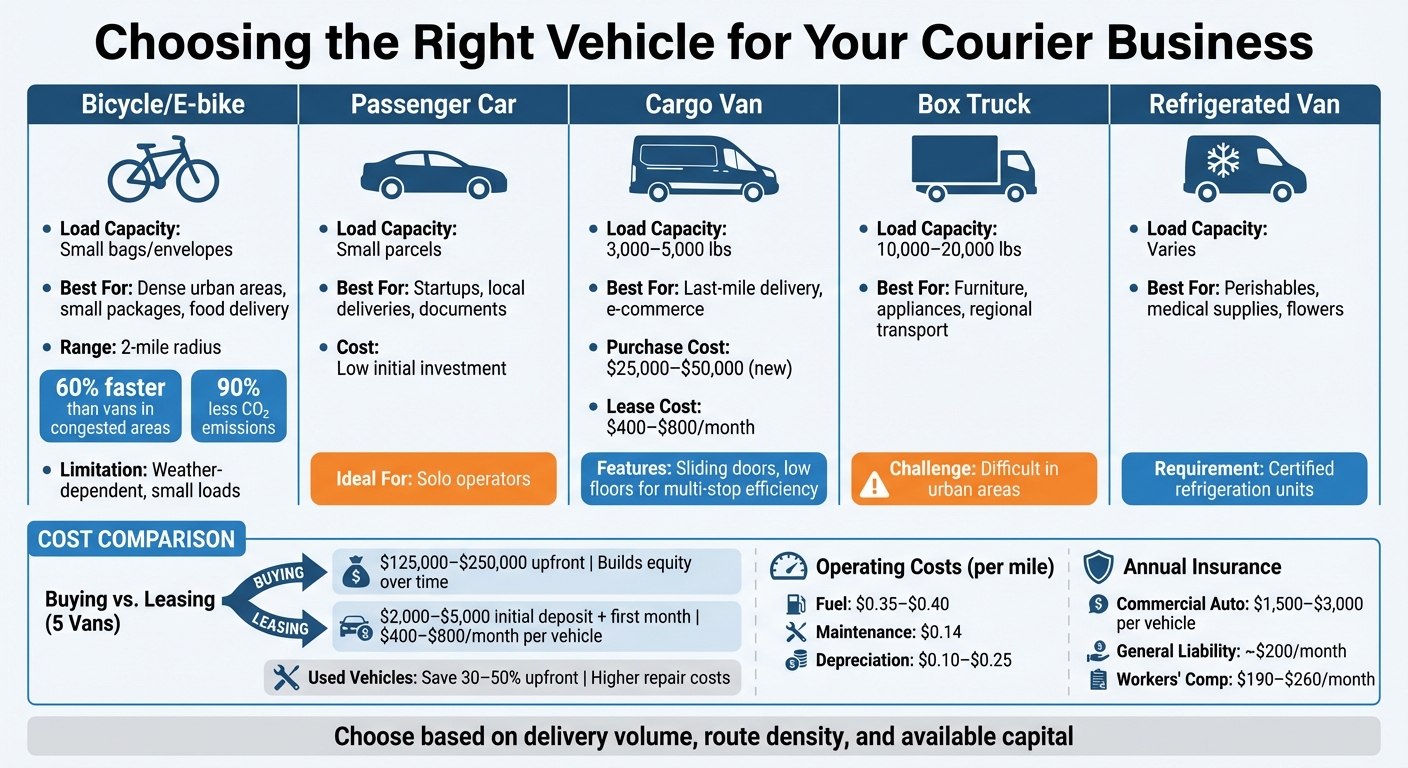
Courier Business Vehicle Types: Capacity, Costs & Best Use Cases
The vehicle you choose plays a key role in shaping your operating costs, delivery capacity, and overall profitability. Your decision should align with what you’re delivering, where you’re delivering it, and how much capital you have to work with. A bicycle courier in Manhattan, for instance, has vastly different needs compared to someone delivering furniture in suburban neighborhoods.
Here’s a quick reality check: fuel costs run about $0.35–$0.40 per mile, and maintenance adds another $0.14 per mile. Choosing a vehicle that matches your delivery volume and route density is the key to keeping costs under control.
Vehicle Types and Their Uses
Start with your target market. Then, pick a vehicle that suits the type of deliveries you’ll handle. For example:
- Bicycles and e-bikes are perfect for dense urban areas within a 2-mile radius. They’re great for delivering legal documents, small packages, and food orders. They also shine in congested city centers - bicycle deliveries are 60% faster than vans and cut CO₂ emissions by 90%. But they’re limited by small loads and bad weather.
- Passenger cars are a low-cost option for solo operators just starting out. They work well for documents and small parcels but aren’t ideal for high-volume deliveries.
- Cargo vans like the Ford Transit or Mercedes-Benz Sprinter are the go-to choice for last-mile deliveries. They can handle loads of 3,000–5,000 pounds, and their sliding doors and low floors make multi-stop routes more efficient. New cargo vans typically cost $25,000–$50,000.
- Box trucks (cube vans) are better suited for larger items like furniture and appliances. They’re ideal for regional distribution but can be tricky to navigate in crowded urban areas.
- Semi-trucks are built for bulk freight up to 80,000 pounds, but they’re generally unnecessary for most local courier businesses.
- Refrigerated vans are essential for transporting perishable goods, medical supplies, or flowers. Unlike portable coolers, certified refrigeration units with proper shelving can help you better serve these niches.
| Vehicle Type | Load Capacity | Best Use Case |
|---|---|---|
| Bicycle/E-bike | Small bags/envelopes | Dense urban areas for small packages, food |
| Passenger Car | Small parcels | Startups and local deliveries |
| Cargo Van | 3,000–5,000 lbs | Last-mile delivery, e-commerce |
| Box Truck | 10,000–20,000 lbs | Furniture, appliances, regional transport |
| Refrigerated Van | Varies | Perishables, medical supplies, flowers |
When deciding between buying and leasing, consider your budget. Buying requires a hefty upfront investment (around $125,000–$250,000 for five vans) but builds equity over time [15,18]. Leasing, on the other hand, lowers initial costs - think $2,000–$5,000 per vehicle for deposits and the first month’s payment, with monthly costs of $400–$800. Used vehicles can save you 30%–50% upfront but may lead to higher repair and downtime costs [16,18].
Once you’ve chosen your vehicles, the next step is insurance and legal compliance.
Commercial Insurance and Legal Requirements
After selecting your vehicles, securing the right insurance and meeting legal requirements are critical to protecting your business. Managing these costs is just as important as controlling fuel and maintenance expenses.
Standard personal auto insurance won’t cover business deliveries. In fact, most policies explicitly exclude commercial use [5,6]. You’ll need commercial auto insurance, which typically costs $1,500–$3,000 per vehicle annually. If your drivers use their own cars, consider getting hired and non-owned auto insurance to protect your operations.
Beyond vehicle coverage, you’ll also need:
- General liability insurance: Covers third-party claims for bodily injury or property damage. Expect to pay about $200 per month.
- Cargo insurance: Protects the goods you transport and usually costs 0.1%–0.3% of the cargo’s value.
- Workers’ compensation insurance: Required in 49 states (except Texas), this costs about $190–$260 per month [7,10].
For licensing, a Commercial Driver’s License (CDL) isn’t necessary unless you’re operating larger vehicles or transporting hazardous materials [11,12]. But if your vehicles weigh over 10,000 pounds, cross state lines, or carry hazardous goods, you’ll need a USDOT number, which costs $300–$500 to register [6,13,15].
To protect yourself legally, register your business as an LLC or Corporation [7,10]. You’ll also need an Employer Identification Number (EIN) from the IRS for hiring employees and managing finances [8–11]. Check with your local DMV for any specific endorsements required for transporting items like food, medical samples, or legal documents.
"A courier business may require a zoning permit if it operates within a specified region." – LJ Viveros, Distinguished Growth & M&A Transition Advisor
Finally, reach out to your city or county clerk’s office for details on business licenses, courier-specific permits, and zoning approvals - especially if you’re running your business from a home office or physical location [8,10,12].
Planning Delivery Routes
Once you've chosen the right vehicles, the next step is mapping out efficient delivery routes. This can have a huge impact on reducing costs and speeding up delivery times. While manually planning routes for 10 stops might take 30–45 minutes, automated software can handle the same task in under a minute - and with at least 20% better efficiency.
Optimized routes can significantly lower fuel expenses (up to 45%), increase driver capacity by 30–50%, and ensure 95–98% on-time deliveries. The key is picking a tool that fits your delivery model. For instance:
- Onfleet is ideal for high-volume, on-demand deliveries. It uses AI-powered optimization and features a driver-friendly app.
- Routific caters to small businesses with planned, next-day deliveries - like florists or meal subscription services - with pricing starting around $150 per month.
- EasyRoutes, designed for Shopify stores, pulls orders directly from the platform to create routes automatically. It has a 4.8-star rating and is trusted by over 5,000 businesses.
"Onfleet helped us continue to differentiate through excellent customer delivery service. Their route optimization technology and intuitive app made our drivers' jobs easy..." – Neil Hampshire, Chief Information Officer, Parallel
Route Optimization Tools
Simplify the process by uploading delivery addresses via Excel or CSV to save time and reduce errors. Before running optimization, you can set constraints like vehicle capacity, driver hours, and customer-specific time windows. Tools such as the Google Maps Route Optimization API allow for tailored routes that balance travel efficiency and load distribution. Meanwhile, Route4Me offers features like real-time driver tracking and fleet management for multi-stop planning.
Another critical feature to consider is geocoding verification, which flags unclear addresses to ensure drivers reach the correct locations instead of getting lost. Additionally, tools that track driver familiarity with routes can enhance delivery speed by roughly 10%.
Once your routes are digitally optimized, you can further improve efficiency by organizing your service area.
Zoning and Delivery Schedules
Dividing your delivery area into zones - based on neighborhoods, postal codes, or distance from your hub - helps localize drivers and makes same-day deliveries more practical. Urban zones often require smaller vehicles to navigate tight, congested streets, while larger trucks are better suited for regional zones with longer routes. Using geofencing can also prevent inefficient "spaghetti routes" and reduce fuel wastage.
Balancing delivery priorities is equally important. Pair same-day express deliveries with next-day standard orders by grouping non-urgent stops together to maximize route density. Extending delivery windows when possible allows vehicles to carry more packages per trip, cutting down on fuel usage. Additionally, combining drop-offs with pickups (reverse logistics) on the same route can reduce overall mileage by up to 20%.
Setting Your Pricing
Once your routes are optimized, the next step is to refine your pricing strategy. This ensures your business stays profitable while remaining competitive in the market. Start by calculating your cost per mile (CPM). Add together fixed costs (vehicle payments, insurance, permits, office rent) and variable costs (fuel, maintenance, tires, tolls), then divide the total by the miles driven. Don’t forget hidden expenses like depreciation ($0.10–$0.25 per mile) and deadhead miles, which can increase costs by 10–25%.
"The difference between your rate and cost per mile is your profit margin, which supports business growth, unforeseen expenses, and owners' compensation." – Rakesh Patel, Logistics Expert
It’s also important to research your competitors’ pricing. Call local services or use their online calculators to get quotes for various scenarios. While the average market rate ranges between $1.00 and $3.00 per mile, avoid the temptation to undercut everyone. As FreshBooks advises:
"Don't try to simply price lower than your competition, as potential customers will be suspicious. You probably won't be able to cover your overhead with really low rates either".
Your pricing should cover costs while aligning with market expectations.
Cost and Competitor Analysis
Understanding your expenses is key to setting the right rates. For example, factor in fuel and maintenance averages and account for commercial insurance as previously discussed. If you employ drivers, wages will vary: delivery truck drivers earn around $15.12 per hour, while specialized courier workers can make up to $25.10 per hour.
Once you’ve calculated your costs, compare them to competitors’ rates. Local delivery services typically charge $1.00–$1.45 per mile with profit margins of 8–20%, while specialty transport can reach $2.50–$3.75 per mile with margins up to 20%. Never price below your CPM - doing so means losing money on every delivery.
Creating a Tiered Pricing Model
A tiered pricing structure can help you cater to different customer needs. Most courier businesses include a base fee, a per-mile rate, and surcharges for premium services. Commonly, there are three speed tiers:
- Standard: Delivery within 2–3 business days
- Express: Overnight or same-day delivery with a 10% premium
- Rush: Immediate delivery, often with a flat fee of $15–$20
For packages, consider setting a weight threshold (typically 50 lbs) and charge an extra $10–$25 for heavier items. You can also apply surcharges for weekend or after-hours deliveries (10–20%) or waiting times beyond a 5-minute grace period ($0.50 per minute). However, keep in mind that only 23% of customers are willing to pay extra for premium delivery. Your standard tier should be competitively priced to attract a broad customer base, while express options can target those willing to spend more.
Breakeven Analysis for Profitability
To ensure your pricing is sustainable, calculate your breakeven point. For example, if your monthly fixed costs are $2,150 and variable costs are $2,550 for 4,000 miles, your breakeven CPM is $1.18. To achieve a 25% profit margin, you’d need to charge at least $1.48 per mile.
You can also determine how many deliveries you need each month to cover expenses. Divide your fixed costs by your contribution margin (profit left after variable costs are subtracted per delivery). This calculation reveals the delivery volume required to sustain your business. Efficient route planning and cost management play a critical role in keeping your breakeven point achievable.
| Service Tier | Cost Per Mile | Rate Per Mile | Profit Margin |
|---|---|---|---|
| Local Delivery | $0.70–$1.15 | $1.00–$1.45 | 8%–20% |
| Field Service | $0.90–$1.60 | $1.25–$2.00 | 8%–22% |
| Long-haul Trucking | $1.90–$2.40 | $2.30–$2.90 | 7%–18% |
| Specialty Transport | $2.00–$3.00 | $2.50–$3.75 | 10%–20% |
Investing in routing software can also help. Most systems pay for themselves in 60–90 days through fuel savings alone, reducing operational costs by 15–25% and speeding up your breakeven timeline.
Combining Vehicles, Routes, and Pricing
The choices you make about vehicles, routes, and pricing are deeply connected - they shape whether your courier business thrives or struggles. For instance, opting for a compact van might save on initial costs and fuel, but it limits how much you can deliver in one trip. On the other hand, using route optimization software can cut your cost per mile, allowing you to set competitive prices without eating into your profits.
It's crucial to align these three factors right from the start. If your focus is on urban deliveries with smaller packages, a fuel-efficient van combined with tightly planned routes can help keep costs low. For larger shipments or longer trips, a bigger truck might be necessary, but you'll face higher fuel and maintenance expenses. That means your pricing strategy must account for those added costs. Every decision about vehicles and routes feeds directly into your pricing model. By matching your vehicle and route choices with realistic costs, you can build a pricing plan that supports long-term profitability.
Startup Cost Budget
Getting your vehicle, route, and pricing strategy in sync begins with a solid budget that balances upfront investments with ongoing expenses. Starting a courier business requires both initial capital and enough cash to cover the first few months of operations. For a fleet of five vans, you’ll need $12,500 to $50,000 as a down payment if financing vehicles, plus $10,000 to $15,000 annually for commercial insurance. Licenses and permits can cost anywhere from $500 to $5,000, depending on your location and the type of cargo. Route optimization software adds $50 to $200 per month, and you’ll need working capital of $120,000 to $250,000 to manage operating expenses while waiting for revenue to flow in.
Cash reserves are especially important since many business clients pay on 30- to 60-day terms. That means you’ll need liquidity to keep things running while waiting for invoices to clear. Preventive maintenance is another smart move - it helps avoid costly emergency repairs that can derail your budget.
| Cost Category | Initial Investment (5 Vans) | Monthly Operating Expense |
|---|---|---|
| Vehicle Acquisition | $12,500 – $50,000 (Down payment) | $2,000 – $4,000 (Lease/Loan) |
| Insurance | $10,000 – $15,000 (Annual) | $800 – $1,250 |
| Technology/Software | $2,000 – $5,000 | $200 – $1,000 |
| Fuel & Maintenance | N/A | $1,500 – $3,000 |
| Driver Salaries | $10,000 (Training) | $12,500 – $20,800 |
Revenue and Growth Projections
Once your costs are mapped out, the next step is to project your revenue and determine profitability. Start by estimating the number of deliveries you can complete each month based on your service area, vehicle capacity, and driver availability. Multiply that by your average delivery rate - local services usually earn around $30 per delivery. Subtract your operating expenses to calculate your net profit or loss.
To refine your projections, monitor key metrics like fuel cost per mile, delivery success rates, and driver idle time. For example, the trucking company Haulin Assets launched in 2019 with a $13,486 truck down payment and a $4,893 trailer down payment. By closely tracking costs per mile and managing overhead, they generated $200,000 in gross revenue during their first year. Most courier businesses aim to break even by their second year. Those that prioritize route optimization early on often see 15–30% lower fuel costs, helping them achieve profitability more quickly.
Conclusion
Launching a courier business hinges on three tightly connected decisions: choosing the right vehicles, planning routes effectively, and setting competitive pricing. These elements must work together to maintain profitability.
The courier industry is expanding rapidly, with projections hitting $636.14 billion by 2030, but profit margins remain slim at just 2% to 5%. To succeed, it’s crucial to align your vehicle selection, route planning, and pricing strategies. For example, in densely packed cities, bikes or compact vans are ideal for navigating traffic, while cargo vans are better suited for handling larger e-commerce shipments. Route optimization is also a must - it cuts fuel costs and reduces wear and tear on your fleet.
When it comes to pricing, make sure every expense is accounted for, from fuel and maintenance to driver wages, which can take up as much as 60% of your operating costs. Adding surcharges for rush deliveries or after-hours services can further safeguard your margins. By thoughtfully integrating these three components, you’ll set the foundation for steady growth in a competitive and fast-growing market.
FAQs
Which courier niche should I start with first?
Choosing the right courier niche is all about aligning market demand with what you can realistically offer. Some of the most popular and reliable options include food delivery, grocery delivery, and parcel services - these tend to generate steady profits thanks to consistent demand.
If you're just starting out, food or grocery delivery can be a smart choice. These services already have a strong customer base, making it easier to gain traction. On the other hand, if you're looking to stand out, you might explore specialized areas like medical supply delivery or handling high-value items. These niches often have less competition but require more attention to detail and possibly additional resources.
Ultimately, the key is to focus on what your local community needs while considering the resources you have at your disposal.
Do I need a CDL or a USDOT number to operate?
Whether you need a CDL (Commercial Driver's License) or a USDOT number depends entirely on how your courier business operates. A USDOT number is mandatory if your business involves interstate commerce, transporting hazardous materials, or using commercial vehicles that meet specific size or weight thresholds. On the other hand, a CDL is required for driving certain types of vehicles, like large trucks.
For smaller, local courier services that stay within state lines and avoid handling hazardous materials, neither a CDL nor a USDOT number may be necessary. However, it’s crucial to review both federal and state regulations to make sure your business stays compliant.
How do I price deliveries when miles are unpredictable?
To calculate pricing for deliveries with unpredictable mileage, start by determining the total cost per delivery. This includes both fixed expenses (like vehicle maintenance and insurance) and variable costs (like fuel and driver wages). Then, estimate an average cost per mile based on typical delivery routes, adding a buffer to account for unexpected variations in distance.
Leveraging route optimization tools can help minimize costs and improve the accuracy of your estimates. Additionally, it's important to clearly communicate with customers about potential extra charges for longer distances. This transparency helps set expectations while ensuring your business remains profitable.
Related Blog Posts
- How to Start a Mobile Car Detailing Business: Complete Guide
- How to Start a Food Truck Business: Permits to Profits
- How to Start a Profitable Lawn Care Business: Complete Guide
- Laundry Service (Pickup & Delivery): Bags, Routes, Profit