
During economic downturns, some businesses stand strong because they address problems people can't ignore. Services like car repairs, home maintenance, childcare, and tax preparation remain priorities even when budgets shrink. Why? These services solve unavoidable issues, focus on recurring needs, and often operate with low costs. For example:
- Auto Repairs: People fix cars instead of buying new ones.
- Home Maintenance: Leaky roofs or broken heaters can't wait.
- Financial Services: Tax filing and money management stay critical.
- Childcare/Elder Care: Families depend on these services to function.
These businesses thrive by solving urgent problems, offering repeat services, and keeping operations lean. If you're starting a service business, focus on solving specific, high-priority issues and validate your idea before scaling up. You can also learn how to launch your business through our free entrepreneurship courses.
12 Businesses That Thrive In A Recession (2025)
sbb-itb-08dd11e
Why Service Businesses Stay Strong During Recessions
Service businesses tend to weather economic downturns well because they meet essential, unavoidable needs. When money is tight, people cut back on luxuries like vacations, dining out, or splurging on new gadgets. But they still need their cars repaired, their taxes filed, and their homes maintained. These are not optional expenses - they’re necessities that keep daily life running. This dynamic pushes consumers to prioritize essential services over non-essentials.
How Consumers Prioritize Necessary Services
During tough economic times, consumer spending shifts from wants to needs. Instead of buying new cars, people repair the ones they already own. Across various industries, this "repair over replace" mindset leads consumers to extend the life of what they have rather than invest in new items.
This creates steady demand for maintenance services. For example, a broken furnace in the middle of winter or a leaky roof can’t be ignored. Emergency plumbing issues also demand immediate attention. As Mailchimp explains:
"The strongest recession-resistant businesses operate independently of broader economic trends... They operate independently of consumer sentiment and discretionary spending".
Financial and legal services see similar stability. Tax preparation, bookkeeping, and compliance services remain vital for both individuals and businesses, especially when navigating financial challenges. The financial advisor industry, for instance, is expected to grow by 13% between 2022 and 2032, highlighting the ongoing demand for expert guidance during uncertain times.
Everyday Needs That Never Go Away
In addition to repair and compliance services, some needs remain constant no matter the economic climate. Childcare and elderly care, for example, are essential for families to function, as working parents and caregivers rely on these services. Even pet care proves resilient - sales in this sector grew by 5.1% during the 2008 recession, reflecting how pet owners prioritize their animals as family members.
Interestingly, small indulgences also hold their ground. Beauty salons in the U.S. grew by 14.4% during the Great Recession, a phenomenon often called the "Lipstick Effect." This term describes how people continue spending on affordable luxuries - like haircuts or small treats - that provide emotional comfort during challenging times. These minor expenses feel manageable and help lift spirits without breaking the bank.
Service Businesses That Survive Recessions
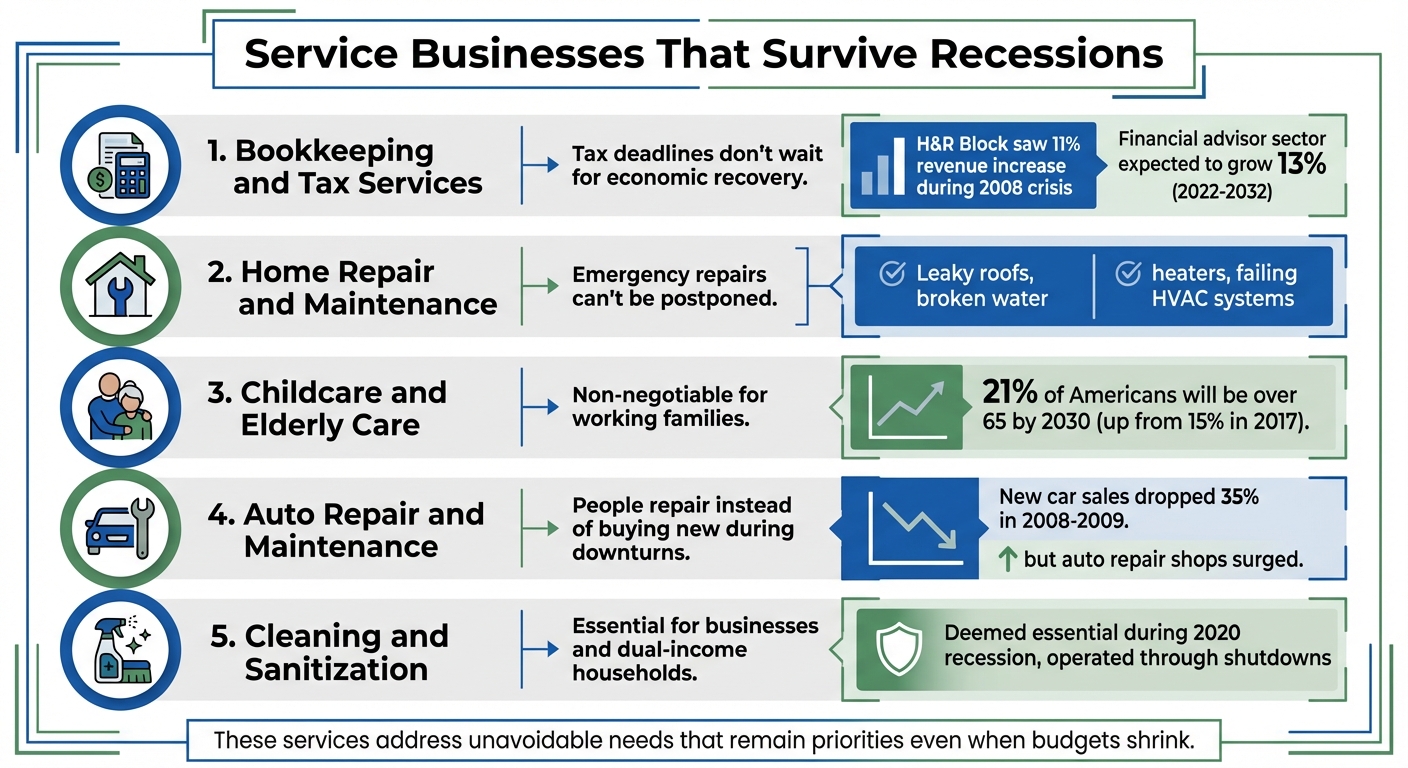
5 Recession-Proof Service Business Types and Their Key Strengths
Some service industries have a knack for weathering economic downturns. Why? They cater to everyday needs that people can’t ignore, even when money is tight. These businesses focus on essential services that remain in demand, regardless of financial uncertainty.
Bookkeeping and Tax Services
Managing finances becomes even more critical during tough economic times. Businesses and individuals alike turn to financial professionals to help stretch every dollar, manage debt, and stay compliant with tax laws. Tax deadlines don’t wait for the economy to recover, and missing them can lead to hefty penalties.
A great example of this resilience is H&R Block. During the early days of the 2008 financial crisis, the company saw an 11% revenue increase as people sought expert advice to maximize tax benefits and navigate financial challenges. Looking ahead, the financial advisor sector is expected to grow by 13% between 2022 and 2032.
Home Repair and Maintenance
Some repairs simply can’t wait. A leaky roof, a broken water heater, or a failing HVAC system demands immediate attention. While homeowners might hold off on aesthetic upgrades like kitchen remodels, they’ll prioritize fixing anything that impacts their daily lives. This keeps home repair professionals in demand, even during economic slumps.
Childcare and Elderly Care
Childcare and elder care are non-negotiable for many families. Parents need reliable childcare to stay employed, and as the population ages, elder care services become increasingly vital. By 2030, 21% of Americans are expected to be over the age of 65, up from 15% in 2017. This steady demand ensures these services remain a cornerstone of the economy, regardless of its state.
Auto Repair and Maintenance
When the economy falters, people hold onto their cars longer rather than buying new ones. This was evident during the 2008–2009 recession when new car sales dropped by 35%, but auto repair shops saw a surge in business. From routine maintenance to major repairs, consumers prioritize keeping their vehicles running, fueling consistent demand for these services.
Cleaning and Sanitization
Cleanliness isn’t optional, especially for businesses like offices, medical facilities, and restaurants. Commercial cleaning services remain critical to maintaining hygiene standards. Residential cleaning services also hold their ground, as many dual-income households value the time savings they provide. During the 2020 recession, cleaning and sanitization services were deemed essential, allowing them to operate through shutdowns and maintain stability in the industry.
How to Test and Launch a Service Business
Finding High-Demand Service Opportunities
Successful service businesses focus on solving specific, urgent problems that customers recognize immediately. For example, instead of broadly offering "marketing services", you might specialize in something like "resolving outbound email deliverability issues for B2B SaaS founders." This level of focus helps you stand out and attracts clients who need immediate solutions rather than vague promises.
Start by reaching out to 30 potential customers through LinkedIn, cold emails, or niche online communities. Ask targeted questions such as, "How are you currently addressing this issue?" or "What is this problem costing you each month?" Their answers will help you gauge whether the problem is pressing enough for them to invest in a solution, even during challenging economic times. With this feedback, you’ll be able to assess whether your service idea has real market traction.
Using IdeaFloat to Test Your Service Idea
Before committing significant resources, consider using IdeaFloat's Problem Validator to confirm whether your service idea addresses a pain point people are willing to pay to resolve. This tool measures how urgent the problem is, identifies weak signals in the market, and provides actionable insights. Pair this with Consumer Insights to explore online communities and learn the exact language potential customers use when describing their challenges. This step ensures you can position your service in a way that resonates immediately.
Additionally, IdeaFloat's Competitor Analysis can map out the key players in your market, highlighting gaps they’re not addressing. This allows you to identify underserved audiences and carve out a space where your service becomes the clear choice. Once you’ve validated demand, the Go-to-Market Strategy tool can help you pinpoint the best channels to reach your audience, estimate customer acquisition costs, and even provide ready-to-use outreach scripts. With these tools, you’ll be ready to move forward and design a scalable business model.
Creating a Low-Cost, Flexible Business Model
To keep initial costs low, manually deliver your service until you’ve proven there’s consistent demand. As April Isaacs, Staff Writer and Editor at Under30CEO, explains:
"Fancy websites, logos, and tools feel productive but delay learning. Validation happens through conversations and commitments, not aesthetics".
Start with a simple, one-sentence offer that clearly states who you serve, the problem you solve, and the result they can expect. Then, pitch a paid pilot to your most engaged prospects. A paid commitment is the ultimate test of demand. During these early projects, track how long tasks take and identify inefficiencies. You’ll likely find that 80% of the value you deliver comes from just 20% of the work. Focus on standardizing those high-value tasks and eliminate anything that doesn’t contribute meaningfully.
When it comes to pricing, base your rates on the value you provide rather than making assumptions. Ask prospects which budget they’d allocate for the solution and how much the problem is costing them monthly. This ensures your pricing holds up, even during times of economic uncertainty. Keeping your startup lean minimizes risk and allows you to adapt more easily if market conditions change. As Isaacs cautions:
"If delivery feels chaotic or miserable at small scale, it will only get worse with more clients".
What You Need to Know About Recession-Resistant Services
What Makes a Service Business Recession-Resistant
Service businesses that thrive during economic downturns tend to have a few key characteristics in common. First and foremost, they address urgent, unavoidable problems - think of fixing a broken furnace in the middle of winter or managing critical tax filings. These are the kinds of services people prioritize, even when they're cutting back elsewhere.
Another advantage is their typically low overhead. Unlike businesses that require costly inventory, large storage facilities, or intricate manufacturing setups, service businesses can often be launched with minimal upfront investment. This flexibility also makes it easier to adapt quickly to changes in demand.
Recurring revenue models play a huge role in creating stability. As the CEO of Builderall puts it:
"Service-based companies can benefit from employing subscription or retainer models. This guarantees two things: repeat customers and a continuous revenue stream".
By offering ongoing services - like monthly cleaning, routine bookkeeping, or regular maintenance - you can establish a steady income stream that helps cushion the business against economic uncertainty.
These traits form the foundation for building a service business that can withstand tough times.
Steps to Start Your Service Business
If you're ready to create a resilient service business, here’s how to get started while incorporating the principles of low overhead, essential services, and recurring revenue.
Begin by ensuring your service solves a critical problem. Tools like IdeaFloat's Problem Validator can help confirm the need for your offering. Use Consumer Insights to understand how potential customers describe their challenges, and conduct a Competitor Analysis to identify unmet needs in the market.
From there, refine your approach using IdeaFloat's resources. Tools like Go-to-Market Strategy, Financial Model, and Pricing Research will guide you in shaping your business strategy, estimating costs, and landing your first paying customer. These steps will help you build a strong foundation for a service business that can endure economic ups and downs.
FAQs
How do I choose one service niche that stays in demand during a recession?
When planning a business strategy, it's smart to concentrate on essential services - the kind people or businesses can’t afford to delay. Think about areas like healthcare, plumbing, HVAC, repairs, or cleaning. These services address critical needs and are often non-negotiable.
You might also want to explore niches that tackle recurring problems or offer cost-saving solutions. For example, auto repair or home maintenance services often fit this description, as they help people avoid bigger expenses down the road.
Focusing on industries with inelastic demand - where people continue to need the service regardless of economic conditions - can also be a game-changer. Pairing that with recurring revenue streams can create a more stable foundation for success, even during challenging economic times.
What’s the fastest way to validate people will pay for my service?
The fastest way to see if there's demand for your idea is to test it with minimal effort and resources. You can try pre-sales, offer limited-time discounts, or set up a basic landing page to measure interest and gather feedback. Another effective approach is to talk directly with potential customers or run small pilot programs. These methods let you understand their needs and willingness to pay - all without requiring a big initial investment.
How can I make a service business recurring without a subscription?
Creating recurring revenue doesn’t always require a subscription model. You can achieve this by implementing loyalty programs, offering repeat customer incentives, or establishing long-term service agreements.
For instance, you could reward customers with discounts or perks for returning to your business, encouraging them to keep coming back. Another option is to use contractual agreements that ensure consistent income while also building stronger customer relationships. These strategies not only help stabilize your revenue but also nurture long-term loyalty.
Related Blog Posts
- Business Ideas That Thrive in a Recession
- 7 Business Ideas That Thrive When the Economy Crashes
- 5 "Boring" Businesses Making Their Owners Rich in 2025
- 17 Recession-Resilient Businesses for 2025 (With Unit Economics)