
Most business ideas fail because they don’t solve real problems or lack proper validation. Before diving into a new venture, ask yourself:
- Does it address a real, urgent problem? Customers must actively seek solutions, not just acknowledge the issue.
- Is the market large and growing? Understand Total Addressable Market (TAM), Serviceable Market (SAM), and what you can realistically capture.
- Can it make money? Calculate costs, breakeven points, and profit margins.
- Does it align with your skills and resources? Your expertise and long-term commitment are just as important as the numbers.
The key is validation - testing your idea with data before investing time and money. Tools like search volume analysis, competitor research, and financial modeling can help you identify gaps, confirm demand, and reduce risks. Skipping this step often leads to wasted resources.
Bottom line: A great business idea solves a pressing need, has growth potential, is financially viable, and matches your personal strengths. Start by validating your concept to save time, money, and effort.
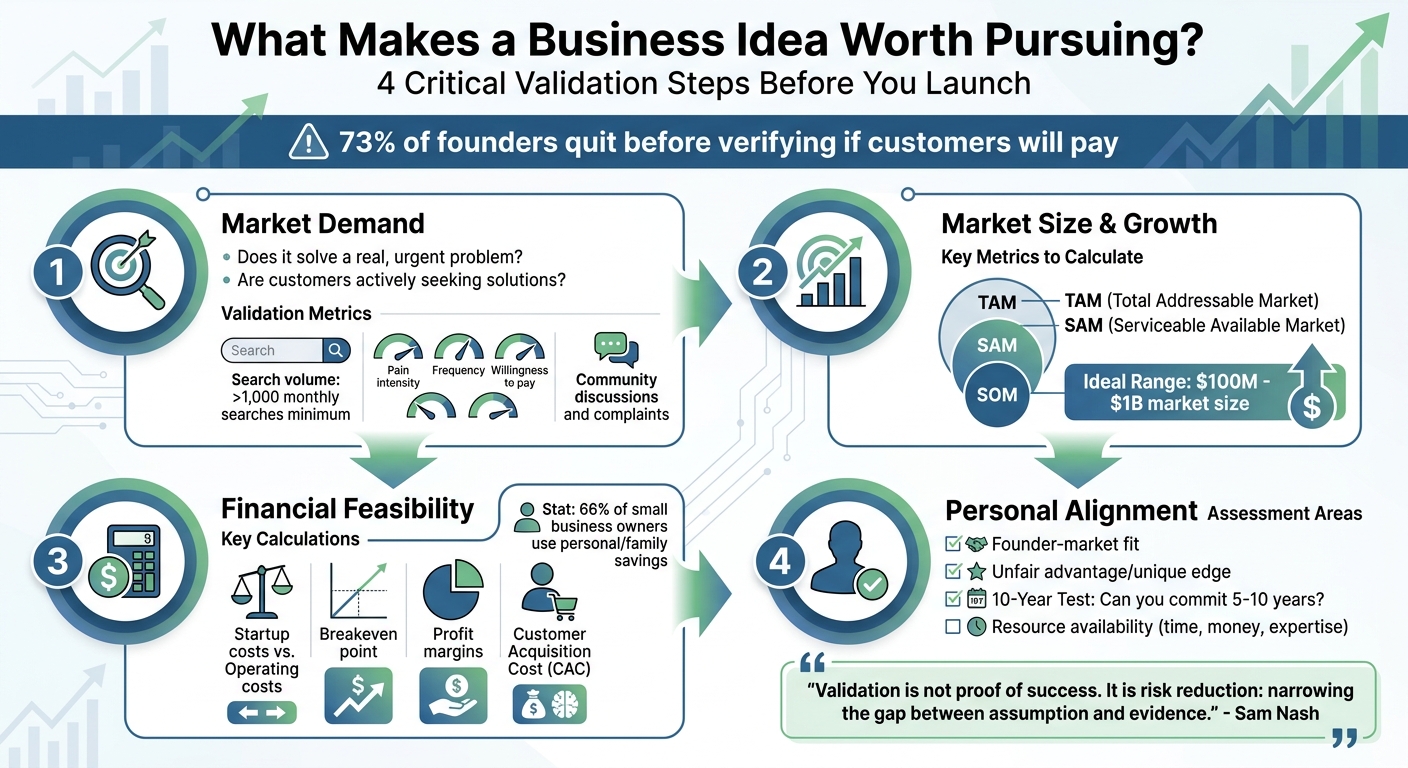
4-Step Framework for Validating Business Ideas
Use This PROVEN Formula to Validate Your Next Startup Idea
sbb-itb-08dd11e
Market Demand: Does It Solve a Real Problem?
The success of any idea depends on whether it tackles a pressing issue. It's not enough for people to acknowledge a problem exists - they need to be actively seeking solutions right now. If your potential customers aren’t searching for fixes, venting frustrations in forums, or trying subpar workarounds, your idea could struggle to gain traction.
Identifying the Problem
To gauge the seriousness of a problem, focus on three key factors: pain intensity, frequency, and willingness to pay. A real problem disrupts daily workflows, leads to unnecessary costs, and pushes people to adopt less-than-perfect solutions. For instance, if you're considering a productivity tool, look for signs that your target audience is already paying for partial fixes, creating complex spreadsheet workarounds, or hiring help to manage tasks manually. These behaviors are far more telling than survey responses where people casually claim they "would definitely use" your product.
Before diving into development, confirm you're solving an issue that matters. Tools like IdeaFloat’s Problem Validator guide you through a structured process to measure urgency and detect weak demand signals early. This helps you avoid the common pitfall that causes 73% of founders to abandon their projects before finding out if buyers exist. Once you spot signs of a real need, back them up with hard data.
Gathering Data to Confirm Demand
Empirical evidence is essential. Start by reviewing search volume for keywords related to the problem. If fewer than 1,000 people per month are searching for terms like "how to fix [your problem]" or "struggling with [pain point]", it could signal limited demand. But search data is just the beginning.
Next, dive into online communities where your audience is active. IdeaFloat’s Consumer Insights tool scans platforms like Reddit and Quora to analyze real conversations. This helps you understand the exact words people use to describe their frustrations. You're looking for patterns: recurring complaints, highly upvoted posts, and threads where users openly ask for solutions that don’t yet exist.
"IdeaFloat saved us weeks of work by helping us explore demand for new products across different regions and took the guesswork out of finding gaps in the market." - Nick Sherwing, Founder of woohoPets
By analyzing customer language and pain points, you’ll be better prepared to assess your competitors and identify opportunities.
Analyzing Competitors for Market Position
A solid validation process also includes a deep dive into your competitive landscape. The presence of competitors doesn’t mean your idea won’t work - it often proves there’s money to be made. Your task is to pinpoint the gaps in their offerings. IdeaFloat’s Competitor Analysis tool maps out all the players in your space, helping you zero in on their weaknesses: poorly rated features, ignored customer segments, or pricing strategies that miss the mark.
Review platforms like G2, Capterra, and Trustpilot are goldmines for this kind of research. Focus on mid-range reviews, as they often highlight features or services that are "almost good enough" but fall short. When multiple reviewers mention the same missing functionality or frustration, you’ve uncovered a clear opportunity to differentiate. Align these gaps with your idea’s strengths to carve out a niche where your product becomes the obvious choice.
Market Size and Growth Potential
Before diving headfirst into a new business idea, it’s crucial to confirm that the demand for your solution exists. Beyond that, you need to ensure the market is large enough and growing. Why? Because without that growth potential, your idea risks staying a niche project or an expensive hobby rather than evolving into a sustainable business. Market sizing helps you understand the scope of your opportunity and lays the foundation for making informed decisions. The next step? Quantifying your market with the right metrics.
Estimating TAM, SAM, and SOM
To properly assess your market opportunity, focus on three essential metrics: Total Addressable Market (TAM), Serviceable Available Market (SAM), and Serviceable Obtainable Market (SOM).
- TAM is the total revenue you could generate if your business captured 100% of the market - essentially the biggest picture possible.
- SAM narrows this down to the segment you can realistically target, factoring in your business model, geography, and specific customer demographics.
- SOM takes it a step further, estimating the portion of the market you can reasonably capture in the early stages of your business.
For accurate estimates, rely on live research and credible data. Tools like IdeaFloat's Smart Market Sizing can simplify this process by pulling insights from market reports, industry publications, and demographic data. This approach not only saves time but also provides a clear view of your potential customer base when combined with your Ideal Customer Profile.
Evaluating Growth Capacity
A market’s size alone doesn’t guarantee success - it’s only an opportunity if your business model can scale. To assess growth potential, start by analyzing your customer acquisition cost (CAC) across different channels. If your CAC is too high to maintain healthy profit margins, scaling becomes a challenge.
Next, think about how scalable your acquisition channels are. Paid advertising, for instance, often becomes more expensive as competition increases. On the other hand, strategies like content marketing or referral programs may become more efficient over time as your brand gains traction.
Operational scalability is equally important. Can your business handle increased demand without a proportional rise in costs? Automation and streamlined processes can make all the difference, allowing you to grow without requiring a linear increase in resources. Automated tools for market sizing, which can deliver insights in as little as 15 minutes, are a smart way to gauge your scalability potential.
Financial Feasibility: Can It Make Money?
Once you've confirmed there's demand and room for growth, the next step is to figure out if your idea can actually make money. This is the point where many ventures succeed - or fail. Surprisingly, about 73% of founders abandon their projects before even verifying if customers are willing to pay for their solution. To avoid that pitfall, you need a firm grasp of costs, pricing, profit margins, and cash flow.
Calculating Costs and Breakeven
To start, break down your expenses into two categories: startup costs and operating costs. Startup costs include one-time investments like equipment, legal fees, and initial inventory. Operating costs, on the other hand, cover recurring expenses such as software subscriptions, materials, and labor. This breakdown gives you a clear idea of the capital you'll need upfront and what it takes to keep your business running day-to-day.
Next, determine your breakeven point - the point where your revenue matches your total costs. Knowing this helps you figure out how many sales or customers you'll need before you start turning a profit. Tools like IdeaFloat's Financial Model and Cost Analysis can make this process easier by tracking your income and expenses and showing exactly when you'll hit breakeven.
Once you've nailed down your costs and breakeven point, the focus shifts to pricing strategies and identifying potential revenue streams.
Setting Prices and Revenue Streams
Your pricing strategy should be grounded in market research and established pricing methods. IdeaFloat's Advanced Pricing Research tool can help by analyzing real-time market data to recommend price points that maximize profit margins. You can also manually tweak prices based on competitor trends for added flexibility.
But pricing is just one side of the coin. Take a closer look at your revenue streams. Will your income come from direct sales, subscription services, maintenance plans, or licensing? It's equally important to calculate your true margins - the profit left after all costs are deducted. Keep an eye on customer acquisition costs (CAC) to ensure your margins remain sustainable.
Creating Financial Projections
With pricing and revenue models in place, it's time to create detailed financial projections. These projections should outline your path to profitability and flag any early funding requirements. Key questions to address include: Will you need outside funding? If so, how much? And when can you realistically pay it back?
"IdeaFloat has been invaluable for expanding and franchising our business. It replaced months of research and Excel modeling with real-time data insights."
– Soba, Bar, Pilates, and Yoga Studio
IdeaFloat's Financial Projections & Breakeven Analysis tool uses interactive graphs to show exactly when you'll reach profitability, making it easier to plan for funding needs. To date, over 1,247 business ideas have been validated using these AI-powered financial modeling tools.
Alignment with Your Goals and Resources
When considering a business idea, it’s not just about market trends and financial forecasts. Your personal compatibility with the idea plays a huge role in its long-term success. Even the most promising numbers can fall flat if your skills and resources don’t align with the demands of the venture. This is where founder-market fit becomes critical - it’s the synergy between your expertise and the market’s needs. Without this alignment, challenges arise quickly. For instance, creative founders might struggle with operational tasks, while analytical types could burn out managing constant social media engagement.
Matching the Idea to Your Strengths
The first step is understanding your founder personality type. Are you someone who thrives on creativity, storytelling, and aesthetics? If so, industries like fashion, food, or wellness might be a natural fit. On the other hand, if you’re more analytical, you may excel in fields like logistics or B2B software. Connectors, who shine in community-building and education, and Operators, who thrive in process-driven businesses like manufacturing, also have distinct areas where they can succeed.
Next, identify your unfair advantage - that unique edge you bring to the table. This could be specialized domain knowledge, rare technical skills, or even an existing audience. Think about the Peter Thiel Question: What important truth do few recognize?. The answer might uncover a niche where your insight gives you a competitive edge.
Another crucial consideration is the 10-Year Test. Ask yourself: Can you see yourself dedicated to this idea for the next 5–10 years? Without genuine interest, it’s easy to lose steam when the initial excitement fades and the inevitable challenges - the "Trough of Sorrow" - set in.
"Without genuine interest, you'll quit in the trough [of sorrow]."
- NicheCheck Team
Once you’ve pinpointed your strengths and long-term commitment, assess whether your current resources can support this journey.
Checking Resource Availability
After clarifying your strengths and commitment, it’s time to evaluate your resources. This includes your personal and financial situation: Can you sustain a startup for at least 12 months? Are you juggling responsibilities like young children, aging parents, or health concerns? Is your current job flexible enough, or do you rely on it for critical income? Statistics show that 66% of small business owners fund their startups using personal or family savings, highlighting the importance of a solid financial runway.
Create a list of the essential resources you’ll need - such as human capital, technology, materials, and expertise - and confirm their availability. If your idea requires significant upfront investment, consider whether it aligns with your risk tolerance. For example, a business demanding 80-hour workweeks might generate profit but could clash with personal goals like achieving work-life balance. Tools like IdeaFloat’s Cost Analysis can help you calculate monthly startup and operating expenses, giving you a clearer picture of the financial commitment required.
Conclusion
Deciding whether a business idea is worth pursuing boils down to four key factors: market demand, scalability, profitability, and alignment with your personal goals and resources. At its core, you need to address a real problem that people are willing to pay to solve. Beyond that, the market should be large enough to support growth - ideally between $100 million and $1 billion. Financial projections must show a clear path to profit, and the venture should align with your skills and lifestyle to ensure long-term commitment and success. Without these elements working together, even the most exciting idea can drain your time and resources.
When assessing market demand and growth potential, it’s clear that validation isn’t just a nice-to-have - it’s essential for reducing risk. Traditional methods of validating business ideas often take months of research and trial-and-error. However, data-driven validation can shrink this timeline to just days by automating key tasks like market research, competitor analysis, and financial modeling. Instead of relying on gut feelings or overly optimistic feedback, this approach provides honest insights into real opportunities and challenges.
"Validation is not proof of success. It is risk reduction: narrowing the gap between assumption and evidence."
- Sam Nash, Author
A staggering 73% of founders quit before confirming if customers are actually willing to pay. Don’t fall into this trap. Test market urgency, calculate TAM (Total Addressable Market), SAM (Serviceable Addressable Market), and SOM (Serviceable Obtainable Market), and map out clear financial break-even projections. IdeaFloat’s four-phase framework - spanning Problem Validation, Opportunity Sizing, Financial Modeling, and Customer Acquisition - transforms assumptions into actionable evidence.
Skipping validation often leads to building a product no one wants. On the other hand, leveraging AI for validation is fast, cost-effective, and insightful. Your idea deserves more than hopeful guesses - it deserves real, actionable data that lays the groundwork for sustainable growth.
FAQs
How can I validate demand without building the product?
Validating demand doesn’t always mean you have to build a product right away. You can gauge interest by connecting with potential customers directly. This could mean having conversations, running surveys, or even setting up simple landing pages to see if people are genuinely interested - and willing to pay.
Quick methods like asking potential customers, “Would you pay for this?”, can reveal a lot. You can also use AI tools to analyze market trends and competitor data for deeper insights. The key is to determine if the problem you’re solving is big enough and if people are prepared to invest in a solution.
What’s a quick way to estimate TAM, SAM, and SOM?
To estimate TAM (Total Addressable Market), SAM (Serviceable Available Market), and SOM (Serviceable Obtainable Market) quickly, try a bottom-up approach using actual customer data. Here's how: multiply the number of target customers by the annual price per customer. Begin with your SOM - a realistic projection of what you can capture in three years - and then scale up to calculate SAM and TAM. For reliable estimates, use trusted data sources like the Census Bureau or LinkedIn.
How can I test if people will pay for my idea?
To see if people are willing to pay for your idea, try using demand validation techniques. Start by directly asking potential customers if they’d pay for your product or service. You can also run small ad campaigns to gauge purchase intent. Look for real commitments - things like sign-ups, preorders, or even paid pilots. These actions provide strong indicators of whether your idea resonates enough with your target audience to justify a price tag.
Related Blog Posts
- IdeaFloat: The 15-Minute Business Plan Solution
- Validate Your Idea Before Wasting Money
- I Validated My Business Idea in 24 Hours - Here's The Exact Process
- How to Decide Whether a Business Idea Is Scalable or Just Busy Work