
If you want to avoid wasting time and money on an idea that no one needs, validation is your first step. 42% of startups fail because there’s no market need. Instead of building a product right away, test your assumptions using simple, low-cost methods. Here’s how:
- Define your assumptions: Identify the problem, target audience, and key risks (market, problem, revenue). Turn these into testable hypotheses.
- Talk to potential customers: Conduct interviews to confirm the problem is real and significant. Look for workarounds they’re already using.
- Test demand: Use landing pages, surveys, or pre-sales to see if people will commit their time or money.
- Check market size and finances: Estimate your addressable market and calculate if the business can be profitable.
The goal? Gather real evidence - like pre-orders or deposits - not just compliments, to decide if your idea is worth pursuing.
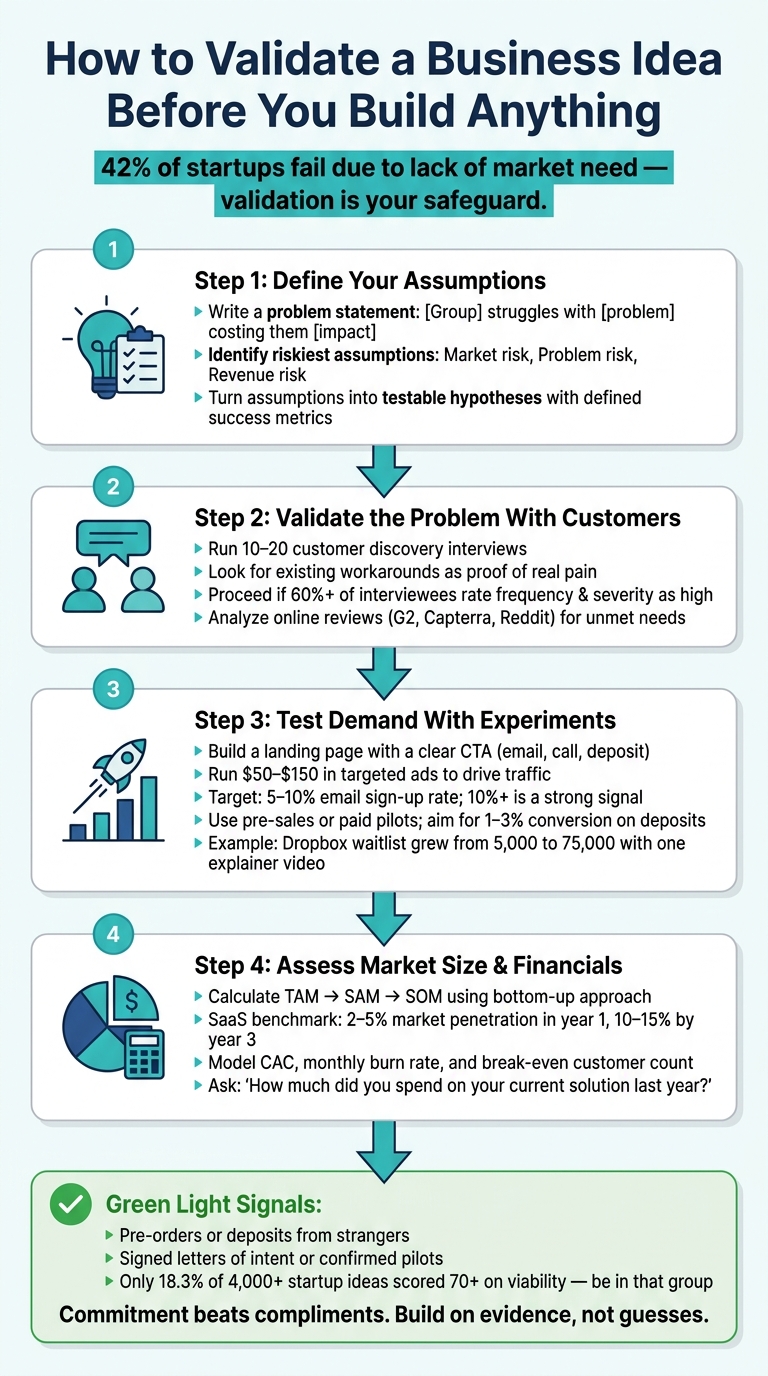
How to Validate a Business Idea in 4 Steps
How to Validate Your Startup Idea for $50 (Same Method That Built a $100M Brand)
sbb-itb-08dd11e
Step 1: Define Your Assumptions and Goals
Before diving into any testing, it’s critical to outline your core assumptions. Every business idea is built on a foundation of assumptions that haven’t yet been proven. The purpose of this step is to document these assumptions, rank them by risk level, and transform them into hypotheses that can be tested.
Identify the Problem and Target Audience
Start by crafting a concise problem statement. Use this formula: [Specific group] struggles with [problem] due to [cause], costing them [impact]. This simple structure helps clarify the issue you’re addressing and who it affects.
Next, narrow down your target audience. This isn’t about broad demographics like age or location. Instead, focus on specifics: Who exactly are they? Where do they spend their time online? Are they active on platforms like Reddit, LinkedIn, or niche communities like Slack groups? Most importantly, do they have the budget and authority to purchase a solution? These details are far more telling than generic traits.
One key indicator of a valid problem is whether your audience is already using workarounds. If they’re relying on temporary fixes, it’s a strong sign that the issue is real.
"If your startup failed, it's because it didn't solve a tier 1 problem for a large enough audience." - Mitchell Harper, Co-founder, Bigcommerce
With a clear understanding of the problem and audience, you’re ready to turn these insights into actionable hypotheses.
Turn Assumptions Into Testable Hypotheses
Now that you’ve defined the problem, it’s time to list your assumptions. Identify all of them, then focus on the riskiest ones - those that, if proven false, could undermine your entire business idea.
Transform these assumptions into testable hypotheses. Use this structure: "We believe [niche] with [pain] will [action] within [timeframe] because [value]. Success equals [metric] at or above [threshold]." This approach forces you to define success upfront, ensuring clarity before any testing begins.
Rank your hypotheses by three types of risk:
- Market risk: Will people even want this?
- Problem risk: Is the pain significant enough to act on?
- Revenue risk: Will they pay enough to make the idea viable?
Testing in this order ensures you don’t waste resources building something impressive that no one actually needs.
Use AI to Refine Your Assumptions
Once you’ve manually outlined your assumptions, AI tools can help validate and refine them. Without AI, this process can be slow, but using the right tools can streamline testing across critical areas like market size, founder fit, and potential deal-breakers (the factors most likely to cause your idea to fail in its early stages).
For example, IdeaFloat’s Problem Validator is designed for this exact phase. It guides you through a structured process to assess urgency, uncover weak spots in your assumptions, and identify gaps in your customer profile before you commit resources. Pair it with their Consumer Insights tool, which analyzes online conversations to extract real customer language. This lets you test your problem statement against actual behavior instead of relying on guesswork. The result? Sharper, more specific hypotheses that are ready for testing.
Step 2: Validate the Problem With Potential Customers
Now that you've refined your assumptions in Step 1, it's time to test those ideas with real customers. The goal here is straightforward: get honest feedback from people outside your immediate network to confirm whether the problem you're addressing is significant enough that someone would pay to solve it.
Run Customer Discovery Interviews
Start by conducting 10–20 interviews, but don’t pitch your solution just yet. Instead, focus on understanding the problem itself. Ask about specific instances when the issue occurred, how much time or money it cost them, and any workarounds they’ve tried. If people are already spending time or money on workarounds, it’s a strong indicator that the problem is real and worth solving.
Make sure to include at least one question designed to challenge your assumptions. And always ask, "Who else should I talk to?" - this can help you expand your network of interviewees. As Julia Austin, Senior Lecturer at Harvard Business School, wisely points out:
"People have the tendency to tell you what you want to hear, or they imagine how they might do something, but rarely do they do what they said they might do."
Once you’ve gathered insights through interviews, take things a step further by validating your findings with online research.
Analyze Online Behavior and Competitor Gaps
Online research can give you a broader perspective to complement your interviews. Dive into reviews on platforms like G2 and Capterra, especially 1-star and 3-star ratings. These often reveal pain points and unmet needs. Also, explore forums like Reddit or niche Slack groups, keeping an eye out for phrases like, "I'm so frustrated with..." or "What do you use for...?" These unfiltered conversations can provide a goldmine of insights into how customers describe their challenges - language you can later use in your marketing.
While doing this, watch for warning signs. For example, if complaints about existing solutions are only about price, it might indicate a commoditized market where standing out could be tough.
Decide Whether the Problem Is Worth Solving
Once you’ve gathered all your data, it’s decision time: should you proceed, pivot, or walk away? Assess the problem based on three key factors: frequency, severity, and how much people are already spending on workarounds. If more than 60% of your interviewees rate these factors as high, chances are you’re onto something.
However, the strongest indicator isn’t what people say - it’s what they do. Brian Shin, founder of the disposable camera app Once, validated demand by taking action before building anything. He sent 250 cold messages to event hosts, and 12 committed to using the product at real events. As he put it:
"We made sure that people committed to this product before writing a single line of code."
This kind of commitment - whether it’s a booked event, a signed letter of intent, or a paid pilot - shows real demand, not just polite interest. Tools like IdeaFloat's Problem Validator can help you measure urgency and identify weak signals, ensuring your decision is backed by data rather than guesswork.
Step 3: Test Demand With Simple Experiments
Once you've identified a problem, the next step is figuring out if people are willing to pay for your solution. This is where you test demand quickly and affordably before investing too much time or money.
Build a Simple Offer and Landing Page
You don’t need a fancy design to test demand. A basic landing page with a clear structure will do the trick. Focus on these elements: call out your target audience, highlight the problem, offer a clear solution, and include one strong call to action (CTA).
Actions speak louder than clicks. Asking for an email, scheduling a call, or collecting a deposit provides stronger evidence of interest than a simple "I'm interested" button. A great example of this approach comes from Dropbox. Before building their product, founder Drew Houston released a short explainer video showcasing the problem and solution. The result? Their waitlist skyrocketed from 5,000 to over 75,000 users overnight. No product, just a clear message.
Tools like IdeaFloat's Waitlist Landing Page make this process easier. They allow you to create a landing page with compelling copy, collect emails, and generate early interest - all without needing a designer or developer.
Run Surveys and Intent Tests
Once your landing page is live, start driving traffic to it. A small budget - $50 to $150 - spent on targeted ads over a weekend can provide valuable insights. For example, during a test for a dog training app, $47 in ad spend over three days resulted in 31 clicks and 9 email sign-ups - a 29% conversion rate.
When using surveys, avoid broad questions. Instead, ask direct ones, especially about pricing and urgency. The Van Westendorp method is a helpful framework, using four specific questions to find the acceptable price range: What’s too cheap? A bargain? Expensive? Too expensive?. Generally, a 5–10% email sign-up rate from targeted traffic is a good indicator, while anything above 10% is a strong signal. These early results can guide you toward deeper validation through pre-sales and pilot programs.
Use Pre-Sales and Paid Pilots to Confirm Demand
The strongest proof of demand comes when people are willing to pay. Pre-sales and paid pilots force potential customers to make a real decision - either they pay, or they don’t. A practical way to start is with a Concierge MVP, where you manually solve the problem for a small group of paying customers. This approach helps you learn what to automate as you refine your solution.
Set clear goals, like securing "5 paid pilots by June 30", and stick to them. A 1–3% conversion rate from pre-orders or deposits is a strong indicator that your idea has potential. Tools like IdeaFloat’s pricing and revenue calculators can help you plan these early steps, ensuring you stay focused on building a business that works.
"Validation confirms that a narrow customer segment will take a specific action that supports a viable business." - Alex Robb, Founder, Launching Next
Step 4: Assess Market Size and Financial Viability
Once you've confirmed that there's interest in your solution, it's time to dig into the numbers. Pre-sales and pilot programs may show demand, but that doesn't automatically mean your idea is financially sustainable. This step is all about figuring out if your business can stand on its own financially in the long run.
Estimate Your Market Opportunity
Market sizing helps you understand the size of the opportunity and how much of it you can realistically capture. Typically, this involves three layers:
- TAM (Total Addressable Market): Everyone who could potentially use your product or service.
- SAM (Serviceable Addressable Market): The subset you can realistically target.
- SOM (Serviceable Obtainable Market): The portion you can likely capture within the next three to five years.
A bottom-up approach works best here. Start with a specific customer segment, count its size using reliable data, estimate a reasonable adoption rate, and multiply that by your revenue per customer. For example, new SaaS tools often achieve a market penetration of 2–5% in their first year, with growth to 10–15% by year three.
"Market research asks: 'How big is the opportunity?' Market validation asks: 'Will this specific product sell to these specific customers at this specific price?'" - ValidateStrategy Team
To ensure your estimates are solid, compare your bottom-up calculations with top-down market reports. If there's a massive gap (say, more than 10 times), revisit your assumptions. Tools like IdeaFloat's Smart Market Sizing can simplify this process by pulling in verified data and citations, helping you avoid basing decisions on guesswork.
A great example of this approach is Casper's 2014 market analysis. The founders examined the overall mattress market, narrowed it down to foam mattresses, and then focused on the e-commerce segment. By layering these filters, they pinpointed a realistic slice of the market to target before launching.
Model Costs and Revenue Projections
Once you know the size of your market, it's time to evaluate if the business can be profitable. Start by identifying three key inputs:
- One-time launch costs
- Monthly burn rate (fixed expenses like software and variable costs like advertising)
- Customer Acquisition Cost (CAC)
Using these inputs, create a basic revenue forecast. Multiply a 2–5% penetration rate by your SOM and price point, then compare that revenue to your expenses. Your break-even point is the number of customers you need to cover your costs. If reaching that number feels unrealistic given your CAC, it’s a sign to rethink your pricing model or cut back on costs. Tools like IdeaFloat’s Financial Projections & Breakeven Analysis can help you map this out month by month, showing when - or if - your business might become profitable.
Here’s a tip for pricing: Instead of asking potential customers, "Would you pay $X?", try asking, "How much did you spend on your current solution last year?" This often leads to more accurate insights into their actual budget.
Armed with these financial insights, you’ll be better positioned to fine-tune your strategy and connect with your target audience.
Hone Your Positioning and Launch Strategy
Understanding your unit economics helps you create a focused and efficient go-to-market plan. A strong Unique Value Proposition (UVP) ensures your target audience immediately sees why your solution is the best fit for their needs.
IdeaFloat’s Unique Value Proposition and Go-to-Market Strategy tools can help you identify the channels your customers use most, calculate realistic acquisition costs, and craft tailored outreach strategies. This isn’t just about creating a generic marketing plan - it’s about building a clear, step-by-step launch strategy that connects your validated idea with paying customers effectively.
Conclusion: Make Your Decision Based on Data, Not Guesswork
You’ve gone through the entire validation process - defining your assumptions, confirming the problem, testing demand, and crunching the numbers. These steps aren’t just busywork; they’re the building blocks of your decision-making. And now, you have something that most founders lack before diving into development: real evidence.
Why does this matter? Research analyzing over 4,000 startup ideas revealed that only 18.3% scored 70 or higher on a viability scale. The leading cause of startup failure isn’t bad execution - it’s a lack of market need. Validation is your safeguard against becoming another statistic.
The ultimate green light? Genuine commitment. Whether it’s pre-orders, deposits, or confirmed sign-ups, these actions speak volumes. When strangers are willing to put their money or time on the line, you’ve got your proof. Polite interest or encouraging words won’t cut it - commitment is about action, not compliments.
"Validation isn't about proving you're right; it's about trying to prove yourself wrong as quickly and cheaply as possible." - David Brooks, Financial Markets Editor, WePitched
FAQs
What’s the fastest way to validate my idea with zero code?
The fastest way to see if your idea has potential - without writing a single line of code - is by talking to customers, running smoke tests, and gauging demand with tools like landing pages or pre-sales. Start by clearly identifying the problem you're solving. Then, validate it by speaking with at least 10 potential customers to confirm it's a real pain point. Finally, test the waters with a landing page or pre-sale offer to measure interest. You can often complete this entire process in just a few days.
How do I get honest customer feedback without pitching my solution?
Instead of jumping straight into showcasing your product, shift your attention to understanding what your customers truly need. Start by conducting interviews with open-ended questions to uncover their pain points. Ask them about the challenges they face, not about how your product might solve them. This way, you can get honest, unbiased feedback.
You can also use tools like surveys or landing pages to measure their interest. The key here is to emphasize the problem itself, not your solution. By doing this, you'll gain authentic insights into their struggles and how motivated they are to solve them - without unintentionally steering the conversation toward your product.
What counts as real validation vs just “interest”?
Real validation goes beyond surface-level interest - it’s about proving there’s actual market demand and a willingness to pay for your idea. This means looking for measurable actions, such as purchases, sign-ups, or explicit commitments. Interest alone - like likes, compliments, or polite feedback - doesn’t cut it. To truly validate, you need structured tests, such as landing pages, customer interviews, or smoke tests, that reveal clear signals of demand.
Related Blog Posts
- IdeaFloat: The 15-Minute Business Plan Solution
- Validate Your Idea Before Wasting Money
- The "Three-Customer" Test That Validates Any Business Idea
- What Makes a Business Idea Worth Pursuing?