
Starting a junk removal business can cost anywhere from $5,000 to $50,000, depending on the scale of your operation. Here's a quick breakdown of the key expenses you'll face:
- Truck Costs: A used pickup with a utility trailer costs $5,000–$12,000, while a box truck starts at $15,000. Renting is an option at $150–$200 per day but isn’t ideal for frequent jobs.
- Tipping Fees: Disposal costs vary by region, averaging $62.28 per ton nationally. Minimum gate fees range from $12–$35, with extra charges for items like mattresses and appliances.
- Labor Costs: Solo operators keep 40–72% profit margins, while hiring staff reduces margins to 20–35%. Labor costs include wages ($17–$23/hr) plus taxes and insurance.
The key to profitability lies in managing these costs, quoting jobs accurately, and scaling carefully. Start small, test demand, and focus on efficiency to grow your business sustainably.
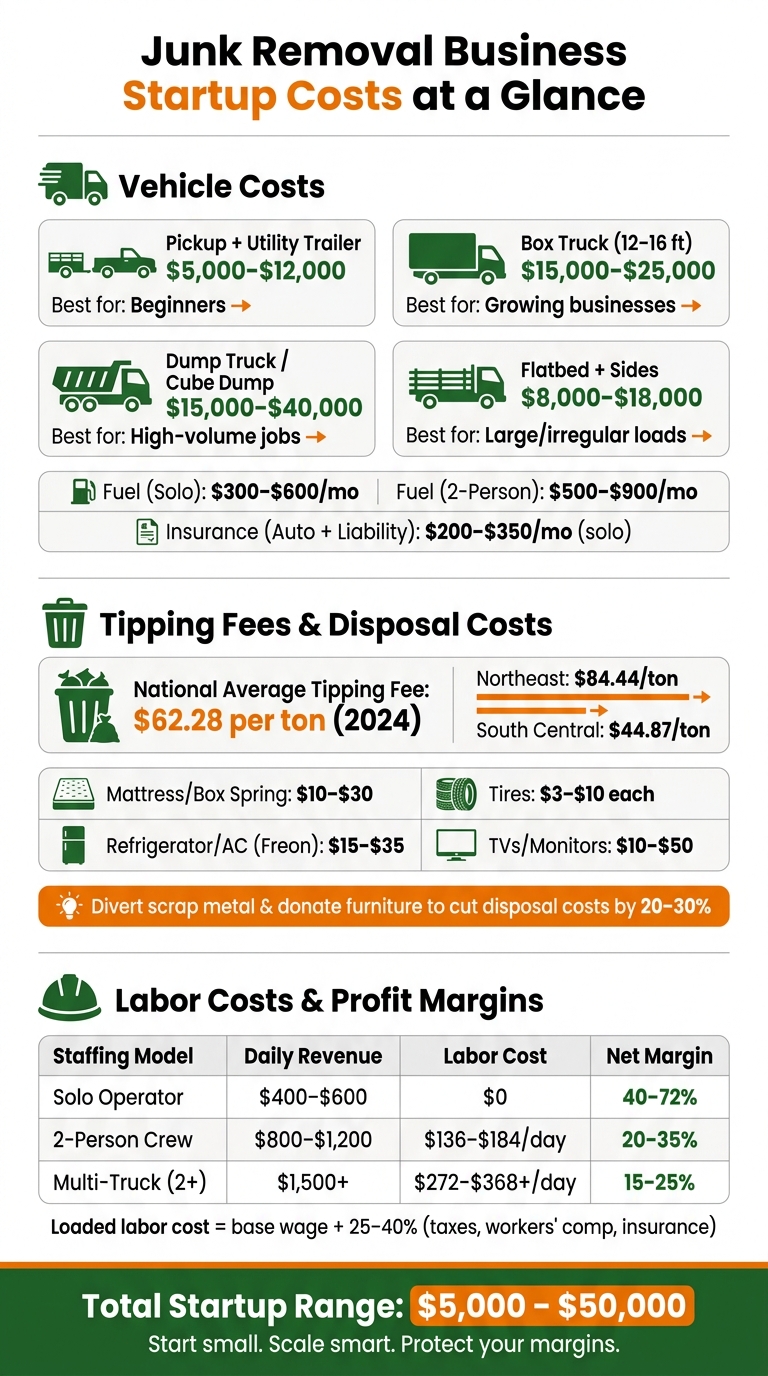
Junk Removal Business Startup Costs: Trucks, Tipping Fees & Labor Breakdown
The Real Cost To Start Junk Removal (Not What The Gurus Say)
sbb-itb-08dd11e
Truck and Vehicle Costs
Your vehicle is the backbone of your operation and likely your biggest startup expense. Choosing wisely from the start can set you up for a lean, profitable business - or leave you struggling under financial strain before you even get going. This cost breakdown focuses on managing three crucial expense areas: your vehicle, tipping fees, and labor.
Choosing the Right Vehicle
The truck you select should align with your budget, workload, and the needs of your local market.
| Vehicle Option | Cost (Used) | Best For |
|---|---|---|
| Pickup + Utility Trailer | $5,000–$12,000 | Beginners testing the waters |
| Box Truck (12–16 ft) | $15,000–$25,000 | Growing businesses needing more capacity and branding opportunities |
| Dump Truck / Cube Dump | $15,000–$40,000 | High-volume jobs requiring quick unloading |
| Flatbed + Sides | $8,000–$18,000 | Handling large or irregularly shaped loads |
A used 14-foot box truck is a common choice for those scaling up. Priced between $15,000 and $25,000, these trucks often have mileage ranging from 100,000 to 170,000. They not only carry more but also provide large surfaces for vehicle wraps - turning your truck into a rolling billboard.
Keep in mind: vehicles over 10,001 pounds need a DOT number displayed on both sides. If the Gross Vehicle Weight Rating (GVWR) exceeds 26,001 pounds, you'll also need a Commercial Driver's License (CDL). These requirements can add complexity, so factor them into your decision-making process.
Buying vs. Renting a Vehicle
| Factor | Buying (Used Box Truck) | Renting (Daily) |
|---|---|---|
| Upfront Cost | $15,000–$25,000 | $0 |
| Daily/Monthly Cost | Loan payments + maintenance | ~$150–$200/day |
| Branding | Custom wraps possible | Not an option |
| Maintenance Responsibility | On the owner | Covered by the rental company |
| Long-Term Value | Builds equity | No equity gained |
Renting, which costs about $150–$200 per day, might work for occasional jobs or testing the market. However, if you’re handling regular work, purchasing becomes more economical over time.
"A $25,000 box truck sitting empty in your driveway is just an expensive lawn ornament." - Durable Business Guides
If you're just starting out, it’s often best to use what you already have. For instance, if you own a pickup truck, you can add a utility trailer (costing $1,500–$2,500) and complete around 20 jobs. This approach allows you to gauge demand and refine your volume estimates before committing to a bigger investment.
Recurring Vehicle Expenses
Recurring costs can catch new operators off guard, especially when it comes to insurance, fuel, and maintenance.
Commercial auto insurance is a must, as personal policies won’t cover accidents during paid hauling. Expect annual premiums between $1,200 and $2,500 for a single truck, with larger vehicles or more coverage pushing this up to $4,000. General liability insurance adds another $500–$1,500 per year.
Fuel and maintenance are significant ongoing expenses. Plan to spend $30–$40 per job on routine upkeep like tires and brakes, along with unexpected repairs. Monthly fuel expenses typically range from $300 to $600 for solo operators and $500 to $900 for two-person crews.
| Expense | Monthly Cost (Solo) | Monthly Cost (2-Person Crew) |
|---|---|---|
| Fuel | $300–$600 | $500–$900 |
| Maintenance Fund | $100–$300 | $150–$400 |
| Insurance (Auto + Liability) | $200–$350 | $300–$500 |
You can cut fuel costs by grouping jobs within the same neighborhood and avoiding unnecessary miles. This not only saves money but also helps maintain your profit margins without needing to adjust your rates.
Next, we’ll dive into tipping fees and disposal costs to see how they affect your bottom line.
Tipping Fees and Disposal Costs
Every trip to a landfill or transfer station comes with a fixed tipping fee.
"Disposal is the hard floor. You can't negotiate it away. You pay it every run." - Theocbros
How Tipping Fees Are Calculated
Tipping fees are usually charged per ton, with the national average hitting $62.28 per ton in 2024 - a 10% jump from the previous year. However, costs can vary widely by region. For instance, operators in the Northeast often pay around $84.44 per ton, while those in the South Central states (like Texas and Arkansas) pay closer to $44.87 per ton.
For smaller loads, many facilities impose a minimum gate fee, regardless of the actual weight. This fee typically ranges from $12 to $35, meaning that disposing of a single bulky item can cost the same as dumping several hundred pounds of waste. Additionally, certain items come with flat surcharges that are added on top of the weight-based fees:
| Item | Typical Surcharge |
|---|---|
| Mattress / Box Spring | $10–$30 per unit |
| Refrigerator / AC (Freon) | $15–$35 per unit |
| Tires | $3–$10 per tire |
| TVs / Monitors (E-waste) | $10–$50 per item |
It’s always a good idea to call ahead to confirm specific surcharge rates. For example, a job involving two mattresses, a refrigerator, and an old TV could rack up surcharges between $60 and $115, even before factoring in the weight-based tipping fee.
Estimating Disposal Costs Per Job
To get a clearer picture of overall disposal costs, consider both the weight of the load and the type of job.
| Job Type | Typical Weight | Estimated Disposal Cost |
|---|---|---|
| Light Residential (couch, mattress, misc.) | 300–500 lbs | $12–$35 (minimum gate fee) |
| Mixed Commercial (office furniture, electronics) | 800–1,000 lbs | $25–$45 |
| Heavy Construction (tile, shingles, concrete) | 2,000–2,500 lbs | $60–$100+ |
Keep in mind that dense materials like concrete or shingles can max out your truck's weight capacity long before the truck is visually full. For example, a half-full truck of concrete might weigh as much as a fully loaded truck of household junk, leading to higher fees. To avoid surprises with heavy or moisture-laden debris, it’s wise to add a 20% buffer to your cost estimates.
Ways to Cut Disposal Costs
There are ways to trim these expenses by exploring alternative disposal options.
One strategy is to divert materials from the landfill entirely. For example, many scrap yards accept metal for free, and some even pay for it. Similarly, clean, usable furniture can often be donated to organizations like Habitat for Humanity ReStore or Goodwill, eliminating disposal fees and offering the added benefit of a tax receipt.
For appliances containing refrigerants (like refrigerators or window AC units), take them to a certified appliance recycler instead of a landfill. This helps you comply with EPA Section 608 regulations and avoids the typical $15–$35 surcharge many landfills charge. Another cost-saving tip is to sort materials before heading to the disposal site, which can make a big difference in overall fees.
| Material | Best Disposal Route | Typical Cost Impact |
|---|---|---|
| Scrap Metal | Scrap / Recycling Yard | $0 (or may even pay the hauler) |
| Clean Furniture | Donation Centers | $0 (plus a tax receipt) |
| Appliances (Freon) | Certified Recyclers | $0–$15 (avoids a $30+ surcharge) |
| Mixed Household Junk | Landfill / Transfer Station | $40–$100+ per ton |
| Construction Debris | C&D-Specific Landfill | Often higher than MSW rates |
Labor Costs and Staffing Models
After disposal costs, labor is the next big factor impacting your bottom line. Unlike relatively fixed tipping fees, labor expenses offer more flexibility and can be managed carefully - especially when you're just starting out.
Solo Operator vs. Hiring Staff
Operating solo is a great way to keep overhead low and boost net margins. Industry data shows solo operators can reach net profit margins of 40% to 72%. On the other hand, running a two-person crew typically brings margins down to 20% to 35% due to higher labor costs. The trade-off? Capacity. Working alone limits you to smaller jobs and slower unloading times, and heavy lifting - like moving appliances or hot tubs - becomes riskier without help.
| Model | Daily Revenue Potential | Daily Labor Cost | Typical Net Margin |
|---|---|---|---|
| Solo Operator | $400 – $600 (2–3 jobs) | $0 (owner-operated) | 40% – 72% |
| 2-Person Crew | $800 – $1,200 (4–6 jobs) | $136 – $184 (8 hrs @ $17–$23/hr) | 20% – 35% |
| Multi-Truck (2+) | $1,500+ | $272 – $368+ | 15% – 25% |
(Source:)
If you're just starting out, hold off on hiring until your workload consistently exceeds your solo capacity.
Calculating the True Cost of Labor
The hourly wage is just the tip of the iceberg. The loaded cost of an employee includes payroll taxes, workers' compensation insurance, and paid time off. Crew wages generally range from $17 to $23 per hour. For instance, 1-800-GOT-JUNK pays an average of $17.92 per hour. On top of wages, workers' compensation insurance typically adds about $141 per month per employee or $1,000 to $3,000 annually for a small team.
Here’s how labor costs can eat into profits: hiring a helper at $20 per hour for a three-hour job could reduce the profit on a $300 job from $190 to $130. Once you factor in all overhead, labor costs usually make up 40% to 50% of your total job pricing.
Keeping these costs in check is crucial for staying profitable.
Scheduling to Control Labor Costs
After calculating labor costs, efficient scheduling becomes key to protecting your margins. Group jobs by location and pre-qualify them with photos or booking forms to cut down on drive time and avoid unexpected costs. This strategy reduces paid hours without sacrificing the number of jobs completed.
An industry expert summed it up perfectly:
"The difference between breaking even and making real money in the junk removal business comes down to volume estimation (quoting a job accurately), efficient routing (not burning fuel on backtracking), and knowing when to say no to jobs that don't pay." - Durable Editorial
Using scheduling software can further streamline your operations and help you manage labor costs effectively.
Mastering your labor expenses, just like managing vehicle and disposal costs, is a cornerstone of running a profitable junk removal business.
Budgeting for Profitability
Calculating Per-Job Costs and Profit Margins
To ensure profitability, combine all costs - truck, disposal, and labor - into a single per-job total. Add your disposal fee, loaded labor cost, and vehicle expenses, then multiply the sum by 1.3 to 1.5. This calculation helps you achieve a 30–50% profit margin, making it easier to evaluate the profitability of each job.
Here’s an example for a half-truck job:
| Cost Component | Estimated Amount |
|---|---|
| Dump Fee | $75 |
| Labor (2 people, 1.5 hrs) | $75 |
| Truck/Fuel | $30 |
| Total Direct Costs | $180 |
| Target Quote (50% margin) | $360 |
Keep in mind that loaded labor costs are higher than the base wage - typically 25–40% more - due to payroll taxes, workers' compensation, and insurance. For instance, if a worker’s base wage is $18/hour, the actual cost per hour rises to about $23.88.
It’s also smart to implement a minimum trip fee, ranging from $75 to $150. This ensures small jobs don’t end up costing more in fuel and drive time than they bring in revenue.
By understanding the profitability of individual jobs, you’ll have a clearer picture of how scaling your operations might impact your overall margins.
Scenario Planning for Growth
Budgeting for individual jobs is only part of the equation. When scaling your business, you need to consider how growth impacts your profit margins. As you expand, fixed costs may stabilize, but labor expenses often increase. Careful growth planning is key to maintaining healthy margins.
A common growth step is moving from a solo operation to a two-person crew. However, this transition often surprises business owners. Monthly operating costs can jump significantly - from around $1,100–$2,350 for a solo operator to $4,450–$7,800 for a two-person crew, primarily due to higher labor costs. This shift typically compresses net margins from 40–50% to 20–30%. While this margin compression might seem discouraging, it’s not a reason to avoid hiring - it’s a sign that strategic planning is necessary.
Take Kyle Landwehr, for example. He launched his junk removal business with a $6,000 investment. After growing to a multi-truck operation, his annual revenue hit $2.5 million. In his first year, his gross margin was about 50%, but by year two, it dropped to around 30% as payroll and overhead increased.
Tools like IdeaFloat's Financial Model can help you map out these scenarios before you commit to growth. You can project breakeven points, assess how adding a second truck impacts cash flow, and prepare for seasonal slowdowns. For instance, revenue often dips by 40–60% in January and February compared to peak months. Planning for these slower periods can help you avoid cash flow issues. Most new junk removal businesses take about 18 months to recover their startup investment, so early scenario planning is crucial.
"Underestimating initial working capital against low early EBITDA is the single biggest budget mistake, and it feeds every other overrun." - Businessplan-templates.com
Key Takeaways for Aspiring Junk Removal Entrepreneurs
Here’s a quick breakdown of what aspiring junk removal entrepreneurs need to focus on to succeed.
The junk removal industry has strong profit potential, with solo operators achieving margins of up to 35% - a stark contrast to the restaurant industry’s 4% benchmark. However, these margins aren’t automatic. They require careful planning and smart decisions across three key areas: vehicles, disposal costs, and labor.
Start small and test the waters. Instead of diving in with a $15,000–$25,000 box truck, consider starting with a pickup truck and utility trailer, which can cost between $1,500 and $2,500. Brian Scudamore, founder of 1-800-GOT-JUNK, famously started with a $700 used truck in 1989. Today, his company generates over $600 million annually. The takeaway? It’s not about flashy equipment - it’s about execution.
Keep an eye on tipping fees. Disposal costs can eat into your profits if you’re not careful. With landfill fees rising by about 12% recently, strategies like separating scrap metal and donating usable items can reduce these costs by 20–30%. Before quoting a job, check whether your local transfer station charges by weight or per visit. If it’s a flat rate, batching your loads can help protect your margins.
Labor costs can make or break your profits. Labor is often the largest variable cost, accounting for 40–50% of total job pricing. While hiring can increase your capacity, it also reduces your margins. For instance, a $300 job that nets $190 for a solo operator drops to $130 when you add a helper earning $20/hour. Scale cautiously - only expand when your job volume and pricing can comfortably cover payroll.
By combining smart vehicle choices, efficient tipping fee management, and strategic labor planning, you can create a solid foundation for your business. Tools like IdeaFloat’s Financial Model can help you map out these costs before committing to major investments. Use it to identify breakeven points, test pricing strategies against seasonal slowdowns, and see how adding a second truck might impact your cash flow.
"The difference between breaking even and making real money... comes down to volume estimation, efficient routing, and knowing when to say no to jobs that don't pay." - Durable Business Guide
FAQs
Do I need a CDL or DOT number for my junk removal truck?
For most junk removal trucks, you generally don’t need a CDL or DOT number unless specific conditions apply. These include using the truck for interstate commerce, transporting hazardous materials that require a safety permit, or if the truck’s gross vehicle weight rating (GVWR) is 10,001 pounds or more. In typical junk removal operations, a DOT number isn’t usually required.
How should I price jobs when dump fees and surcharges vary?
To handle fluctuating dump fees and surcharges, factor these costs into your pricing by multiplying disposal expenses by 2 to 3 times. Make sure to weigh items before providing quotes and familiarize yourself with the fee structure of your local transfer station. This approach allows you to establish volume-based pricing that not only accounts for changing disposal costs but also ensures your profit margins remain intact.
When does it make financial sense to hire a helper?
Hiring a helper can be a smart financial move if their support enables you to take on more work and boost your profits. Many business owners notice that having a helper leads to higher earnings, as working together often increases productivity. While solo jobs typically yield net margins of 15–35%, adding a helper and collaborating effectively can push these margins higher, making it a practical step for growing your business.
Related Blog Posts
- How to Start a Food Truck Business: Permits to Profits
- How to Start a Profitable Lawn Care Business: Complete Guide
- Pressure Washing Startup Costs: Gear, Licences, ROI
- Junk Removal Business: Pricing by Cubic Metre, Disposal, Insurance