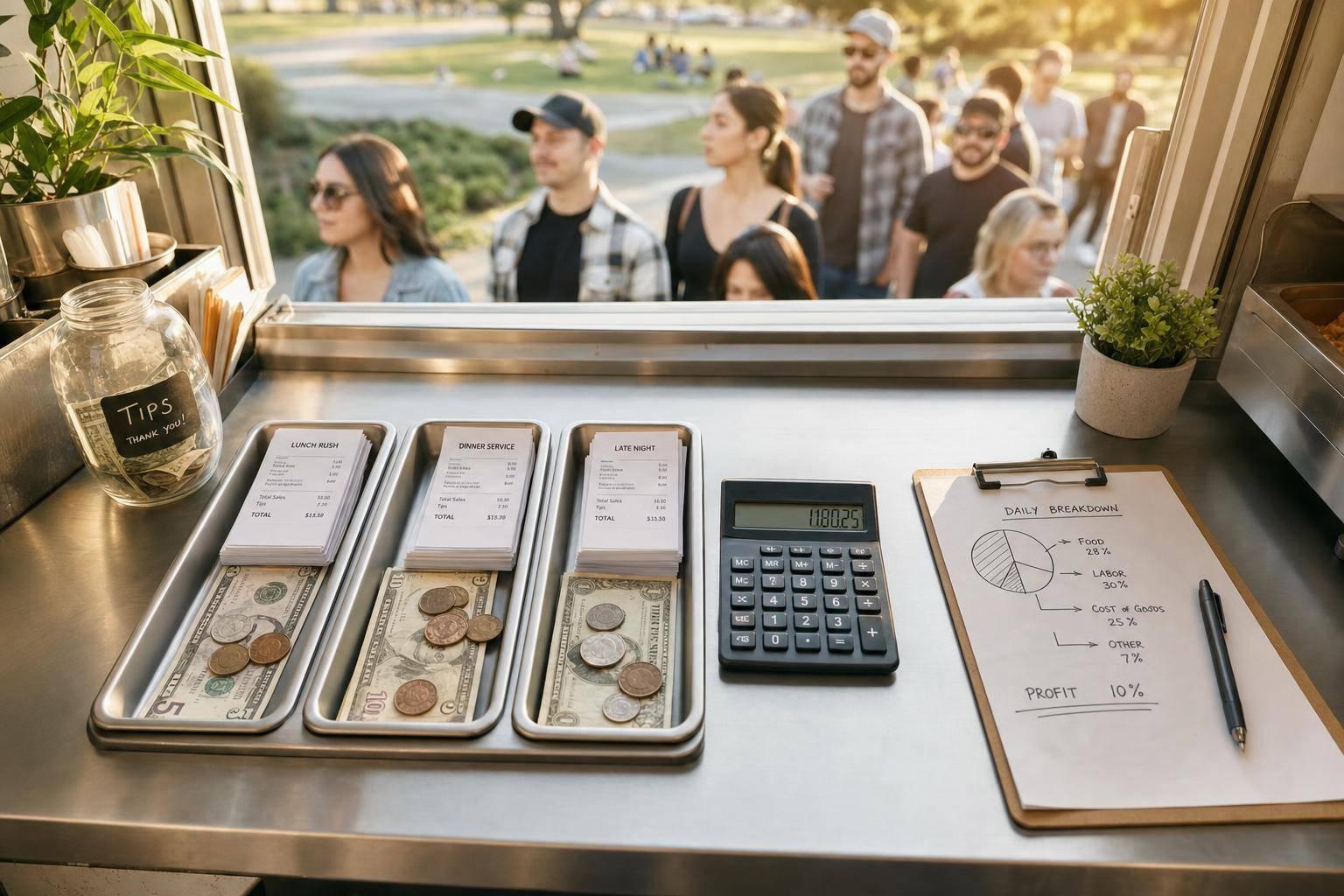
A food truck can post $1,500 in sales and still leave the owner with only $100 to $300 after food, labor, fees, overhead, taxes, and truck costs. That’s the main point: sales are not pay.
If I were sizing up a food truck, I’d focus on three numbers first:
- Gross profit: sales left after food, packaging, card fees, and other direct costs
- Net profit: what stays after overhead, permits, insurance, commissary, and truck costs
- Owner take-home: what I can pay myself after taxes, debt, and money set aside for repairs
The article also shows that service type changes margin a lot:
- Lunch stops often bring 10%–20% net margin
- Festivals can have big sales, but fees and extra labor cut into profit
- Private catering tends to pay the best, often around 40%–50% net margin
- Late-night service can work, but sales swings make income less steady
A few numbers stand out:
- Food cost often needs to stay near 28%–33% of revenue
- Card fees often take 2.6%–3.5%
- Labor can run 15%–25% of revenue
- Average U.S. food truck net margin is about 6.8%
- Owner-run trucks with tight cost control may hit 10%–20%
Here’s the short version: a truck works when each service covers its share of costs and still leaves enough for owner pay. So if I’m judging a lunch stop, festival, catering job, or bar night, I’d ask one question first: how much cash does this put in my pocket after everything is paid?
ARE FOOD TRUCKS PROFITABLE IN 2026? YES BUT ONLY IF.....
sbb-itb-08dd11e
The Cost Stack Behind Every Shift
Every service comes with two kinds of costs: variable costs and fixed overhead. That split explains why two trucks can post the same sales and still end up with very different profit.
Costs That Rise With Sales
The clearest variable costs are food and ingredients, card fees, and hourly labor when a job calls for extra staff or longer service hours.
Food cost is the biggest pressure point. Try to keep it around 28%–33% of revenue. Once it climbs past 35%, margins get squeezed in a hurry.
Card fees usually take 2.6%–3.5% from each transaction, plus a small per-swipe fee.
Costs That Hit Even on Slow Days
Some costs show up whether the shift is packed or painfully quiet. Commissary rent often lands between $350 and $1,500 per month, insurance usually runs $3,000 to $8,000 per year, and permits and licenses often add another $500 to $3,000 annually. On top of that, there are truck payments or lease costs, plus a repair reserve for tires, refrigeration, brakes, and the other stuff that always seems to need attention.
A simple way to think about fixed overhead is to spread it across your monthly services. If overhead is $3,000 and you work 20 services, that’s $150 per service. So before the owner takes home a dime, each shift has to carry its share of that overhead.
Why Two Events With the Same Sales Can Produce Different Profit
Two services can each bring in $3,000 and still tell two very different money stories by the end of the night.
One event might mean free parking, one staff member, and a short drive. Another might come with a $500 vendor booth fee, a 15% revenue share on gross sales, two staff members, and two hours of driving each way.
That second setup loses $950 right off the top from the booth fee and revenue share alone. Then pile on extra labor, payroll taxes and workers' comp, plus fuel for the long trip, and the spread gets a lot bigger.
That’s why lunch stops, festivals, catering jobs, and late-night events can all look good on the sales side but pay out very differently.
Here is the full cost stack to price into every service.
| Cost Line | Type | Typical Range |
|---|---|---|
| Food & ingredients | Variable | 25–35% of revenue |
| Hourly labor (non-owner) | Variable | 15–25% of revenue |
| Payroll taxes & workers' comp | Variable | ~10–15% on top of gross wages |
| Card processing fees | Variable | 2.6–3.5% of sales |
| Fuel & propane/generator | Partly variable | Scales with distance and run time |
| Commissary rent | Fixed | $350–$1,500/month |
| Insurance (auto + liability) | Fixed | $3,000–$8,000/year |
| Permits & licenses | Fixed | $500–$3,000/year |
| Vendor/event fees or revenue share | Event-specific | $50–$3,000+ flat, or 10–20% of gross |
Profit by Service Type: Lunch Stops, Festivals, Catering, and Late-Night Events
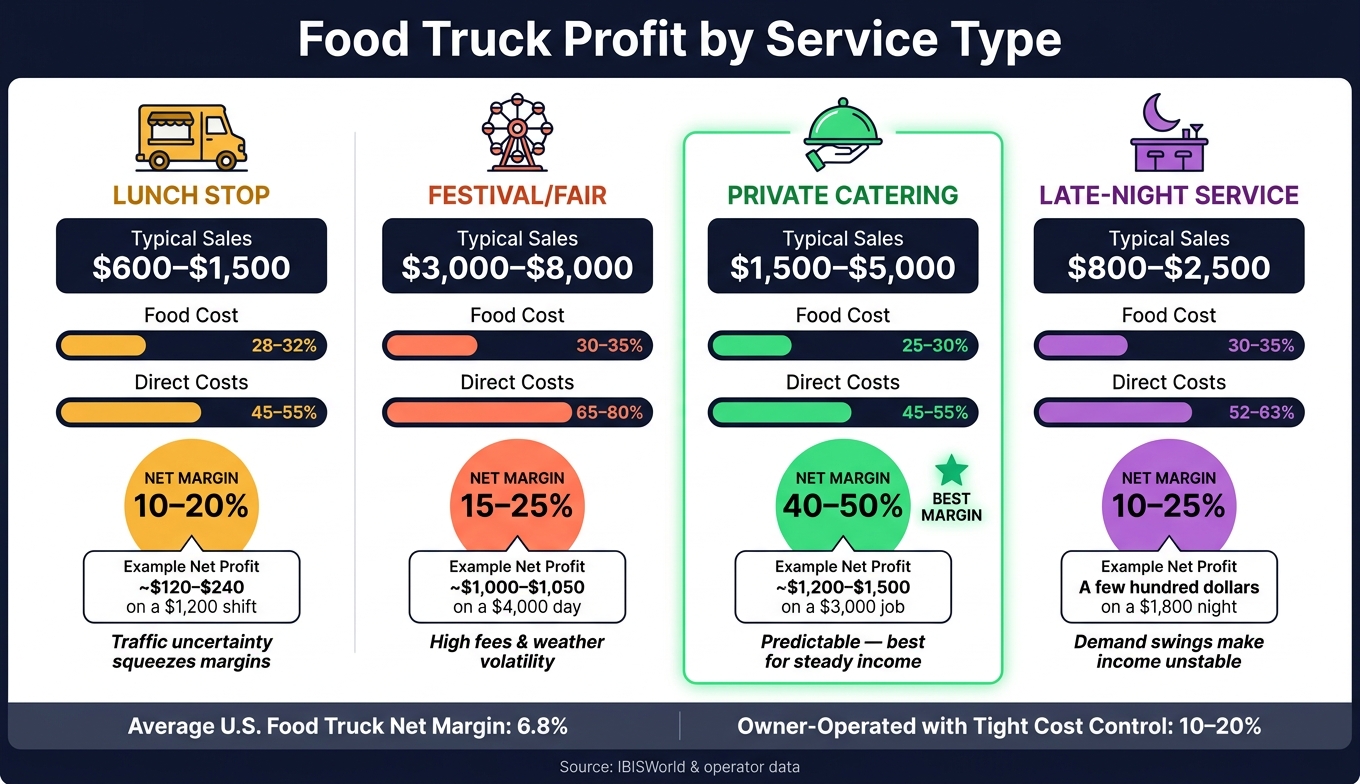
Food Truck Profit by Service Type: Net Margins & Real Take-Home Pay
The cost stack shows where the pressure is. The next step is simpler: figure out which service types actually leave money in your pocket after those costs.
Lunch Stops: Lower Tickets, Faster Turnover, Tight Margins
Lunch service is a volume game. You move a lot of orders in a short window, but each ticket is small, so the margin can get squeezed fast.
A weekday lunch stop in an office park or business district usually brings in $600–$1,500 in sales over a 1.5–3 hour selling window. Average tickets tend to sit around $10–$15. Sounds decent at first glance. But then you factor in setup and teardown, which can eat another 2–3 hours without bringing in a single dollar.
Food cost on lunch routes usually lands near 28–32%, while shift labor adds about 15–20%. Fuel and commissary costs tack on another 3%–5%, so total direct costs often reach 45–55% of sales. On a $1,200 lunch shift, that usually leaves around $120–$240 in net profit after a standard overhead allocation. Once all labor and location costs are counted, net margins for street stops often fall in the 10–20% range.
The biggest issue is traffic uncertainty. Prep for 100 covers and only serve 60, and your food cost percentage jumps while labor output gets worse. Trucks that do better at lunch usually stick to a few habits:
- They lock in rotations with property managers ahead of time.
- They use mobile pre-orders to read demand before service.
- They keep the menu tight so the line moves fast.
Festivals and Fairs: High Sales, High Fees, More Staff
Festivals can look like easy money. Big crowds, big sales, busy lines. But fees and labor can take a big bite out of that top-line number.
A mid-size regional event can bring in $3,000–$8,000 in a single day. That said, the cost setup is very different from a lunch stop.
Vendor fees alone may run $500–$1,000 flat, or 20–25% of gross sales as a revenue share. Add food cost at 30–35% plus extra staff for a longer day, and total direct costs can climb to 65–80% of sales. On a $4,000 festival day, that leaves about $1,200 in gross profit and roughly $1,000–$1,050 in net profit after overhead.
What makes festivals tricky is volatility. Weather, crowd size, and event quality can swing the result hard. One dataset showed a $2,500 weak weekend dropping to about 5% net margin after fixed fees and labor, while an $8,000 strong weekend reached a 54% margin. That gap tells the whole story.
Private Catering vs. Late-Night Service: Predictable Income vs. Demand Swings
Out of all four service types, catering usually gives the cleanest path to margin. Private catering usually delivers the strongest margins of any service type.
The reason is pretty simple. With a pre-booked event and a guaranteed headcount, you can control portions, prep in batches, and buy ingredients to match the order instead of guessing. There usually aren't revenue shares or steep vendor fees either. Food cost tends to stay around 25–30%, labor runs 15–18%, and travel or rental gear adds another 5–10%. That keeps total direct costs around 45–55% of sales.
On a $3,000 catering job, that works out to about $1,350–$1,650 in gross profit. After a modest overhead allocation, net profit usually lands near $1,200–$1,500, or around a 40–50% net margin. Corporate lunch catering priced at $15–$25 per person for 50–200 guests can bring in $1,200–$3,500 per event, and repeat bookings make the model even better.
Late-night service is a different animal. Selling outside bars or breweries can work, but demand can swing a lot from one night to the next. Sales usually range from $800–$2,500 per night, with average tickets of $12–$18. Food cost runs 30–35%, late-hour labor adds 18–22%, and fuel plus commissary allocation pushes total direct costs to about 52–63% of sales. A busy $1,800 night might leave a few hundred dollars after overhead. Weekend nights can improve the picture, but the unpredictability makes late-night service a shaky base for a truck's income.
Use the table below as a quick benchmark for what each service type can usually return.
| Service Type | Typical Sales | Food Cost % | Direct Costs % | Gross Profit | Net Profit | Net Margin |
|---|---|---|---|---|---|---|
| Lunch Stop | $600–$1,500 | 28–32% | 45–55% | $540–$660 on a $1,200 shift | $120–$240 on a $1,200 shift | 10–20% |
| Festival/Fair | $3,000–$8,000 | 30–35% | 65–80% | About $1,200 on a $4,000 day | About $1,000–$1,050 on a $4,000 day | 15–25% |
| Private Catering | $1,500–$5,000 | 25–30% | 45–55% | $1,350–$1,650 on a $3,000 job | $1,200–$1,500 on a $3,000 job | 40–50% |
| Late-Night Service | $800–$2,500 | 30–35% | 52–63% | About $684 on a $1,800 night | A few hundred dollars on a $1,800 night | 10–25% |
How to Calculate Break-Even Sales and Owner Take-Home
Once you know your usual margins, the next step is figuring out the sales minimum that keeps each service from losing money. If you're trying to decide whether a food truck idea works for you, two numbers matter most:
- the minimum sales needed to avoid a loss on a service
- the owner take-home left after everything else gets paid
A Simple Per-Service Break-Even Formula
Break-even sales = (allocated fixed costs + event-specific costs + labor) ÷ (1 − food cost %)
Here’s what that looks like in plain English. You add up the costs tied to that service, then divide by what’s left after food cost.
For a basic weekday lunch stop with $100 in allocated fixed costs, $40 in event-specific costs, and $100 in labor, at a 30% food cost, the math is: (100 + 40 + 100) ÷ (1 − 0.30) = $343 to break even.
That $343 is the line in the sand. Below it, the service loses money. Above it, the extra sales move into gross profit, then net profit, then owner pay.
Now look at a festival. Add a $600 booth fee, extra staff, and more fuel, and the same formula pushes break-even closer to $1,550 before owner pay starts. That's why it pays to run the numbers before you book the event, not after the fact.
Owner take-home comes later. After you calculate net profit, subtract taxes, debt service, and planned reinvestment. Say a strong festival shift brings in $1,000 in net profit and the owner sets aside 20% for taxes, 15% for loan payments, and 15% for maintenance and growth. That leaves $500 as possible owner take-home from that event.
Think of per-service take-home as a monthly average, not a locked-in payout. One big weekend can look great on paper. A slow Tuesday can knock that mood down fast.
How Many Services You Need to Hit a Monthly Income Goal
Use conservative averages here, not your best day ever. A solid starting point might be:
- weekday lunch shifts with $150 in owner take-home
- private catering events with about $400
- strong festival dates with about $500
Those figures are after food cost, labor, overhead, taxes, debt payments, and reinvestment.
So, if your target is $6,000 per month in personal income, a mixed schedule of 12 lunch services ($1,800), 4 catering events ($1,600), and 4 festival dates ($2,000) gets you to $5,400. That's close, but still short.
At that point, the fix is usually pretty simple on paper, even if it's harder in practice: add another service or two, increase prices, or book catering jobs with more upside. This is a reality check on service mix, not a promise.
A simple spreadsheet with columns for service type, service count, and owner take-home makes scenario testing fast.
Those break-even numbers tell you whether a truck can turn into a workable monthly income.
What This Means for Food Truck Viability
Gross sales are just the starting line. What matters more is break-even and what the owner actually takes home.
A food truck is only viable when repeat services cover direct costs, overhead, and owner pay at your target monthly income. That’s the real test. The issue isn’t whether a truck can sell. It’s whether it can sell profitably enough, often enough.
The trucks that tend to support steady owner pay usually do a few things well. They keep food cost near 30% of sales, avoid too much labor on slower services, and judge each event by projected net profit, not expected sales. IBISWorld data puts the average U.S. food truck net margin at 6.8%. But owner-operated trucks with tight cost control can reach 10%–20%. That gap often comes down to service mix, pricing, and cost control.
Owner pay should be estimated from net profit. That sounds obvious, but plenty of operators find out the hard way that they’re paying themselves less than minimum wage once they run the numbers. A truck can look busy all month and still produce very little take-home pay after taxes, maintenance, and cash reserves are set aside.
Viability also isn’t about doing more services just to stay busy. It’s about doing the right services at the right price, while keeping costs tight enough that profit shows up at the end of the month. Steady lunch service or catering, paired with selective festivals, is often more dependable than chasing top-line sales. Judge every service by net profit and owner pay - not sales alone.
FAQs
How much should a food truck owner expect to take home per shift?
Most food truck owners should expect net profit margins of about 7% to 8%. If the operation runs tight and waste stays low, that number can climb to 15%.
What you take home from each shift comes down to a simple math problem: revenue minus variable costs. Those costs usually include food, which often runs 20% to 40% of revenue, plus labor, fuel, and venue fees.
That’s why one shift can look great on paper and the next can feel thin. Revenue changes with location and event type, so knowing your breakeven point matters. Just as important, you need steady sales volume. Without that, even a busy truck can have a hard time turning strong revenue into solid pay.
What is a good profit margin for a food truck?
Typical food truck profit margins are 7% to 8%. If the operation is tight and costs stay under control, that number can climb to 15%.
Getting there comes down to managing both moving and fixed costs. On the moving side, that means ingredients and labor. On the fixed side, it means things like permits and commissary fees. A lean menu can keep food costs in check, and setting up in high-traffic spots can help bring in more sales.
How do I know if an event is worth booking?
Compare projected revenue with total costs to see whether the event makes financial sense. Look at both fixed and variable costs, including ingredients, labor, fuel, permit fees, and venue charges.
A breakeven analysis helps you find the minimum sales volume needed to cover those expenses. It also shows your contribution margin, so you can gauge how changes in pricing or attendance may affect net profit and owner earnings.
Related Blog Posts
- How to Start a Food Truck Business: Permits to Profits
- How to Start a Profitable Food Truck Business: Step-by-Step Guide
- Food Truck Startup Costs: Fit-Out, Fees, and Margins
- How to Start a Food Truck Business: Permits to Profits