
Looking to start a local service business? Here's what you need to know: not all businesses are equal when it comes to startup costs, profit margins, and how fast you can recover your initial investment. Whether you're interested in cleaning, pet care, tutoring, handyman services, or lawn care, each option offers unique advantages and challenges.
Key Takeaways:
- Tutoring: Lowest startup cost ($325–$1,000) and highest margins (70%–90%). Great for quick returns and minimal expenses.
- Pet Care: Start for $500–$3,000 with margins of 50%–80%. Ideal for animal lovers with limited capital.
- Cleaning Services: Costs range from $1,000–$20,000. Margins vary (10%–35%), but recurring clients ensure steady income.
- Handyman Services: Requires $1,250–$8,500 to start. Margins are solid (40%–50%), with fast payback for solo operators.
- Lawn Care: Startup cost is $5,000–$15,000 for solo setups, with margins of 45%–60%. Seasonal but scalable.
Quick Comparison:
| Business Type | Startup Cost | Profit Margin | Payback Period | Best For |
|---|---|---|---|---|
| Tutoring | $325–$1,000 | 70%–90% | Weeks | Educators with low capital |
| Pet Care | $500–$3,000 | 50%–80% | 1–2 weeks | Side hustlers, animal lovers |
| Cleaning Services | $1,000–$20,000 | 10%–35% | 1–12 months | Growth-focused operators |
| Handyman | $1,250–$8,500 | 40%–50% | 2–8 weeks | Skilled tradespeople |
| Lawn Care | $5,000–$15,000 | 45%–60% | 3–6 months | Consistent-income seekers |
Choose a business that fits your budget, skills, and goals. The faster you start, the sooner you can generate income.
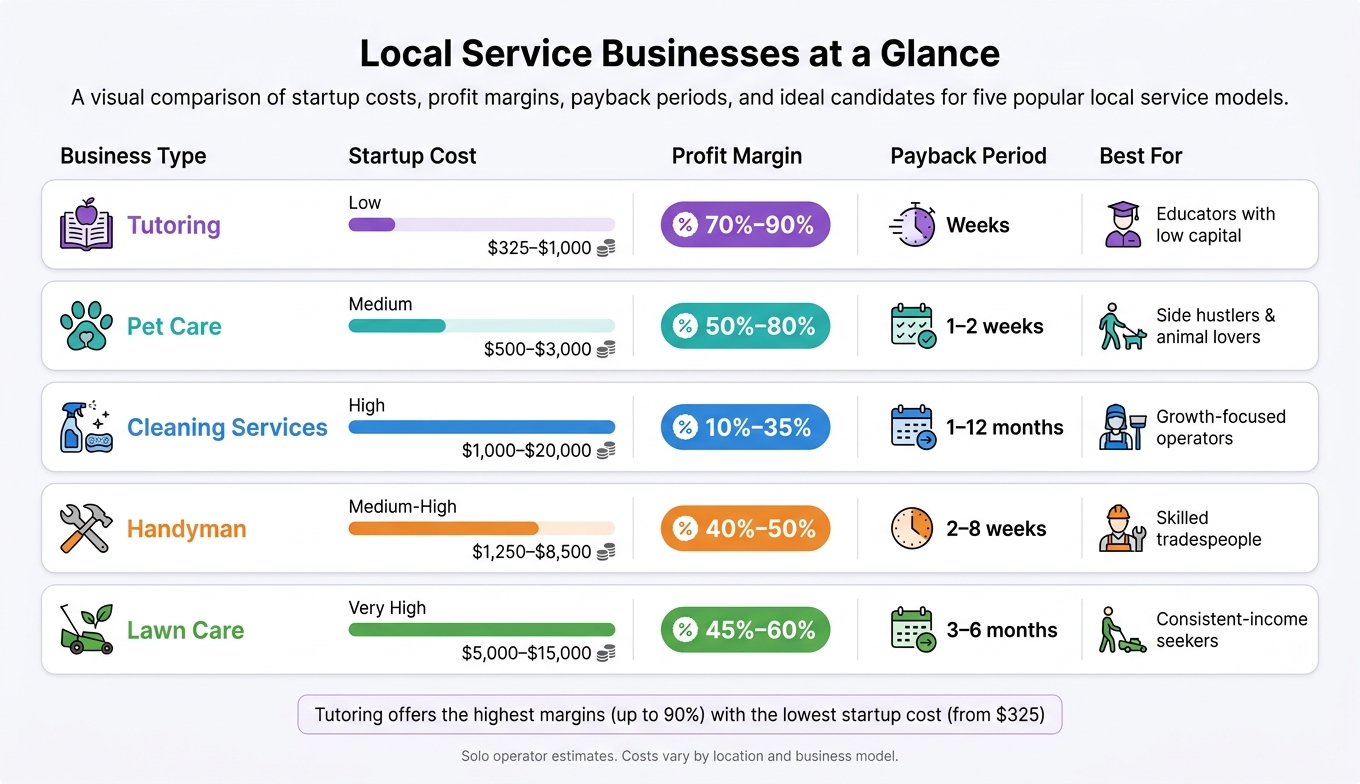
Local Service Businesses: Startup Cost, Margin & Payback Period Compared
9 Service Businesses You Can Start Under $1,000 (No Experience Needed)
sbb-itb-08dd11e
1. Cleaning Services
Cleaning services are among the easiest businesses to start in the U.S., thanks to their low initial costs. A solo residential cleaning business can get off the ground for as little as $500–$1,200. This budget covers essentials like LLC filing, basic supplies, and a month of liability insurance. On the other hand, starting a commercial cleaning operation requires more - typically between $5,000 and $20,000 - because of the need for specialized equipment like floor scrubbers and stricter bonding requirements.
Profitability largely depends on the business model. Solo residential cleaners often enjoy net margins of 25%–35%, with some even exceeding 50% by keeping expenses low. Adding employees can increase revenue potential but typically lowers margins to 15%–25%. For pricing, cleaning a standard 3-bedroom, 2-bathroom home usually runs between $120 and $200 per visit, with deep cleaning services costing 1.5x–2x more. These numbers show how operational choices can impact both profitability and revenue.
| Business Model | Startup Cost | Profit Margin | Payback Period |
|---|---|---|---|
| Solo Residential | $1,000–$3,000 | 25–35% | 1–2 months |
| Residential Team | $5,000–$15,000 | 15–25% | 4–8 months |
| Commercial | $5,000–$20,000 | 10–18% | 6–12 months |
| Franchise | $50,000–$150,000 | 10–15% | 18–36 months |
One of the biggest advantages of this industry is its short payback period. For instance, a $1,400 investment can typically be recouped in about 10 cleaning jobs, or within 3–4 weeks for part-time operations. Many solo operators become cash-flow positive within 30–60 days.
Want to speed up your returns? Offer a 10%–15% discount for recurring customers. This strategy not only builds customer loyalty but also ensures a steady income stream. Additionally, specializing in niches like Airbnb turnovers, post-construction cleanups, or eco-friendly services can allow you to charge up to 40% more than generalists, shrinking the payback period even further.
"Focus on one niche first. Specialists can charge 40% more than generalists in the cleaning industry." - CleaningBizHub
2. Pet Care Services
Pet care services stand out as a promising local business option, offering quick startup times and attractive profit margins. It's a field that combines accessibility with strong demand, making it an appealing choice for aspiring entrepreneurs.
Starting a pet care business can be surprisingly fast. A solo dog walker or pet sitter can get things rolling in just one to two weeks. Initial costs range from $680 to $4,000, which typically covers essentials like LLC registration, liability insurance, marketing efforts, supplies, and booking software. With the U.S. pet services industry generating over $10 billion annually and expected to grow at a 9.2% annual rate through 2030, this sector offers plenty of opportunities for growth.
Service rates vary depending on the type of care and location. For example, a 30-minute dog walk usually costs $20–$35, while overnight in-home pet sitting can range from $50 to $150 per night. Urban areas often support higher rates than suburban or rural locations, and holiday surcharges of 25%–50% are common during peak times like Thanksgiving and Christmas.
| Business Model | Startup Cost | Annual Revenue | Profit Margin |
|---|---|---|---|
| Platform‑Based Solo (Rover/Wag!) | $300–$800 | $15K–$40K | 50%–60% |
| Independent Solo | $1K–$3K | $25K–$60K | 60%–75% |
| In‑Home Boarding | $1K–$5K | $40K–$100K | 55%–70% |
| Multi‑Sitter Agency | $15K–$30K+ | $100K–$300K | 25%–40% |
Solo operators often enjoy higher profit margins since their main expense is their own time. A full-time independent pet sitter can earn between $70,000 and $100,000 annually, with monthly take-home profits ranging from $2,500 to $5,800 after expenses. However, platforms like Rover and Wag! take a 15%–20% commission on each booking, which can impact overall earnings. Many professionals start on these platforms to build their client base before transitioning to direct bookings.
Client acquisition costs range from $30 to $80 per new client, and break-even can be achieved with just 10–20 weekly bookings. Full profitability is typically reached within three to six months. Since about 75% of annual revenue comes from repeat customers, these acquisition costs are often recovered after one to three bookings. To boost revenue, consider offering add-on services like medication administration (+$5–$12), extra pet fees (+$5–$20), or prepaid walk bundles to encourage recurring business.
3. Tutoring and Educational Services
Starting a tutoring business is one of the most affordable ventures out there. A solo tutor can get started for as little as $325, which covers essentials like business registration ($50–$300), teaching materials ($50–$500), a background check ($20–$100), and marketing. If you already have a computer, your initial investment stays well under $1,000.
The format you choose plays a big role in determining your costs. Operating solely online eliminates expenses like commercial rent, keeping startup costs under $2,000 while maintaining profit margins above 70%. On the other hand, opening a physical tutoring center comes with significantly higher costs. You'll need to account for real estate deposits, furniture, curriculum materials, and staff, which can push your startup expenses to $20,000–$75,000. However, this setup allows for competitive hourly rates and solid profit margins.
Hourly earnings vary depending on your niche:
- General K–12 tutoring: $25–$60/hour
- SAT/ACT prep: $60–$150+/hour
- Advanced specialties (e.g., coding or high-stakes exams): $120–$150/hour
If you're running a solo operation, profit margins typically range from 60% to 80%.
| Business Model | Startup Cost | Annual Revenue | Profit Margin |
|---|---|---|---|
| Solo Tutor (General) | $325–$1,000 | $30K–$60K | 70%–80% |
| Test Prep Specialist | $1,000–$3,000 | $60K–$150K | 65%–75% |
| Online Tutoring | $1,000–$3,000 | $50K–$120K | 70%–80% |
| Tutoring Center/Company | $20,000–$75,000 | $100K–$500K | 30%–45% |
Many solo tutors see a quick return on investment, often recouping their startup costs within weeks of securing steady clients. Offering session bundles - like 5- or 10-session packages with a 10%–15% discount - is an effective way to generate upfront cash flow and encourage repeat business. Another proven strategy is reaching out to school guidance counselors, which can quickly establish a reliable referral network.
"Tutoring is one of the most accessible businesses to start, with near-zero startup costs and the ability to earn $50–$100+ per hour from day one." - Bizzby Team
4. Handyman and Home Repair Services
Handyman services stand out as a practical business option, thanks to their low startup costs and potential for quick returns. For those who already own tools and a vehicle, the initial investment can range from just $1,250 to $8,500 for a lean setup. With U.S. homeowners expected to spend $524 billion on renovations and repairs by early 2026, demand for these services is projected to remain strong.
In most states, general handyman work doesn't require a specific license unless the job value exceeds $500–$1,000, at which point a contractor's license is needed. However, specialized tasks like electrical, plumbing, or HVAC repairs always require appropriate trade licenses. Additionally, insurance is a must - most commercial clients and property managers require at least $1 million in general liability coverage, which typically costs $40–$90 per month.
| Business Model | Startup Cost | Annual Revenue | Profit Margin |
|---|---|---|---|
| Lean Solo Operator | $1,250–$8,500 | $50K–$100K+ | 40%–50% |
| Standard/Professional Setup | $8,600–$42,600 | $75K–$150K | 25%–40% |
| Multi-Crew/Fleet Model | $145,000–$212,000+ | $250K+ | 20%–35% |
For solo operators, the profit margins are particularly appealing, often reaching 40%–50% due to minimal overhead and the absence of employee costs. High-margin tasks like TV mounting ($75–$200), drywall repair ($75–$200), and furniture assembly ($80–$250) generate strong returns since they rely primarily on labor rather than expensive materials. Setting a minimum service call fee of $75–$100 ensures even smaller or distant jobs remain profitable.
One of the biggest draws of this business is the short payback period. Solo operators can often recoup their initial investment in as little as 2–8 weeks after securing steady clients. On the other hand, scaling up to a multi-crew or fleet-based model - like a two-van operation with a mobile app and support staff - requires a much larger investment of $145,000 or more and a longer breakeven period of approximately 32 months.
"A handyman business has among the lowest startup costs of any service business, making it an ideal entry point for skilled tradespeople." - HowMuchToStartABusiness
To maximize profits, consider strategies like geographic clustering to cut 10%–20% of drive time and requiring a 50% deposit for material-heavy jobs to maintain steady cash flow.
5. Lawn Care and Landscaping Services
Starting a lawn care business can be surprisingly affordable. If you already own a truck and opt for used equipment, you can get started for as little as $3,000–$5,000. A professional single-crew setup with a dedicated truck and trailer typically requires $40,000–$60,000, while a lean solo operator setup can start at around $5,600. Like other service-based businesses, lawn care offers low startup costs paired with fast payback potential.
Here’s a quick look at the startup costs, profit margins, and payback periods for different business models in lawn care:
| Business Model | Startup Cost | Net Profit Margin | Payback Period |
|---|---|---|---|
| Solo Operator | $5,000–$15,000 | 45%–60% | A few months |
| Mid-Sized (1–3 Crews) | $25,000–$60,000 | 10%–20% | 12–18 months |
| Full-Service / Scaled | $60,000–$150,000+ | 10%–12% | 18+ months |
Solo operators often enjoy the highest profit margins - ranging from 45% to 60% - because they don’t face the labor costs that come with hiring employees.
"Owner income often drops when you hire your first employees. You trade 60% solo margins for 10–15% company margins." - StartCosts
For solo operators running a lean setup, the payback period can be as short as 3–6 months. A full-time solo operator can service 8–10 lawns per day, with each lawn priced at an average of $60. During peak season, this can translate to monthly earnings of $10,560–$13,200. Pricing efficiency is key, with standard residential lawns (around 1/4 acre) typically priced between $45 and $75.
To maximize profitability, keeping high route density is critical. By clustering clients within the same neighborhoods, you can cut down on non-billable travel time. Routing software can further reduce fuel and travel time by up to 30%.
In regions with shorter lawn care seasons, like the Northern states, diversifying your services can help stabilize income. Offering additional services such as leaf removal, snow plowing, or holiday lighting during the off-season can help keep cash flow steady year-round.
Pros and Cons by Business Type
This section builds on earlier details about startup costs, profit margins, and payback periods, offering a snapshot of the strengths and weaknesses of different business types. The table below breaks down these factors, helping you weigh your options based on your resources and goals.
| Business Type | Startup Cost | Profit Margin | Payback Period | Primary Advantage | Primary Disadvantage |
|---|---|---|---|---|---|
| Cleaning Services | $2,000–$5,000 | 40%–60% | 1–3 weeks to launch | Steady, recurring residential and commercial clients | Labor-intensive; margins depend on efficient staff management |
| Pet Care (Walking/Sitting) | $500–$3,000 | 50%–80% | 1–2 weeks to first client | Low entry cost; high emotional loyalty from customers | Limited scalability without additional staffing |
| Tutoring | $500–$2,000 | 70%–90% | As fast as a few weeks | Highest margins with near-zero overhead | Income is capped by the owner's available hours and expertise |
| Handyman / Home Repair | $5,000–$40,000 | 40%–60% (est.) | Project-based; variable | High-ticket jobs; strong revenue-to-investment ratio | Higher equipment costs and greater liability exposure |
| Lawn Care | $3,000–$8,000 | 50%–70% | 2–4 weeks to launch | Predictable weekly revenue; easy to upsell add-on services | Seasonal in northern climates; ongoing equipment maintenance costs |
These profiles highlight the balance between scalability and profit potential. For instance, tutoring and pet care are quick to start and offer high profit margins, but they’re limited by the owner's time and capacity. On the other hand, cleaning services and lawn care provide opportunities to scale through recurring contracts and team expansion, though payroll and equipment costs can eat into profits.
"Service businesses are easiest: cleaning, lawn care, dog walking, tutoring. They require minimal startup capital ($500–$5,000), no special licenses in most states, and can generate income within weeks." - StartCosts
While these businesses have strong potential, financial hurdles are inevitable. According to the SBA, undercapitalization is the top reason small businesses fail. In fact, over 50% of business owners underestimate their first-year startup costs . To prepare, consider adding a 10%–20% buffer to your budget for unexpected costs.
Conclusion
Every business aligns with a specific type of entrepreneur. For those starting with under $1,000 and looking for quick revenue, tutoring and pet care stand out. Tutoring offers margins as high as 90%, while pet care provides up to 70%, with both generating income within weeks. If your goal is to scale through a team, cleaning services and lawn care offer steady, recurring revenue streams, even though their margins might not be as high. This breakdown helps you identify the best match for your situation.
On the other hand, handyman and home repair businesses cater to individuals with trade skills who are comfortable with higher upfront investment and risk. These businesses focus on high-value projects and offer significant revenue potential but require a greater initial commitment.
Here’s a quick comparison to help you decide:
| Business Type | Best For | Key Strength |
|---|---|---|
| Tutoring | Educators with low capital | Highest margins; near-zero overhead |
| Pet Care | Side hustlers; animal lovers | Fast entry; strong customer loyalty |
| Cleaning Services | Growth-focused operators | Scalable; recurring contracts |
| Lawn Care | Consistent-income seekers | Predictable weekly revenue |
| Handyman / Home Repair | Skilled tradespeople | High-value projects; strong revenue potential |
A universal truth applies to all these options:
"Revenue is vanity. Margin is sanity. A 20% net margin on $500k beats a 5% margin on $2M when it comes to actual owner income." - Trafft
The key is finding a business that aligns with your available capital, skills, and personal goals - not just the one with the highest revenue potential. Start small, confirm demand, and focus on building systems before scaling. Use these insights to choose a path that maximizes your returns while working within your resources.
FAQs
Are these margins gross or net?
Gross profit margins represent the percentage of revenue remaining after subtracting the cost of goods sold (COGS) or direct expenses. However, they don't include operating costs, taxes, or other additional expenses.
What costs are often overlooked in startup estimates?
When planning a startup, it's easy to underestimate expenses, especially when it comes to hidden costs. Things like equipment, licensing fees, insurance, permits, marketing efforts, and ongoing operational expenses often slip through the cracks. Overlooking these can throw off your budget and lead to financial strain later. That's why factoring them in during the early planning stages is so important.
Which business is easiest to scale with employees?
Residential cleaning services are among the simplest types of businesses to expand with a team. They don't require extensive training or specialized skills to get started, and the tasks can be quickly assigned to additional crews as the business expands. The combination of steady demand and recurring revenue makes growth relatively smooth. While other service businesses, such as handyman or pressure washing services, can also grow effectively, cleaning services are particularly appealing due to their straightforward nature and scalability.
Related Blog Posts
- How to Start a Profitable Lawn Care Business: Complete Guide
- Pressure Washing Startup Costs: Gear, Licences, ROI
- High-Demand, Low-Competition Service Businesses by City Size
- 25 Boring Businesses Making Owners Rich in 2026