If I wanted a simple service business with solid unit economics, I’d look at bookkeeping, payroll, pest control, pool service, junk removal, pressure washing, and inspection work first. These models tend to work because customers come back, direct costs stay lower than many product businesses, and startup costs can stay in a sane range.
Here’s the short version:
- Bookkeeping and payroll fit solo founders who want monthly recurring revenue
- Pest control and pool service work best when route density is strong
- Junk removal and pressure washing can start lean and sell visible results
- Fire sprinkler and life safety inspection stands out if I’m fine with licensing and compliance work
- In most cases, retention, local demand, and pricing matter more than how “cool” the business sounds
A few numbers explain the appeal:
- Bookkeeping often runs at 60% to 80% gross margin
- Pest control plans often land around 70% to 85% gross margin
- Pool service routes can sell for 10x to 14x monthly recurring revenue
- Junk removal gross margins often range from 40% to 72%
- Pressure washing can start with about $1,000 to $3,000 in equipment (see our guide on how to work out startup costs for more detail)
The main takeaway is simple: boring services can make good money when the work repeats, customers stick, and each job doesn’t eat up too much labor, travel time, or materials.
Quick Comparison
| Business | How it makes money | Startup cost | Revenue pattern | Best fit |
|---|---|---|---|---|
| Bookkeeping | Monthly retainers | $500–$8,000 | Recurring | Solo, virtual |
| Payroll | Monthly or per-pay-cycle fees | $5,000–$20,000 | Recurring | Add-on to bookkeeping |
| Pest Control | Quarterly service plans | $4,800–$11,000 | Recurring | Route-based local operator |
| Pool Service | Weekly or monthly maintenance + repairs | $2,000–$25,000 | Recurring | Warm-weather local routes |
| Junk Removal | Per job, volume-based pricing | $4,500–$18,000 | Project-based | Crew-based growth |
| Pressure Washing | Per job or small contracts | $1,000–$3,000 | Mostly project-based | Low-cost local start |
| Inspection Services | Scheduled compliance inspections | $25,000–$100,000 | Repeat by code cycle | Licensed specialist |
If I were picking from this list, I’d choose based on three things: local demand, route or client density, and how often customers come back.
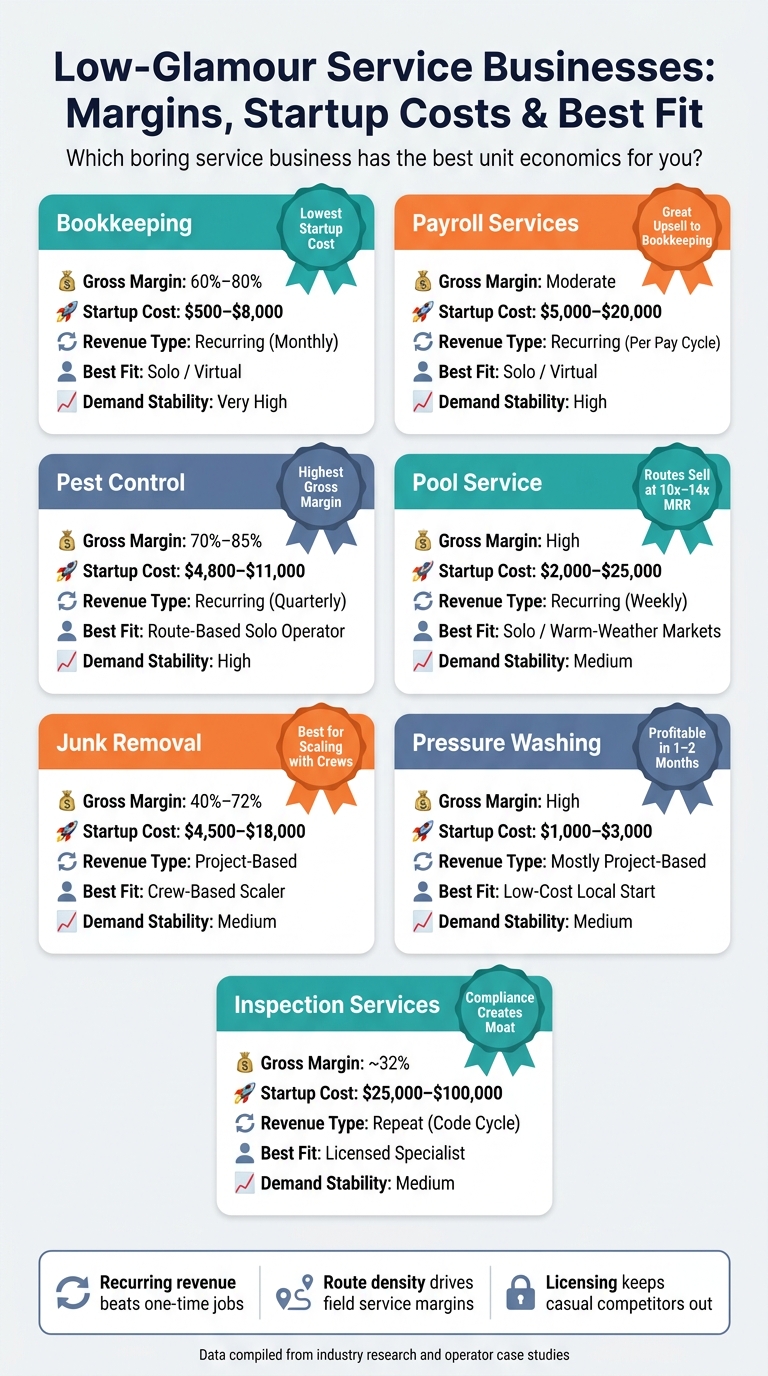
Low-Glamour Service Businesses: Margins, Startup Costs & Best Fit
10 "Boring" Service Businesses Making People Rich (Low Competition!)
sbb-itb-08dd11e
Why These Operational Service Businesses Can Be Financially Attractive
These businesses work for a simple reason: direct costs stay low. Labor does the heavy lifting, not inventory. And that pushes gross margins in fields like financial advisory (60%–75%) and pest control (55%–65%) far above what most product-based businesses can pull off. That’s why the best openings tend to show up in a small set of repeatable service models.
Recurring contracts make the math even better. Instead of trying to earn back customer acquisition costs from a one-time job, you spread those costs across months or years. A quarterly pest control contract priced at $110–$165 per visit or a monthly bookkeeping retainer makes revenue more predictable and lets income build over time. Even small changes in churn have a big effect here. A 2% monthly churn rate keeps about 79% of your customer base over a year, while 5% monthly churn cuts that base roughly in half in the same period. Put plainly: retention drives margin.
In field services, there’s another piece that matters just as much: route density. When jobs are packed into the same area, teams spend less time driving and more time doing billable work. That means more revenue from the same crew and the same fixed cost base. In many cases, fewer empty miles are what separate a healthy business from one that just gets by.
Licensing rules also help. In fields like pest control or property inspection, state certification requirements create a quiet moat. They keep casual operators from jumping in overnight, which tends to hold competition in check and keep margins steadier.
For founders, one of the best parts is demand. These services are non-discretionary. Businesses can’t just skip tax compliance, and homeowners can’t put off a pest problem forever. That makes demand less tied to trends and more tied to day-to-day needs. You can see that most clearly in the categories below.
What Makes a Strong Low-Glamour Service Opportunity
Not every unglamorous service business is worth your time. The best ones tend to share four traits: repeat demand, low setup cost, dense local demand, and room for upsells. A simple rule helps here: if the customer probably won’t need you again within 30 to 90 days, it’s often better to pass.
Startup cost only means something when you compare it with margin and payback time. Junk removal, for example, can get off the ground for about $146 in basic equipment costs. A pool cleaning business, on the other hand, usually needs $2,000 to $25,000 upfront. But routine pool service visits can lead to repair upsells, which often carry better margins.
Location matters more than many people think. Warm weather, dense neighborhoods, and busy real estate markets usually lead to better route economics and steadier demand. The U.S. has more than 10.4 million residential pools, and the four "Sand States" - Florida, California, Texas, and Arizona - make up 66% of all new in-ground pool construction starts. Inspection and property service businesses also tend to move with housing transaction volume, so active real estate markets can mean a steadier stream of work.
Licensing can also work in your favor. Instead of seeing it as a hassle, treat it like a filter. In states such as Florida and Texas, stricter certification rules for pest control and pool repair make it harder for a casual competitor to jump in and slash prices.
The clearest signal is simple: a visible problem people are happy to pay someone else to deal with. That’s the lens to use when judging the categories below.
1. Back-Office Financial Services
Back-office work isn't glamorous. But it is repeatable, sticky, and built for recurring revenue.
That’s why bookkeeping and payroll stand out. Clients pay every month, setup costs stay low, and once a business has someone handling the numbers, it usually doesn’t want to switch. The pattern is simple: recurring billing, low startup costs, and a problem painful enough that clients tend to stay put.
Bookkeeping
Bookkeeping often runs at 60% to 80% gross margin for a solo operator. Client retention also tends to be strong, often above 90% per year, because small-business owners usually dread changing providers. And the market is still far from tapped out: an estimated 77% of SMBs with under $5 million in revenue still handle bookkeeping poorly in-house.
Startup costs are usually modest, around $2,000 to $8,000 for software, insurance, and registration. With just 15 to 25 clients, a solo operator can often earn $90,000 to $150,000 per year.
There’s also room for solid income without a big team. One bookkeeper reached $16,200 in monthly revenue with a 65% profit margin after 14 months, while managing 28 clients from home.
The pricing model matters a lot here. Flat monthly retainers tend to work better than hourly billing. And when a client’s books are a mess, many operators charge a separate cleanup fee of $750 to $6,000 for prior-period work.
Payroll Services
Payroll is the natural next step once bookkeeping is in place. It’s not optional. Businesses have to pay people, and most small companies outsource at least part of payroll to stay compliant.
Fees usually land between $150 and $500 per client per month, often set as a base fee plus a per-employee charge. For an existing bookkeeping practice, payroll can do two things at once: increase revenue by up to 25% and cut client churn by 15%.
That makes it a clean upsell. The client already trusts you with the books, and payroll fits right into the same monthly workflow.
2. Recurring Route-Based Field Services
Two of the strongest low-glamour field service models are pest control and pool service. They work for the same simple reason: dense routes, repeat visits, and low direct costs. That mix can make the numbers look pretty attractive.
Pest Control
Recurring residential plans usually cost $95 to $185 per quarter, with gross margins of 70% to 85%. Retention often stays above 80%, even in recessions.
That matters because this isn't just about monthly cash flow. It can also turn into sale value later. One Raleigh operator started with $4,800, grew to 142 customers and $10,224 in monthly revenue in 14 months, then sold the business for $128,000.
Pool service follows a lot of the same route-density logic, but it has one extra angle: repairs can add more revenue from the same customer base.
Pool Service
Pool service gets less attention than pest control, but the repeat demand is just as strong. If someone owns a pool, they need regular cleaning and chemical balancing. That makes churn less common. Monthly plans usually run $150 to $240 for full-service maintenance, and mature routes often sell for 10x to 14x monthly recurring revenue.
In pool service, the moat comes from a few plain things done well:
- Dense routes
- Equipment replacement capture
- Hiring systems
- Pricing discipline
Repairs add another income stream on top of recurring service. Pump swaps and equipment replacements often bill at $95 to $145 per hour. Startup costs usually range from $8,000 to $25,000.
3. Project-Based Property Services
When recurring contracts are tough to lock in, property-triggered jobs can still deliver strong margins. These businesses don’t depend on monthly service plans. They make money when a property changes hands or needs to be cleared out fast, like after an estate cleanout, a tenant turnover, or a renovation.
Junk Removal
Junk removal has strong unit economics. Gross margins usually fall between 40% and 72%. Demand tends to come from estate cleanouts, downsizing, renovations, and home sales. The average job ticket is about $325, while full truckload jobs with a 14-foot trailer usually bill between $550 and $850. Estate cleanouts tied to downsizing, assisted living moves, and estate settlements can bring in $1,500 to $5,500 per job.
Getting started doesn’t take a huge budget. If you already have a truck, startup costs can land around $4,500 to $7,500. A dump trailer rig setup usually runs $11,000 to $18,000.
The biggest edge is simple: speed. Crews that answer within an hour qualify far more leads, and volume-based pricing favors operators who can move fast and clear jobs out without delay.
There’s also a plain way to keep more of each job. Diverting 15% to 30% of loads to scrap yards or donation centers can improve net margins by 5% to 10% because it cuts tipping fees.
If junk removal wins on urgency, pressure washing wins on visibility and quick turnaround.
Pressure Washing
Pressure washing is cheap to start. Equipment usually costs $1,000 to $3,000, and the business can become profitable within one to two months. Jobs often include driveways, siding, decks, storefronts, and parking lots.
What sets the best operators apart isn’t fancy gear. It’s fast replies, showing up on time, and using before-and-after photos to prove the result. That kind of professionalism helps a lot in a category where plenty of competitors look casual.
B2B relationships matter here too, especially with property managers, real estate agents, and estate attorneys. Those are often the people closest to the trigger events that create the job in the first place.
4. Inspection and Compliance Services
Inspection and compliance services aren't flashy. But they are sticky, recurring, and tough to replace. That mix helps support steady margins. Instead of chasing one-off jobs, these businesses get work because regulation puts inspections on the calendar.
Unlike urgent cleanup work, compliance services win through timing and rules.
Fire Sprinkler and Life Safety Inspection
Once a property is on the inspection calendar, renewal tends to happen automatically. Buildings can't legally skip these inspections. Insurance carriers enforce them, and city codes do too.
Put simply, once a building enters the inspection cycle, it usually stays there because compliance is mandatory.
Annual fees usually range from $500 to $5,000 per building, margins sit around 32%, and startup costs often fall between $25,000 and $100,000. NICET Level II certification is the main gate to doing this work on your own. That rule keeps casual competitors out and gives established operators a real moat.
Margins can get even better when the same company handles the repairs or upgrades tied to the deficiencies it finds.
Among low-glamour service businesses, inspection work fits founders who like process, compliance, and keeping accounts over chasing sales volume. The pitch is pretty simple: compliance creates recurring work that's harder to swap out than most project-based services.
Comparing the Best Fits for Different Types of Founders
Not every low-glamour service is a match for every founder. The right pick comes down to a few simple things: how much money you can put in, how comfortable you are managing people, and whether you want to stay lean or build a business you can step away from later.
The table below lines up the main models in this article by startup capital, margin profile, recurring revenue, and operating style. Use it to match each model to your budget, licensing comfort, and how you like to work.
The split is pretty straightforward: some models work best for solo operators, some are better with crews, and a few lean heavily on compliance know-how.
| Service | Startup Capital | Margin Profile | Recurring Revenue | Best Founder Fit | Demand Stability |
|---|---|---|---|---|---|
| Bookkeeping | $500–$3,000 | Very High | High (Monthly) | Solo / Virtual | Very High |
| Pest Control | $6,500–$11,000 | High | High (Quarterly) | Solo founder / growth operator | High |
| Pool Cleaning | $2,000–$25,000 | High | High (Weekly) | Solo | Medium |
| Junk Removal | $4,500–$7,500 | High | Low (Project) | Scaler (Crews) | Medium |
| Payroll Services | $5,000–$20,000 | Moderate | High (Per Pay Cycle) | Solo / Virtual | High |
| Property Inspection | $10,000–$50,000 | Moderate | Low (Project) | Solo / Specialist | Medium |
For solo founders, the cleanest economics usually come from bookkeeping and payroll services. Pool cleaning and pest control can also work well if you're fine with field work or licensing. Bookkeeping and payroll are especially attractive because they run well from anywhere and can be bundled to add recurring revenue without much extra delivery cost per client. Pest control is a strong fit for solo operators who can handle licensed work and build route density.
If you want to scale with crews, junk removal stands out first. This model tends to need helpers earlier than most trades because two-person teams are meaningfully faster and safer when you're dealing with heavy loads.
Property inspection fits founders who like technical, compliance-driven work more than route-based operations. Regulation keeps inspections on the calendar, which gives the category recurring work that's harder to push aside than most project-based services.
Geography matters a lot for field services. Pool cleaning is highly seasonal in Northern U.S. markets. A route in Minnesota is going to look very different from one in Florida or Arizona. Pest control and junk removal usually hold up better in winter because rodent calls and estate cleanouts don't stop when temperatures fall. Bookkeeping and payroll, by contrast, aren't tied to local geography and can be run across state lines from day one.
That means the best opportunity has less to do with glamour and more to do with fit.
Conclusion
These businesses aren't flashy. But they solve repeat problems people have to deal with, and that can lead to strong gross margins, steady demand, and a startup path that isn't too complicated.
The main question isn't whether the business sounds cool. It's whether the local numbers make sense.
Boring services tend to win when they fix frequent, unavoidable problems. So pick the model with the best local economics, not the one with the best story.
Before you choose one, test the market fast. Check local demand, licensing, and variable costs before you commit.
Unglamorous businesses work when the numbers fit and execution stays disciplined.
FAQs
Which service business is easiest to start solo?
Bookkeeping is often the easiest business for a solo entrepreneur to get off the ground. You don’t need much startup cash, there’s no physical labor, and you can work without specialized equipment. On top of that, you can run it remotely and keep overhead very low.
Junk removal is also fairly easy to start if you’re okay with hands-on work. Pest control and commercial cleaning can bring in strong margins and recurring revenue, but they usually come with more licensing, setup, or both.
How do I validate local demand before launching?
Start by checking who already serves your area on Nextdoor, local Facebook groups, and Yelp. Focus on providers that seem to get steady attention, and read the reviews closely. The praise shows what people like. The complaints often tell you even more, especially when people mention poor quality, no-shows, late arrivals, or bad communication. That’s where gaps tend to show up.
For a low-cost test, take on your first job for a neighbor or friend at cost. Then document the work with before-and-after photos and share the results in local channels. It’s a simple way to see how people respond without spending much.
You can also test demand with:
- Door-knocking in nearby neighborhoods
- Targeted ads within a 2-to-4-mile radius
That gives you a quick read on local interest before you spend heavily.
What matters more: margin, retention, or route density?
Margin matters most because it shows what the business actually keeps after expenses, including your salary.
But retention and route density are what make strong margins possible. Recurring clients cut acquisition costs and help keep cash flow steady, while tighter routes reduce drive time and labor waste.
Related Blog Posts
- 5 "Boring" Businesses Making Their Owners Rich in 2025
- 25 Boring Businesses Making Owners Rich in 2026
- Local Service Businesses Ranked by Startup Cost, Margin, and Payback Period
- Business Ideas With Low Competition and Low Startup Cost